Greyhound Betting Odds Explained: Formats, Value & Best Odds Guaranteed
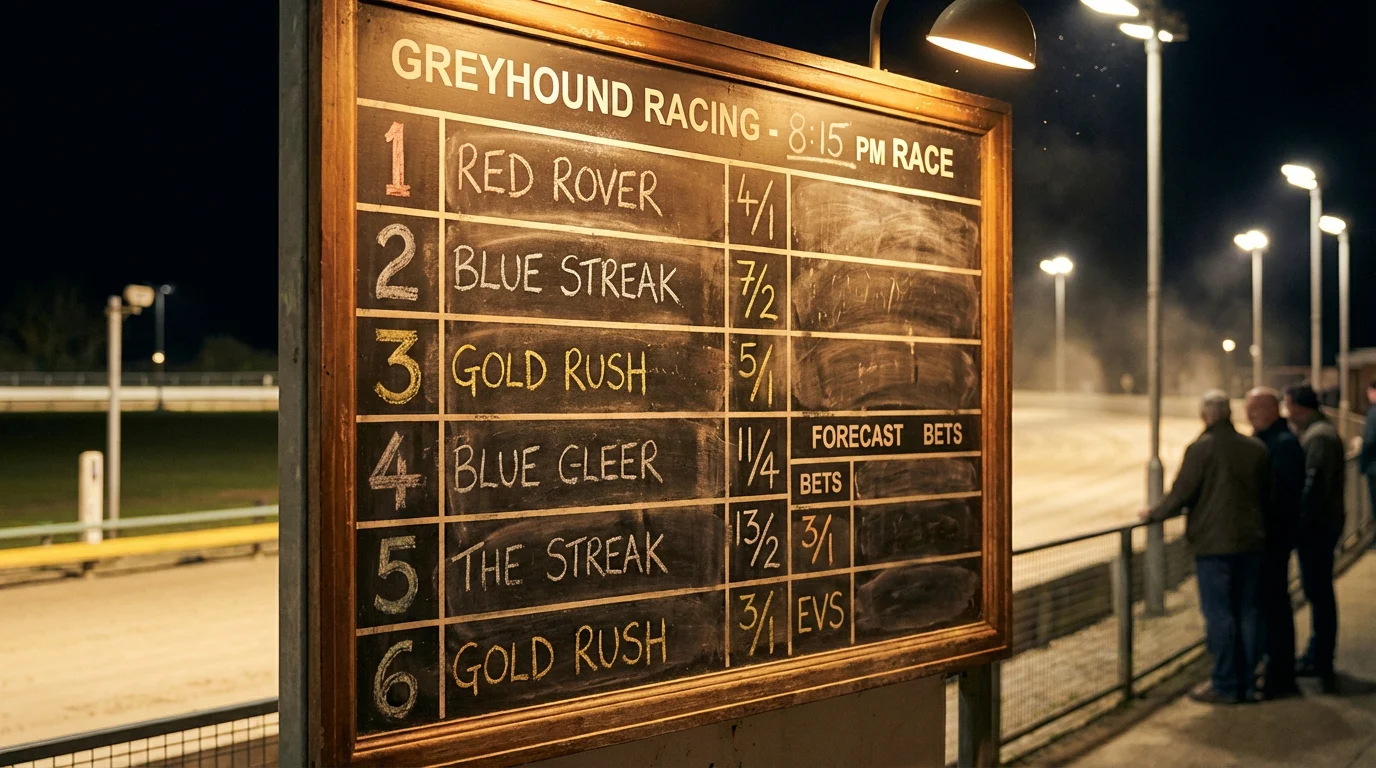
Odds Are a Language — Here’s How to Speak It
Every number on the board is an argument about probability. When a greyhound is priced at 4/1, the market is telling you — in its own shorthand — that this dog is expected to win roughly once in every five attempts. Whether that assessment is accurate is a separate question, and one that matters enormously if you want to bet with any kind of edge. But before you can evaluate the accuracy of odds, you need to understand what they actually represent and how the different formats translate into real money.
Greyhound racing in the UK uses odds in a way that is largely consistent with horse racing, but the context is different enough to warrant its own explanation. Six-dog fields create a tighter market than the twelve- or twenty-runner fields you see in flat racing at Ascot. The favourite wins more often. The outsider wins less often. The range of prices is narrower, and the implied probabilities are compressed. Understanding these dynamics is essential because they affect how you assess value, how you time your bets, and how you use promotions like best odds guaranteed.
This guide covers the three odds formats you will encounter when betting on UK greyhounds — fractional, decimal, and the starting price mechanism — and then moves into the practical applications: how to spot value, how to read odds movement, and how BOG changes the risk profile of taking an early price. If you have ever placed a bet without fully understanding why you were paid what you were paid, this is where that gap closes.
One point to establish upfront: odds are not the bookmaker’s prediction. They are the bookmaker’s price, shaped by their own assessment, the weight of money from other punters, and the margin they need to build in to stay profitable. The odds reflect the market, not the truth. And the gap between market and truth is where every profitable bettor operates.
Fractional Odds: The UK Standard
4/1 means four pounds profit for every pound staked. That is the entire principle, and everything else is arithmetic. Fractional odds are the default format at UK greyhound tracks, in betting shops, and on most British bookmaker websites when set to their standard display. The number on the left is your potential profit; the number on the right is your stake. A winning bet at 4/1 with a five-pound stake returns twenty-five pounds: twenty pounds profit plus your original five-pound stake back.
The notation looks simple, and for round numbers it is. But fractional odds can become awkward when the market demands precision. Prices like 11/8, 13/8, 100/30, and 11/10 are all common in greyhound racing, and they are less intuitive than 2/1 or 5/1. A bet at 11/8 means eleven pounds profit for every eight staked — which, for a five-pound stake, returns £11.88 in total. The maths is not difficult, but it requires a moment of calculation that the simpler prices do not.
Fractional odds also express implied probability, though they do not make it obvious. To convert any fractional price into a probability, divide the right-hand number by the sum of both numbers. At 4/1, the implied probability is 1 divided by 5, which equals 20%. At 2/1, it is 1 divided by 3, or 33.3%. At even money (1/1), it is 50%. At odds-on prices — where the left number is smaller than the right, like 4/6 — the implied probability exceeds 50%, which means the market considers the dog more likely to win than not.
In greyhound racing, odds-on favourites are common. A six-dog field with one standout runner often produces a market where the favourite is priced at 4/6 or even shorter, and the remaining five dogs share the rest of the probability. This compression is important for bettors because backing short-priced favourites in greyhound racing requires a high strike rate to turn a profit. At 4/6, you need to win more than 60% of your bets just to break even, and greyhound favourites across all grades win roughly 30 to 35% of the time. The maths does not flatter the favourite backer.
One quirk of fractional odds that catches newcomers: the same real probability can be expressed in multiple ways. 2/1 and 4/2 mean the same thing, as do 5/2 and 10/4. Bookmakers standardise to the simplest fraction, but you will occasionally see non-standard expressions on older track boards or in tote dividend displays. If the numbers look unfamiliar, reduce the fraction and the meaning becomes clear.
For UK greyhound punters, fractional odds are the language of the sport. Even if you prefer to calculate in decimals — and many experienced bettors do — you need to read fractional prices fluently, because that is how the market quotes them at the track, on betting slips, and in most results displays.
Decimal Odds and Implied Probability
Decimals make the maths simple — multiply your stake by the price and you have your total return, stake included. A dog priced at 5.0 in decimal odds with a ten-pound stake returns fifty pounds if it wins. No need to add the stake back separately, no need to work out profit and return as two distinct numbers. The decimal price is a single multiplier, and that clarity is why many serious bettors prefer it even when their bookmaker defaults to fractions.
Converting between fractional and decimal is straightforward. Divide the left-hand number of the fraction by the right-hand number, then add 1. So 4/1 becomes (4 divided by 1) + 1 = 5.0. 11/8 becomes (11 divided by 8) + 1 = 2.375. Evens (1/1) becomes 2.0. Once you internalise the conversion, you can switch between formats without hesitation, but most online bookmakers let you toggle the display with a single click.
The real advantage of decimal odds is how transparently they express implied probability. The formula is simple: divide 1 by the decimal price. At 5.0, the implied probability is 1/5 = 20%. At 3.0, it is 33.3%. At 1.50, it is 66.7%. This is useful because it lets you compare the bookmaker’s assessment directly against your own. If you believe a dog has a 25% chance of winning and the decimal price is 5.0 (implying 20%), you have identified a potential value bet — the market is underestimating the dog’s chance, and the price is higher than it should be.
There is a catch, and it is built into every odds market. If you add up the implied probabilities of all six dogs in a greyhound race, the total will exceed 100%. It might be 112%, or 118%, or even higher in less competitive markets. That excess is the bookmaker’s margin — the overround. It is how they guarantee a profit regardless of which dog wins. In a perfectly fair market, the implied probabilities would sum to exactly 100%. In the real world, they never do, and the size of the overround tells you how much value is being extracted from the market as a whole.
Greyhound racing markets tend to carry a higher overround than horse racing markets, partly because the fields are smaller and the markets attract less sophisticated money. An overround of 115% to 120% is typical for a standard graded race at a GBGB track. For bigger events — open races, televised competitions — the overround may tighten as more money enters the market and bookmakers compete more aggressively on price. Understanding the overround is not about avoiding it (you cannot), but about recognising that some markets offer better value than others, and that the same dog at the same price represents better value in a low-overround market than in a high one.
Decimal odds are also the standard format for betting exchanges, where punters bet against each other rather than against a bookmaker. Exchange prices tend to be sharper (closer to true probability) because the exchange takes a flat commission on winnings rather than building a margin into every price. If you are serious about finding value on greyhounds, comparing exchange prices against bookmaker prices is one of the simplest ways to identify discrepancies.
Starting Price vs Early Price
Taking a price is a decision, not a formality. In UK greyhound racing, you face this decision every time you bet: do you take the price available now (the early price), or do you wait and accept whatever the starting price turns out to be when the traps open? The answer depends on your assessment of the dog, the market conditions, and whether best odds guaranteed is in play — but the choice itself is one of the most consequential and least discussed aspects of greyhound betting.
The starting price (SP) is the official price at the time the race begins. In track-based betting, it is determined by the on-course bookmakers — the prices they display when the hare starts its run. For races covered by the SP framework, the starting price is recorded as a matter of official record and is the price used to settle any bet placed at SP. Online bookmakers offer SP as a selectable option on the bet slip, meaning you defer the price until the off and accept whatever it turns out to be.
The early price, by contrast, is whatever the bookmaker is offering in advance of the race — sometimes hours before, sometimes just minutes. Early prices on greyhound racing are typically available from around thirty minutes before the first race on a card, though the timing varies between bookmakers and the significance of the meeting. Early prices on evening meetings at major tracks like Romford or Monmore Green may open earlier and attract more market activity than an afternoon card at a smaller venue.
The strategic question is straightforward: if you believe a dog will attract support and its price will shorten before the off, taking the early price locks in a higher return. If you believe the dog will drift — perhaps because smarter money identifies a reason to oppose it — waiting for SP might give you a better price. In practice, most greyhound punters take the early price when they have a strong opinion, because the market for greyhound racing is thinner than for horse racing and prices can move sharply on relatively small amounts of money.
There are risks to both approaches. Taking an early price means committing to a dog before all the information is in — late withdrawals, reserve runners, and track condition changes can all affect the race after you have placed your bet. Waiting for SP means accepting the possibility that the dog you liked at 5/1 opens at 3/1, cutting your potential return by 40%. Neither approach is universally correct. The right choice depends on the specific race, the specific market, and — critically — whether the bookmaker offers best odds guaranteed.
One pattern worth recognising: in greyhound racing, the favourite at the early show is the eventual winner more often than the market average suggests. This is partly because the fields are small and the form is more transparent than in large horse racing fields. When the market identifies a clear favourite early, it tends to be right more often than not. That does not mean favourites are always good bets — the price still has to offer value — but it does mean that waiting for a drift on the favourite is less likely to pay off than it might in a twenty-runner handicap at Cheltenham.
Best Odds Guaranteed: How BOG Changes the Game
BOG removes the biggest risk of taking an early price. Best odds guaranteed is a promotion offered by most major UK bookmakers on selected greyhound races, and it works exactly as the name suggests: if you take an early price and the starting price turns out to be higher, the bookmaker pays you at the better price. You get the upside of waiting for SP without giving up the security of locking in your price in advance.
The mechanics are simple. You back a dog at 4/1 three hours before the race. By the time the traps open, the SP has drifted to 6/1. With BOG, you are paid at 6/1. If the SP had shortened to 2/1 instead, you would still be paid at your original 4/1. In every scenario, you receive whichever price is higher. The decision to take the early price becomes risk-free in terms of price movement, which fundamentally changes the calculus described in the previous section.
Not every race qualifies for BOG, and the terms vary between bookmakers. Most operators restrict BOG to races broadcast on SIS or Sky Sports — which covers the majority of GBGB meetings — but some exclude early morning or smaller meetings. Check the terms before assuming BOG applies to a specific race. The restriction is typically disclosed in the promotion’s terms and conditions rather than being flagged prominently on the bet slip, so it is worth verifying before you commit your stake.
The strategic implication of BOG is significant. Without it, taking an early price is a gamble within a gamble — you are betting on the dog to win and on the price not to improve. With BOG, you eliminate the second gamble entirely. This makes early-price betting on greyhounds with BOG strictly superior to betting at SP, assuming the promotion applies to the race in question. There is no rational reason to bet at SP on a BOG-eligible race if you have already formed a view and the early price is available.
For serious greyhound punters, BOG availability is one of the key criteria when choosing a bookmaker. An operator that offers BOG across all televised UK greyhound meetings gives you a structural advantage over the course of a season. The benefit on any individual bet might be small — an extra point of odds here, half a point there — but compounded across hundreds of bets, it adds meaningful value to your bottom line. Think of it as a guaranteed rebate on price volatility, paid by the bookmaker rather than absorbed by you.
Spotting Value: When Odds and Probability Disagree
Value exists when the market underestimates a dog’s chance. That is the entire concept, stripped of jargon: a value bet is one where the odds available are higher than the odds should be, given the dog’s true probability of winning. If you believe a dog has a 25% chance of winning and the bookmaker is offering 5/1 (which implies a 16.7% chance), the price overestimates the difficulty of the dog winning. That is value, and over enough bets, backing value consistently produces profit even when individual bets lose.
The difficulty, of course, is in determining “true probability.” Nobody knows it with precision. Greyhound racing involves too many variables — trap draw, early pace, crowding, track conditions, the behaviour of five other live animals — for any model to be exact. But you do not need precision. You need a reasonable estimate that is more accurate than the market’s estimate, and in greyhound racing, there are structural reasons why the market can be wrong.
The most common source of mispricing in greyhound markets is recency bias. The market overweights a dog’s most recent run and underweights the context. A dog that finished sixth last time out will drift in the betting, even if it was crowded at the first bend, lost three lengths, and still posted the fastest closing sectional in the race. The “6” dominates the headline form, and casual bettors see a loser. The racecard reader who digs into run descriptions and sectional times sees a dog that ran well in defeat — and that discrepancy between perception and reality is where value lives.
Grade changes are another fertile ground. When a dog drops from A3 to A5, the market often treats it as a sign of declining ability. Sometimes it is. But often it simply means the dog was outclassed at A3 — too slow for that grade but faster than most A5 competitors. The drop in grade does not change the dog’s raw speed; it changes the quality of opposition. If the dog’s times are competitive at A5 level, the price may not fully reflect its advantage, particularly if casual punters see the grade drop as a negative signal.
Track and distance suitability is a subtler source of value. A dog that has run all its recent races over 480 metres might be stepping back to 270 metres, or vice versa. If the dog has older form at the shorter distance that shows genuine early pace, the market might not price that in because the recent form — over the wrong distance — looks mediocre. Similarly, a dog moving to a track where it has previously run well but not recently may be underpriced if the market focuses on venue-neutral recent form rather than track-specific historical form.
To put value betting into practice, you do not need a spreadsheet (though it helps). You need a habit: before every race, form your own view of each dog’s chance, then compare that view against the available odds. If a dog you rate at roughly 4/1 is being offered at 7/1, that is a potential value bet. If a dog you rate at 4/1 is being offered at 2/1, that is a bet to avoid regardless of how strong the dog looks. The price matters as much as the pick, and disciplined value bettors walk away from strong dogs at weak prices just as readily as they back moderate dogs at generous ones.
Value betting is not a guarantee of short-term profit. A value bet can lose — and will lose, regularly. A dog with a genuine 25% chance of winning will lose 75% of the time. The profit comes from the 25% of occasions where it wins at a price that implies only a 16% chance. Over dozens and hundreds of bets, the mathematics favour the value bettor. Over any single night at the track, anything can happen. That distinction between process and outcome is the hardest lesson in betting, and odds literacy is where it begins.
Odds Movement: What Drifting and Shortening Tell You
Watch the money, not just the dogs. Between the time early prices are posted and the moment the traps open, greyhound odds move — sometimes gradually, sometimes sharply. Those movements are information. They tell you where the money is going, and while money is not always smart, it is always worth listening to.
When a dog’s price shortens — drops from 5/1 to 3/1, say — it means the bookmaker has taken enough money on that dog to adjust the price downward. This can happen for several reasons. Informed punters who study form closely may have identified the dog as the likely winner and backed it early. A tipster with a following may have recommended it, triggering a wave of bets. Or the bookmaker’s own traders may have reassessed the race and decided the original price was too generous. Whatever the cause, a shortening price reflects increased confidence in the dog’s chance, either from the market or from the bookmaker’s own team.
When a dog drifts — its price lengthens from 3/1 to 5/1 — the opposite is happening. Money is going elsewhere. The market is losing confidence in that runner, either because another dog is attracting support or because information has emerged (a poor trial, a weight change, a trainer’s cold streak) that makes the dog look less appealing than it did when the early prices were first published. A drifting favourite is one of the strongest market signals in greyhound racing, because it suggests that the people closest to the sport — trainers, kennel staff, regular trackside punters — are not backing the dog the public expected to be popular.
Interpreting these movements requires caution. Not all shortening is driven by informed money. A well-known dog with a catchy name might attract public money simply because casual bettors recognise it, which pushes the price down without reflecting any analytical insight. Similarly, a dog might drift not because it is weak but because its competitors have attracted disproportionate support — the market is a relative system, and money backing one dog necessarily pushes others out.
The most actionable pattern is when a dog shortens steadily from the early show through to the off. A sustained move suggests genuine, informed backing rather than a single large bet or a momentary fluctuation. If a dog opens at 6/1, moves to 9/2 within thirty minutes, and is 3/1 by the time the hare starts, that is a clear market signal. It does not mean the dog will win — nothing means the dog will win — but it means the weight of opinion among those who are putting money down is strongly in its favour.
Conversely, the value opportunity often lies with dogs that drift. If your own analysis tells you a dog at 4/1 has a genuine chance, and it drifts to 6/1 because the market is fixated on a rival, your value has improved without anything about the dog’s ability changing. The dog is the same runner it was an hour ago; the market has simply moved away from it, and if your assessment is sound, the drift is a gift. Combined with BOG, taking the early price on a dog you believe in — and then watching it drift to a price you get paid at anyway — is one of the most reliable strategic advantages available to greyhound punters.
The Number Behind Every Bet Slip
Understanding odds doesn’t guarantee wins — it guarantees informed decisions. Every time you place a greyhound bet, you are accepting a price, and that price either reflects the dog’s true chance or it does not. If you cannot assess which, you are flying blind. If you can, you have the foundation on which every other aspect of greyhound betting is built.
The formats themselves — fractional, decimal, implied probability — are just notation. They are different ways of writing the same number, and fluency in all three is a matter of practice rather than talent. What matters is what you do with the number once you understand it. Can you convert a fractional price into an implied probability quickly enough to compare it against your own assessment? Can you recognise when the overround on a specific race is unusually high, suggesting the bookmaker is extracting more margin than normal? Can you identify value not by gut feeling but by a disciplined comparison of price and probability?
These are skills, and like all skills, they improve with use. The punter who starts by learning that 4/1 means four pounds profit for every pound staked will, after a season of attentive betting, instinctively recognise that a 4/1 shot with a 30% win probability represents significant value — and that a 1/2 shot with the same probability is a terrible bet regardless of how impressive the dog looks on paper. That progression from arithmetic to judgement is the trajectory of every serious bettor, and odds literacy is where it starts.
Greyhound odds markets are not perfectly efficient. They are thinner than horse racing markets, less scrutinised by professional punters, and more susceptible to the biases of casual bettors. That inefficiency is an opportunity for anyone willing to learn the language and apply it with discipline. The numbers are there on every racecard, every bet slip, every screen. The question is whether you read them as decoration or as data.