
UK Greyhound Tracks 2026: The Full Directory of Licensed Stadiums
 Available in US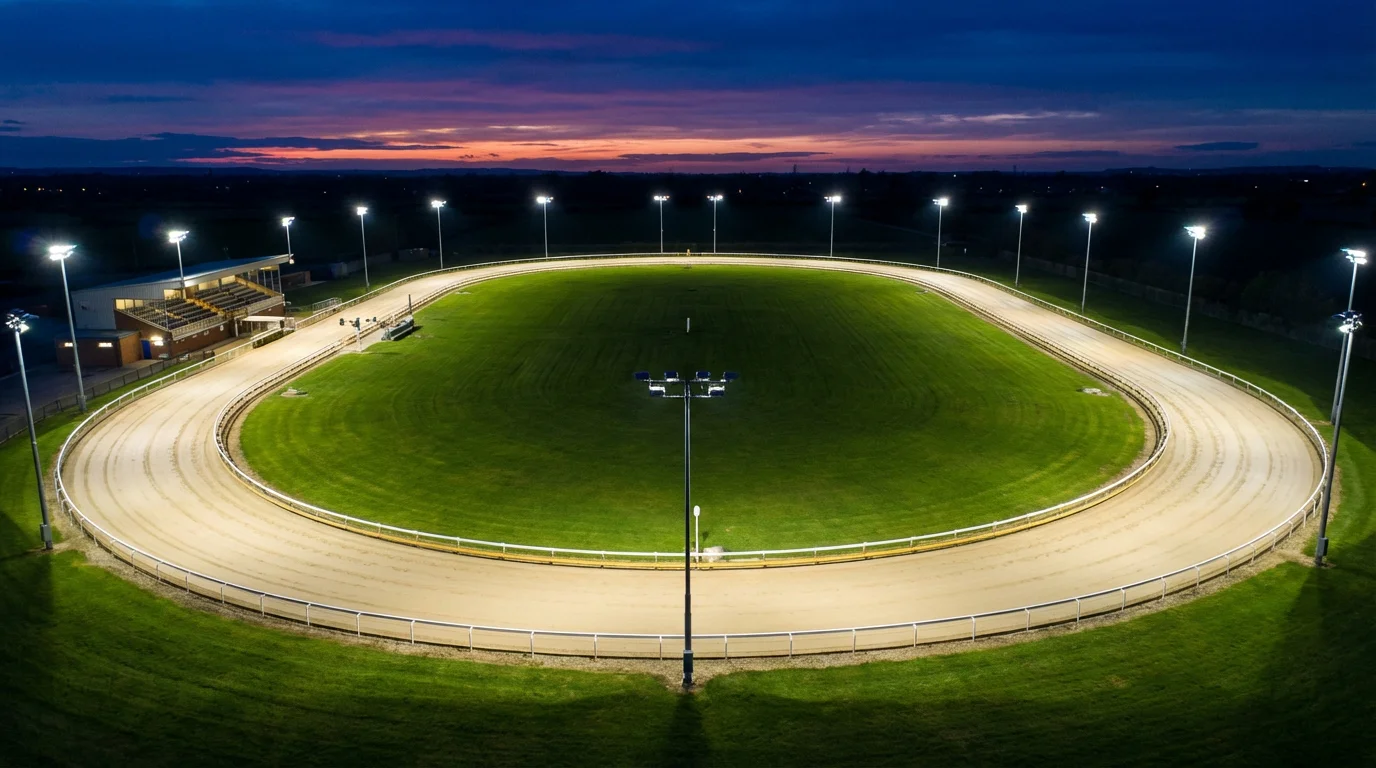
The Shrinking Map of British Dog Racing
Britain had more than sixty licensed greyhound tracks in the 1960s. Fewer than twenty remain. The trajectory is unmistakable, and anyone who has followed the sport over the past decade has watched it accelerate. Wimbledon closed in 2017. Henlow shut its gates in January 2024. Crayford — the last track in south-east London, home of the Golden Jacket — ran its final race on 19 January 2025 after Entain decided the operation was no longer commercially viable. Perry Barr in Birmingham followed in August of the same year, its racing transferred to a new purpose-built track at Dunstall Park in Wolverhampton. And Swindon, one of the longest-running venues in the west of England, closed at the end of 2025.
The closures carry a pattern. Development land in London and major cities commands prices that make dog tracks a poor return on real estate. Entain and Arena Racing Company, the two dominant track operators, make decisions based on commercial logic, not sentiment. Where the land is worth more as housing or retail than as a racing venue, the outcome is predictable.
Yet the sport is not dead. As of early 2026, there are nineteen GBGB-licensed stadiums — eighteen in England and one in Wales, the Valley Greyhound Stadium in Ystrad Mynach, which gained its GBGB licence in 2023 — though the Welsh government’s Prohibition of Greyhound Racing (Wales) Bill, progressing through the Senedd, threatens to make Wales the first UK nation to ban the sport entirely. Racing takes place almost every day of the week, with fixtures broadcast live through betting platforms and SIS feeds. The Greyhound Derby remains a Category One event with a winner’s prize of one hundred and seventy-five thousand pounds. And the 2026 calendar celebrates the sport’s centenary, marking a hundred years since the first oval-track race at Belle Vue in Manchester.
This guide catalogues every currently active licensed track in the country. If you are a former Crayford regular looking for a new local, a punter who only bets online and wants to know what makes each venue different, or a newcomer working out which tracks suit which betting approaches, the information here is current, practical, and organised by region.
Find more track guides at crayforddogsresults.
How UK Greyhound Tracks Are Licensed
The GBGB is the sport’s regulatory body. It licences racecourses, enforces the Rules of Racing, and oversees everything from kennel standards to drug testing. A GBGB licence is not a formality — it requires facilities to meet specific standards for track dimensions, safety equipment, veterinary provision, and animal welfare. Tracks are inspected regularly, and stewards attend every meeting to ensure compliance. The system is imperfect, as any regulator’s is, but it provides a framework of accountability that separates licensed racing from the old independent sector.
Independent tracks — sometimes called “flapping” tracks — once operated outside any central regulation. They had no mandatory drug testing, no standardised rules, and no welfare oversight beyond whatever local authorities chose to enforce. The last independent track in England closed in March 2025, and Thornton Stadium in Fife, Scotland, remains the only venue outside GBGB governance that still stages racing. For betting purposes, the distinction is largely academic: virtually all greyhound racing available through licensed UK bookmakers takes place at GBGB-regulated venues.
Licences are not permanent. The GBGB can revoke or suspend a licence if a track fails to meet its standards, and tracks must reapply annually. The commercial pressure runs in the other direction too: several tracks have voluntarily surrendered their licences when operators decided the business was no longer sustainable. The licence fee, combined with the costs of maintaining a track to GBGB standards, creates a baseline expense that only venues with consistent fixtures and betting revenue can justify.
For bettors, the licensing system provides a practical guarantee. Any race at a GBGB-licensed track uses standardised form data, publishes official racecards, operates under consistent rules for grading and trap allocation, and produces results that are archived and searchable. This consistency is what makes cross-track analysis possible. A dog’s form at Romford, recorded under the same system as its form at Newcastle, can be meaningfully compared — something that was never true of the independent sector.
Track operators in the UK currently fall into three categories: Arena Racing Company, which runs the largest portfolio of venues; independent owners managing single stadiums; and Entain, which previously operated Crayford and retains commercial interests in the sport through its betting brands. The corporate ownership structure affects how tracks are managed, what investments are made, and ultimately whether a venue stays open — but from a bettor’s perspective, the racing product is governed by the GBGB regardless of who owns the building.
London and the South East
Romford is the last dog track inside the M25. That sentence would have seemed absurd twenty years ago, when London had four licensed stadiums and the sport was woven into the fabric of weekend life across the capital. Now it is a statement of fact, and it places an outsized weight of expectation on a single venue in east London.
Romford
Romford Greyhound Stadium, operated by Coral (part of the Entain group), sits on London Road in the borough of Havering. It races six days a week — Monday, Tuesday, and Wednesday mornings or afternoons, plus Friday and Saturday evenings, with a Saturday morning session as well — and offers additional BAGS fixtures during the daytime. The track is a tight circuit with race distances of 225, 400, 575, and 750 metres, and its compact bends tend to favour early-pace dogs that can secure a position going into the first turn. Trap one has a historically strong record at this track — the inside rail advantage is pronounced on tighter circuits, and Romford is one of the tightest in the country.
For London-based punters, Romford is the accessible option. It has road links to the A12 and M25, is served by Romford railway station, and offers a restaurant, bars, and trackside viewing. It hosts several Category One events through the year and remains one of the better-attended tracks in the country. Its importance to the London greyhound scene cannot be overstated, because if Romford closes, the capital loses its last connection to a sport that once defined its Saturday nights.
Central Park, Sittingbourne
Central Park Stadium in Sittingbourne, Kent, operates under independent ownership and provides a contrast to the corporate-run tracks. The circuit is smaller, the facilities more modest, and the atmosphere less polished — but it is a genuine racing venue with a loyal following. Race distances of 270, 450, 630, and 850 metres cover everything from sprint to stayers, and the track’s wider bends offer a slightly different dynamic to Romford’s tight turns.
Central Park races on most weekday evenings and contributes regular fixtures to the BAGS service. It is not a glamour venue, but for bettors who study form, the smaller pool of trainers and dogs that race here regularly can create patterns worth exploiting. You will see the same names recur on the card more often than at larger tracks, and familiarity with a kennel’s form cycle can be a genuine edge.
Hove
Brighton and Hove Greyhound Stadium — usually just called Hove — is one of the most prominent tracks in the south of England. Operated by Arena Racing Company, it sits on Nevill Road and races on Monday, Wednesday, Friday, and Saturday evenings. The track offers distances of 285, 500, 515, 695, and 880 metres, making it one of the more versatile circuits in terms of distance range.
Hove’s significance in the racing calendar is substantial. It hosts the Regency, one of the sport’s established Category One events, and regularly features on the open race programme. The track itself is a fair galloping circuit — wider bends than Romford, less of a bias toward early speed. Dogs that run on from the second bend tend to do well here, and the standard distance of 515 metres is longer than the 480m typical at many other venues, which suits dogs with stamina over pure speed. For bettors travelling from London, Hove is an hour by train from Victoria — closer than it looks on a map and worth the trip for anyone who wants to experience a properly run track with competitive fields.
The Midlands
The Midlands is the engine room of British greyhound racing. More tracks, more fixtures, and more trainers are based in this region than in any other, and the concentration of venues creates a competitive ecosystem that keeps the racing quality high.
Monmore Green
Monmore Green Stadium in Wolverhampton is one of the busiest and most respected tracks in the country. Operated by Arena Racing Company, it races on Monday, Saturday, and frequently during the week for BAGS fixtures. The track circuit accommodates distances of 264, 480, 630, and 840 metres, and its well-maintained sand surface is considered one of the truest in British racing — fast, fair, and consistent.
Monmore has earned a reputation as a punter’s track. The form tends to hold here more reliably than at some of the quirkier circuits, largely because the bends are well-banked and the racing line is predictable. Trap bias exists — it does at every track — but it is less extreme than at tighter venues. The track hosts several Category One events, and its proximity to Wolverhampton city centre makes it accessible by rail and road. For anyone building a form database, Monmore is often the first track where consistent patterns emerge.
Dunstall Park
Dunstall Park Greyhound Stadium is the newest venue in British greyhound racing, having opened on 19 September 2025 inside the grounds of Wolverhampton Racecourse. Purpose-built by Arena Racing Company with a multi-million-pound investment, it replaced Perry Barr in Birmingham, which had staged racing since 1990 and carried the legacy of the original Birchfield stadium that opened in 1929. The entire Perry Barr operation — trainers, racing programme, major events — transferred to the new site.
The move was controversial among traditionalists who saw it as another city losing its track, but the facilities at Dunstall Park represent a significant upgrade. The track sits within a larger entertainment complex that includes the racecourse, a hotel, and hospitality venues. Racing takes place on regular evenings and afternoons, and the venue has already taken on Category One events including the Premier Greyhound Racing Oaks and the St Leger. The track dimensions and racing distances are still being assessed by the form community, but early indications suggest a fair, galloping circuit suited to a range of running styles. For bettors, it is a new variable — and new tracks always take time to reveal their biases.
Nottingham
Nottingham Greyhound Stadium sits barely two miles from the city centre and has become one of the premier racing venues in the country. It hosted the English Greyhound Derby from 2019 before the event moved to Towcester, and it remains a regular host of Category One and Two competitions. The track offers distances of 305, 500, and 680 metres on a large, galloping circuit that rewards dogs with sustained speed rather than pure early pace.
Nottingham races multiple evenings per week and is a mainstay of the BAGS schedule. The track surface is well regarded, and the wide sweeping bends produce some of the fairest racing in the country — crowding incidents are less common here than at tighter circuits. For bettors, Nottingham’s form tends to be reliable across distance categories, and the track’s status as a top-tier venue means the quality of dogs in graded races is consistently high. The city’s rail connections make it reachable from both London and the north, and the stadium’s restaurant and bar facilities are a cut above many competitors.
The North and Scotland
From Sheffield to Sunderland, the north keeps the dogs running. The concentration of tracks across Yorkshire, the North East, and the wider northern region provides a density of racing that rivals the Midlands, and several of these venues have histories stretching back to the sport’s earliest decades.
Owlerton Stadium in Sheffield is one of the most prominent northern tracks. It races on Tuesday, Thursday, and Saturday evenings, offering distances of 270, 480, 660, and 870 metres. The track is tight with sharp bends, which creates a pronounced inside-trap advantage and rewards dogs with early pace. Sheffield is also home to greyhound racing’s most atmospheric setting — the stadium sits on Penistone Road in a valley surrounded by hills, and evening meetings under floodlights have a character that few venues match.
Newcastle Greyhound Stadium has hosted racing for over ninety years and remains a major fixture on the northern circuit. The track offers distances of 290, 480, and 640 metres, with a fast surface that tends to produce quick times. Newcastle hosts Category One events and draws strong fields for its open competitions. The stadium’s indoor facilities include bars, a function room, and a trackside restaurant, and the Tyne Bridge is close enough that a night at the dogs can slot into a broader evening out.
Sunderland Greyhound Stadium races primarily on Monday, Wednesday, and Friday evenings. It is a steady, workmanlike track that produces consistent fixtures for the BAGS schedule. Distances of 261, 450, 640, and 870 metres provide variety, and the track’s running surface is well maintained. Sunderland is not a glamour venue, but it offers reliable racing and a loyal local following.
Pelaw Grange in Chester-le-Street, sometimes referred to as Star Pelaw, is a smaller venue with a devoted fanbase. It races on select evenings and has recently gained attention for potentially introducing hurdle racing — the sport lost its last hurdle track when Crayford closed, and Pelaw Grange acquired the hurdles with plans to revive the discipline. Whether those plans come to fruition remains to be seen, but it would make Pelaw Grange unique among British venues.
Doncaster Greyhound Stadium operates in the shadow of the town’s famous racecourse but holds its own with regular fixtures and a solid reputation. Kinsley Stadium near Pontefract serves the West Yorkshire region with evening and daytime racing. Both are bread-and-butter tracks — not venues that attract national attention, but reliable contributors to the weekly fixture list that keep the sport’s calendar populated.
Further afield, Yarmouth Stadium in Great Yarmouth covers East Anglia and hosts the East Anglian Derby. Harlow Stadium in Essex straddles the boundary between the south-east and the Midlands corridor. Oxford Stadium has re-entered the GBGB fold and provides racing for the Thames Valley region. Towcester Greyhound Stadium in Northamptonshire is the current home of the English Greyhound Derby, the sport’s flagship event, and its large galloping track is considered one of the finest in the country.
Scotland presents a different picture. There are no GBGB-licensed tracks north of the border. Thornton Stadium in Fife operates as an independent track outside GBGB governance, and the Scottish Parliament is considering legislation that would ban greyhound racing entirely. The practical consequence for bettors is that Scottish racing is invisible to the mainstream betting market — you will not find Thornton fixtures on your bookmaker’s app.
Track Comparison Table
A side-by-side look at every active GBGB-licensed track. The table below covers the core information a bettor needs when assessing an unfamiliar venue: location, standard race distance, and the range of distances available. Track characteristics — bend tightness, surface speed, trap bias — vary significantly between venues and are worth researching individually before betting seriously at any circuit.
| Track | Location | Region | Distances (metres) |
|---|---|---|---|
| Romford | London | South East | 225, 400, 575, 750 |
| Central Park | Sittingbourne, Kent | South East | 270, 450, 630, 850 |
| Brighton and Hove | Hove, East Sussex | South East | 285, 500, 515, 695, 880 |
| Monmore Green | Wolverhampton | Midlands | 264, 480, 630, 840 |
| Dunstall Park | Wolverhampton | Midlands | Race distances under review |
| Nottingham | Nottingham | Midlands | 305, 500, 680 |
| Towcester | Towcester, Northants | Midlands | 266, 450, 500, 680, 870 |
| Oxford | Oxford | South / Midlands | 265, 450, 630 |
| Owlerton | Sheffield | North | 270, 480, 660, 870 |
| Newcastle | Newcastle upon Tyne | North East | 290, 480, 640 |
| Sunderland | Sunderland | North East | 261, 450, 640, 870 |
| Pelaw Grange | Chester-le-Street | North East | 262, 450, 620 |
| Doncaster | Doncaster | Yorkshire | 281, 462, 642 |
| Kinsley | Kinsley, W. Yorks | Yorkshire | 275, 460, 660, 870 |
| Yarmouth | Great Yarmouth | East Anglia | 277, 462, 659, 869 |
| Harlow | Harlow, Essex | East / South East | 238, 415, 592 |
| Valley | Ystrad Mynach, Wales | Wales | 265, 451, 637 |
Note: Suffolk Downs in Mildenhall was closed following a fire in 2024 and was expected to reopen in late 2025 or early 2026. Check current status before including it in your betting plans. Dunstall Park’s full distance programme was being established at the time of writing. Valley’s long-term future is uncertain due to the Welsh government’s proposed ban on greyhound racing, though the track continues to operate in 2026.
Choosing a Track When You Can’t Go to Crayford
The question is not just where — it is what suits your betting approach. Every track produces a different kind of race, and the variables that matter most to you should determine where you focus your attention.
If you are an on-course bettor who wants to attend meetings in person, geography narrows the field immediately. London has Romford and nothing else. The south coast has Hove. The Midlands offers Monmore, Dunstall Park, and Nottingham within reasonable driving distance of each other. The north has Owlerton, Newcastle, and Sunderland. Pick the track you can reach most easily and commit to learning it. A bettor who knows one track inside out will outperform a bettor who dabbles across six tracks without understanding any of them.
If you bet online — as most greyhound punters now do — the geographical constraint disappears, but the analytical challenge increases. You can bet on every track in the country from your phone, which sounds like freedom but can quickly become a trap. The temptation to bet on any race available, simply because it is there and the next one starts in four minutes, is the single biggest reason casual online punters lose money on dogs. The countermeasure is specialisation. Choose two or three tracks, learn their form patterns, build a database, and ignore the rest.
For former Crayford regulars specifically, the adjustment involves more than finding a new venue. Crayford was a 380-metre sprint track with extremely tight bends, and the racing style it produced — heavily front-running, inside-trap dominant — does not translate directly to most other circuits. Romford is the closest geographical option, and its tight track shares some characteristics, but the distances are different and the dog population has shifted since Crayford’s closure. Hove offers longer distances and wider bends — a very different betting proposition. The honest answer is that no single track replaces Crayford. What replaces it is the process of learning a new venue, and that process is the same whether you are starting from scratch or rebuilding after a closure.
When evaluating a new track, three factors deserve early attention. First, standard distance: this determines the type of dog that wins most often. Sprint tracks favour early pace; standard and middle-distance tracks reward dogs that settle and finish. Second, bend geometry: tight bends amplify trap bias and increase the likelihood of crowding, which introduces randomness. Wide, banked bends tend to produce fairer results. Third, fixture frequency: a track with four meetings a week produces more data and more opportunities to spot patterns than one that races twice.
Start with one track. Watch a full meeting without betting. Note which traps win, which dogs lead into the first bend, and how the running order changes between the first and last bend. Do that three times, and you will know more about the track than most people who have been betting on it for months without paying attention.
Tracks Aren’t Just Venues — They’re Variables
Every track has a personality. It is shaped by the circumference of the circuit, the banking of the bends, the composition of the sand, the position of the hare rail, and a dozen other factors that most spectators never consciously register but that every serious bettor learns to account for. A dog that dominates at Romford’s tight 400 metres may struggle at Nottingham’s wide 500. A stayer that thrives at Hove’s 695-metre trip may have never seen a distance shorter than 480 at its home track. These are not quirks — they are structural variables that affect the outcome of every race, and ignoring them is the same as ignoring the form.
The shrinking map of British greyhound racing concentrates the remaining tracks into a handful of regions. That concentration has consequences. Trainers based in the Midlands have three or four venues within an hour’s drive. Trainers in the south-east have Romford, Central Park, and a longer journey to Hove or Harlow. The dog population at each track is partly determined by which trainers are local, and trainer quality varies. A strong kennel running at a smaller track can dominate the graded races in a way that distorts the form for punters who do not account for it.
The centenary of British greyhound racing in 2026 is a moment of reflection, and the reflection is mixed. The sport is unquestionably smaller than it was. The list of closed tracks is longer than the list of open ones, and the political environment — with bans progressing in Wales and under discussion in Scotland — suggests the contraction has not finished. Yet the tracks that remain are, in most cases, well run, well attended, and producing competitive racing under a regulatory framework that is more rigorous than at any point in the sport’s history.
Also read our Crayford stadium guide.
For bettors, the practical takeaway is this: the number of tracks matters less than the depth of your knowledge of the ones that are active. Eighteen venues running five hundred fixtures a year between them is more racing than any individual can follow. The edge comes from narrowing your focus, learning a track’s idiosyncrasies, and letting the data — not the sentiment — guide your selections. The dogs will keep racing. The question is whether you will watch closely enough to see what they are telling you.
