Greyhound Racing Guide
Crayford Dogs Results
 Available in US
The Complete UK Greyhound Racing & Betting Guide
Crayford and the State of UK Greyhound Racing
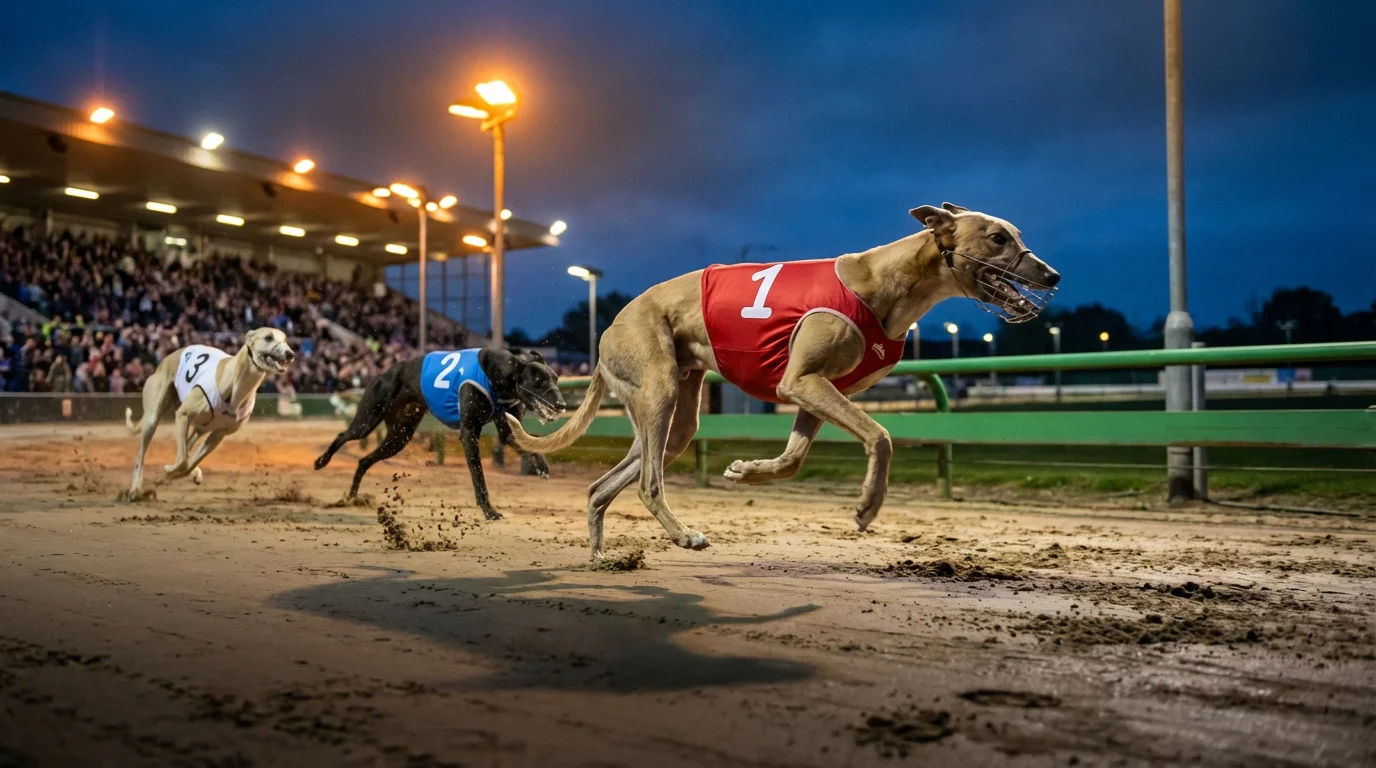
Crayford Stadium ran its last race on a cold January evening in 2025. The final card featured twelve races, a packed grandstand, and a commentator raising his microphone one last time before the lights went dark on nearly four decades of greyhound racing in south-east London. Entain, the gambling group behind Ladbrokes, had announced in November 2024 that operations at the Stadium Way venue were no longer viable. On 19 January 2025, the traps opened for the last time. Two days later, the stadium formally ceased operations.
The closure did not arrive in isolation. Crayford was the latest in a procession of London tracks that have disappeared since the early 2000s. Catford went in 2003. Walthamstow, once regarded as the sport's leading British venue, shut in 2008 and was redeveloped. Wimbledon, the final south London outpost and spiritual home of the Greyhound Derby for three decades, closed in 2017. With Crayford gone, Romford stands as the sole greyhound track inside Greater London. For a sport that once thrived on its proximity to urban audiences, the retreat from the capital tells its own story.
But this guide is not an obituary. If you have arrived here searching for Crayford dogs results, you should know that the historical data still exists across platforms like the Racing Post, Sporting Life, and Timeform. Those archives remain useful for form study, trainer records, and understanding how a tight, all-sand circuit with distances from 380 to 874 metres shaped a particular style of racing. What Crayford no longer provides is live data, and that changes the purpose of a search like this one.
Instead of results from a track that no longer operates, this article offers something broader and more durable: a comprehensive guide to UK greyhound racing and betting. Whether you followed the dogs at Crayford and need to find a new home track, or you are entirely new to the sport and want to understand how results, racecards, odds, and bet types work, every section here is built to be practically useful. We will move through how results are structured, how to decode a racecard, which tracks are still running, how betting mechanics work, what bet types are available, how to analyse form, and how to manage a betting bankroll responsibly.
Crayford Stadium: Key Facts
The current stadium opened on 1 September 1986, replacing the earlier Crayford and Bexleyheath track after Ladbrokes sold part of the original twenty-acre site to Sainsbury's. The rebuilt venue occupied a five-acre plot with a 334-metre all-sand circumference and an outside Swaffham hare. Race distances were 380, 540, 714, and 874 metres. The stadium hosted the Golden Jacket, one of the sport's historic competitions, from 1987 onwards. Its final owner, Entain, confirmed closure in January 2025, citing commercial non-viability. Entain's other UK tracks at Romford, Hove, and Monmore remain operational.
Greyhound racing in Britain reached its peak attendance in the late 1940s, when seventy-seven licensed tracks and more than two hundred independent venues drew crowds that rivalled football. The 1940s are long gone, but the sport still generates significant turnover. Estimated off-course and remote betting on greyhound racing reached approximately 1.5 billion pounds in the 2022-23 period. That figure does not suggest a dying industry so much as one that has shifted almost entirely from trackside to screen. The audience changed. The betting volume did not.
How Greyhound Racing Results Work
A greyhound result is more than a finishing order. It is a compressed record of everything that happened during a race, encoded in a format that looks cryptic at first glance but becomes second nature after a few evenings with a racecard. Understanding what each element means is the first step toward making informed betting decisions rather than guessing based on names and trap numbers.
Every published result from a GBGB-licensed meeting contains the same core data: the finishing position of each dog, the official time of the winner, the distances between finishers, run description codes that summarise each dog's race, and the starting price returned by the on-course market. Some platforms add sectional times, weight on the night, and Timeform or Racing Post ratings. But the basic structure remains consistent whether you are reading results from Romford, Monmore, or a historical Crayford archive.
What a Full Result Includes
A standard result line contains the finishing position, the dog's name, run description codes, the distance behind the dog ahead (or winning time for the first-place finisher), and the starting price.
The finishing position is straightforward: 1st through 6th, since UK greyhound races are run with six-dog fields. If a dog fails to finish, you will see codes like "DNF" or the specific reason for the failure. The winning time is given in seconds and hundredths, measured from trap opening to the moment the first dog's nose crosses the line. Times are track-specific and distance-specific, so a 29.40 over 480 metres at one track is not directly comparable to the same time at another venue with different geometry.
The distances between finishers are expressed in standard increments: a short head (SH), a head, a neck, half a length, then full lengths. These matter because they tell you how close the race was, which is critical for forecast and tricast analysis. A dog that finishes three-quarters of a length behind the winner ran a fundamentally different race from one beaten by six lengths.
Run description codes are the part that trips up newcomers. These two- or three-letter abbreviations summarise what happened to each dog during the race. Common codes include: EP (early pace, meaning the dog showed speed from the traps), SnLd (soon led), Crd (crowded, indicating the dog lost ground through interference), Bmp (bumped), RnOn (ran on, meaning the dog finished strongly), SAw (slow away from the traps), MidTrk (middle track, describing the running line), Wide (ran wide through the bends), and Chl (challenged for the lead). A string of these codes paints a picture. A dog described as "EP, SnLd, Crd 3, RnOn" showed early pace, took the lead, got crowded at the third bend, and still managed to finish well. That is a very different profile from "SAw, Bmp 1, Crd 2, Fdd" (slow away, bumped at the first bend, crowded at the second, faded).
SP (Starting Price) — the final odds on a greyhound at the moment the traps open, as determined by the on-course market. The SP is the default settlement price for bets where no early price was taken, and it serves as the benchmark against which value is measured.
Reading Form Figures at a Glance
Form figures are the numerical shorthand that appears next to every dog's name on a racecard and in published results. A typical form string might read "132641". Each digit represents the finishing position in one of the dog's most recent races, read from left to right with the oldest run first and the most recent last. So "132641" tells you: the dog finished 1st, then 3rd, then 2nd, then 6th, then 4th, then 1st in its last six outings.
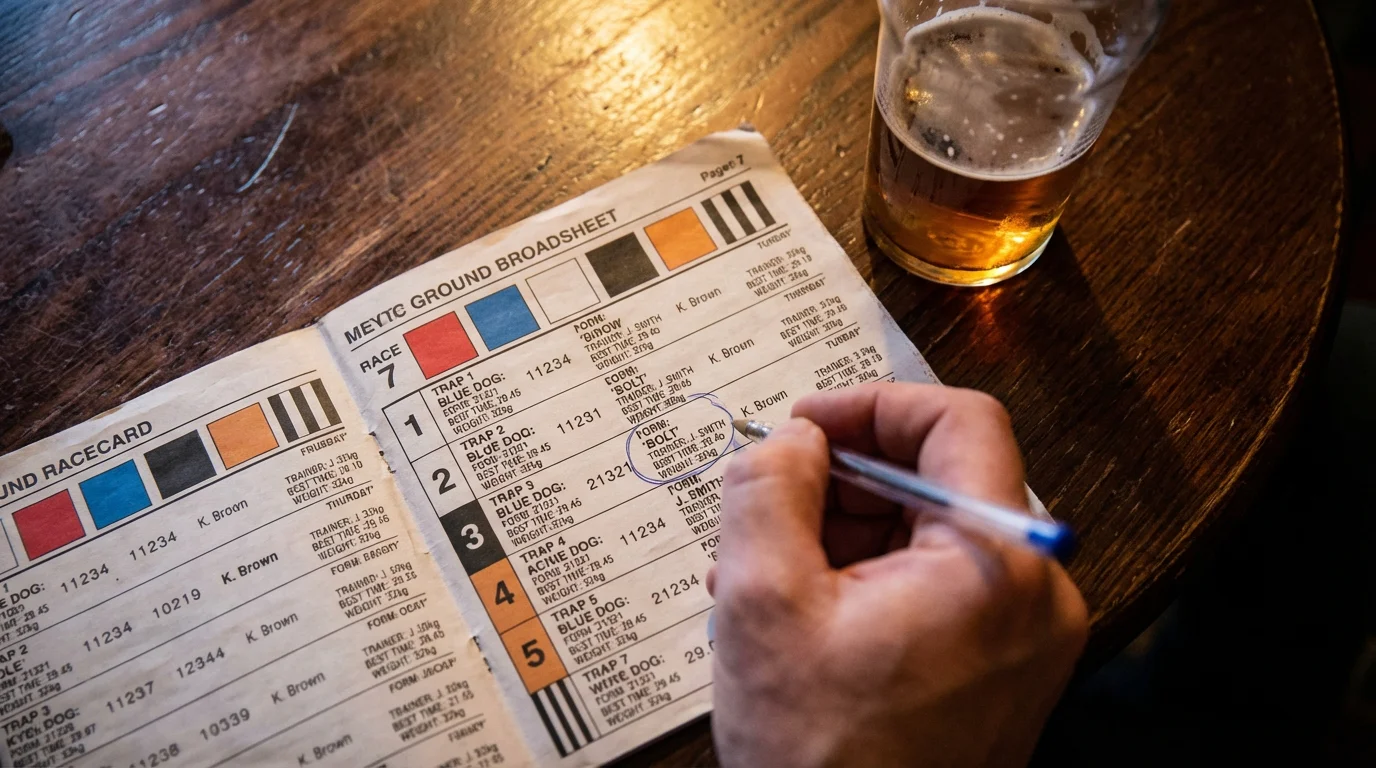
The letters mixed into form strings carry specific meanings. An "m" typically indicates a trial rather than a competitive race. A dash or hyphen can mark a break in the dog's racing schedule. Some platforms use "T" for a trial and "H" for a hurdle race. The critical thing is that form figures tell you about consistency, not just ability. A dog showing "111111" is in exceptional form but may also be climbing through the grades quickly, meaning its next race could be against significantly stronger opposition. A dog showing "332234" is consistently placed but not winning, which might make it a better each-way proposition than a win bet.
Form must be read in context. The grade of each race matters enormously. A sixth-place finish in an open race against the best dogs at the track is not the same as finishing sixth in an A6 graded event. Distances matter too: a dog that finishes 1st over 480 metres but 5th over 640 metres is a sprinter being asked to stay. Once you can read form figures fluently, you are already ahead of the casual punter who picks on gut feeling alone.
Understanding Greyhound Racecards
The racecard is the closest thing greyhound betting has to a scouting report. It lays out everything the track and the regulator want you to know about each dog in each race, and learning to read it properly is the single most productive investment a greyhound punter can make. Every column exists for a reason, and ignoring any of them leaves money on the table.
Trap, Form, Trainer, Weight: Column by Column
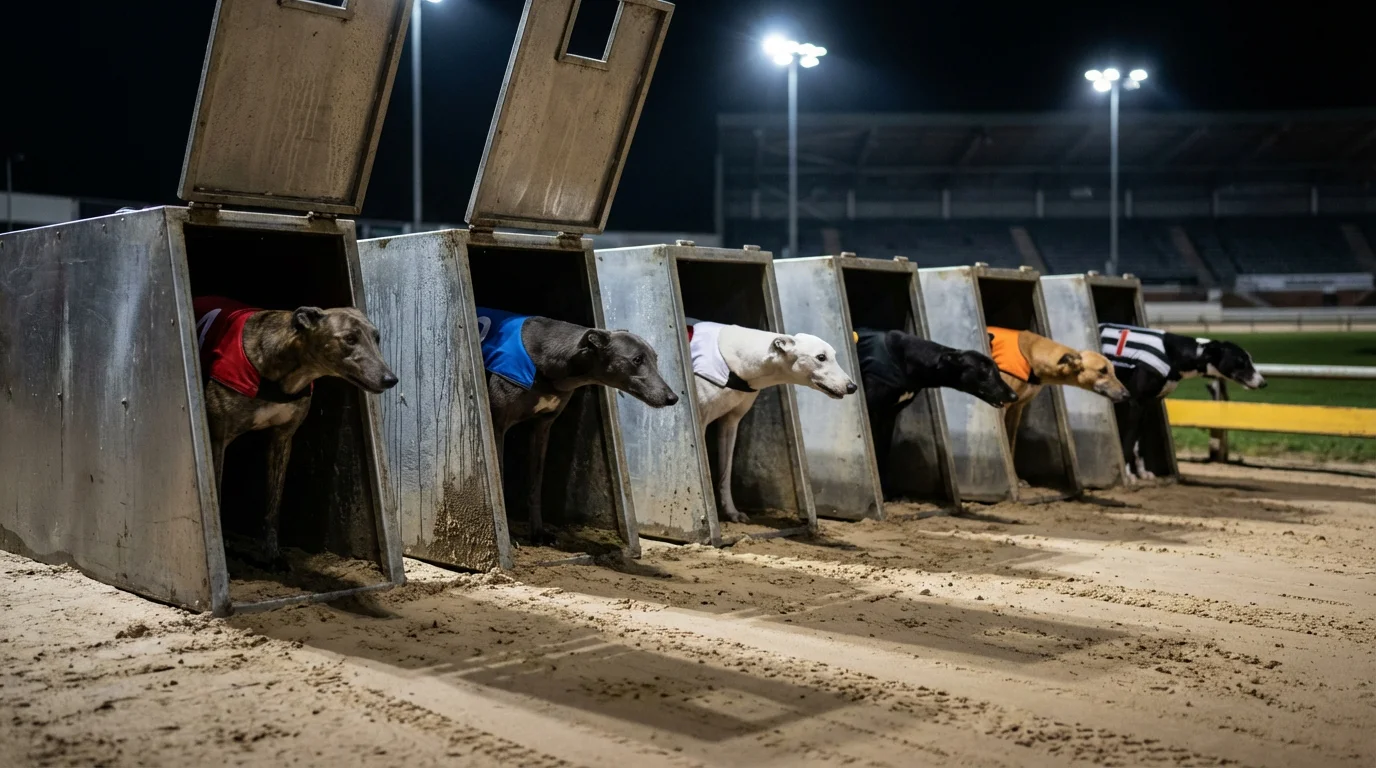
The trap number comes first and tells you the starting position. In UK greyhound racing, traps are numbered 1 (red jacket) through 6 (black and white stripes), always running from the inside rail outward. Trap position matters because it determines the dog's initial racing line into the first bend. Inside traps (1 and 2) generally favour dogs with early pace that can hug the rail. Outside traps (5 and 6) suit wide runners. Trap draw is not destiny, but it is a variable that deserves attention at every track.
Next to the trap number, you will find the dog's name, along with identifiers for sex, colour, and breeding. A typical entry might read something like "Ballymac Doris (bk b)" meaning a black bitch. The sire and dam are listed because breeding lines carry performance characteristics. Some sires consistently produce sprinters; others are known for producing stayers with stamina. Experienced form readers factor breeding into their analysis, particularly when a dog is stepping up to an unfamiliar distance.
The form figures appear as the string of recent finishing positions discussed in the previous section. Alongside form, the racecard will show the trainer's name. Trainer form is an underrated factor. Some trainers consistently prepare dogs to peak for specific competitions. Others have strong records at particular tracks. Checking whether a trainer's recent runners are winning or consistently finishing placed tells you something about the condition of their kennel at that moment.
The weight column shows each dog's racing weight in kilograms, recorded on the night. Small fluctuations are normal, but a significant change compared to recent outings can indicate a shift in condition. Look for consistency rather than reading too much into a single variation.
The best time and last time columns show the fastest time the dog has recorded at this distance and the time from its most recent outing. Best time establishes ceiling ability; last time reflects current form. If a dog's last time is significantly slower than its best, ask why. Was there trouble in running? A grade change? Different track conditions? The gap between best and last time is one of the most useful quick-scan metrics on the card.
Finally, the comments or race notes column provides a brief narrative of the dog's last run, often written by a track analyst. These comments use the same abbreviation codes found in results and can confirm or complicate what the bare form figures suggest.
Sectional Times and What They Reveal
Sectional times divide a race into segments, typically showing how fast each dog ran to a specific point on the track, usually the first bend or the halfway mark. This is where serious form study separates from casual observation, because two dogs can post identical finishing times while running completely different races.
A dog that posts a fast early sectional but a slower closing split is a confirmed front-runner. It relies on breaking cleanly and controlling the race from the front. Trouble at the first bend, caused by crowding or a slow start, will disproportionately affect this type of dog. Conversely, a dog with a slow early split but a rapid closing sectional is a closer. It sits behind the pace and picks off tiring dogs in the home straight. Closers are more dependent on a clear run in the second half of the race and often benefit from races with strong early pace that burns off the front-runners.
Sectional times also reveal hidden form. A dog that finishes fourth but posts the fastest closing sectional in the race was clearly unlucky or poorly positioned. That information does not appear in the form figures, which simply show "4". Without sectional data, you might dismiss the dog. With it, you might identify a value bet. Not every racecard includes sectional times, but platforms such as Timeform and specialist form sites are increasingly making this data available. If you can access it, use it.
The racecard tells you what happened. Sectional times tell you why.
UK Greyhound Tracks Still Racing
Crayford's closure leaves Romford as the last dog track in Greater London, but the wider picture is more nuanced than a simple narrative of decline. There are currently 18 GBGB-licensed stadiums operating across England and Wales, running meetings almost every day of the year. The sport has also entered its centenary era: 2026 marks 100 years since the first official greyhound race took place at Belle Vue Stadium in Manchester, and the GBGB has built a commemorative open race calendar with 50 category one competitions and 27 category twos to mark the occasion. The dogs still have plenty of track to run on.
London and the South East
Romford is now the flagship south-east venue and the only GBGB-licensed track inside the M25. Owned by Entain, it operates a 400-metre sand circuit with standard distances of 225, 400, 575, and 750 metres. Romford races on Friday and Saturday evenings and selected weekday afternoons, with live coverage on Sky Sports Racing. It also hosts category one events and has absorbed some of the fixtures and trainers displaced by Crayford's closure. For any London-based punter, Romford is the default home track.
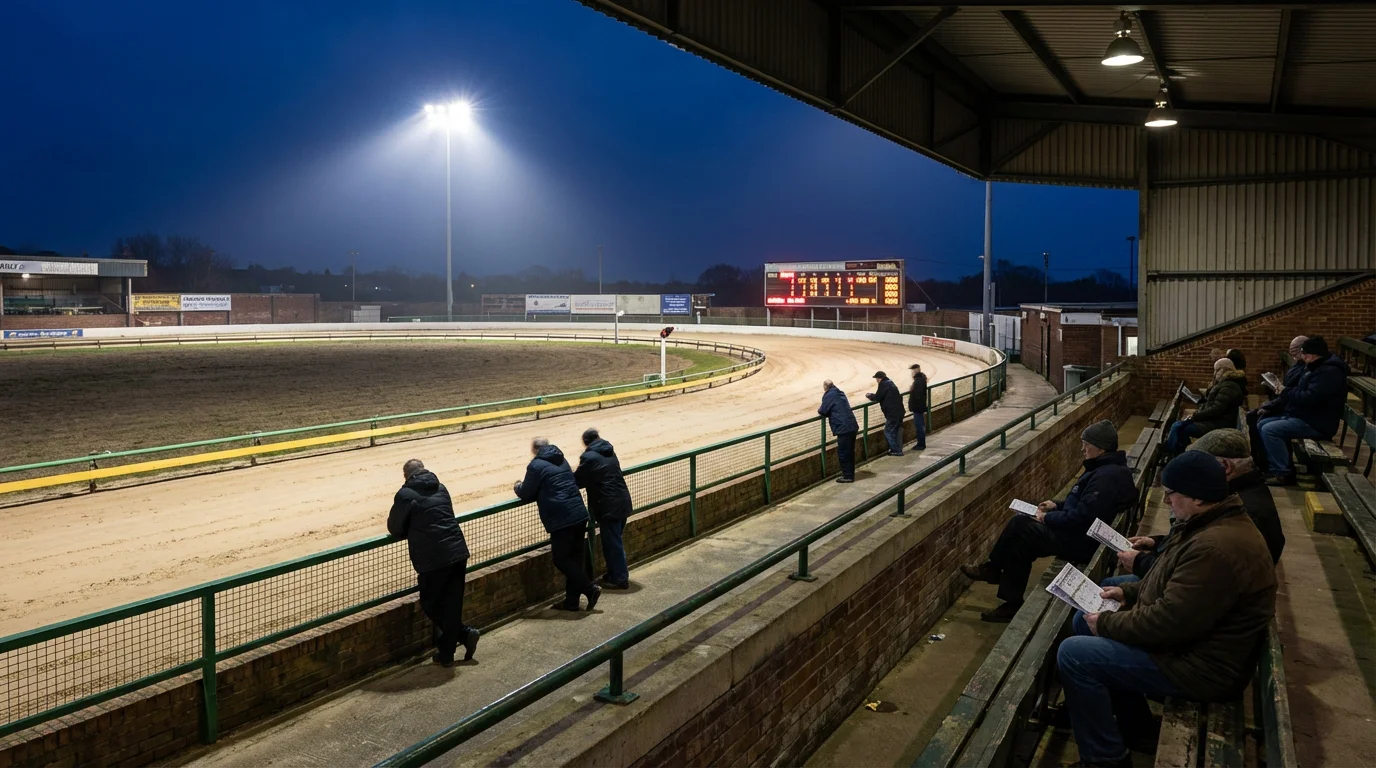
Central Park (Sittingbourne) sits about 45 miles east of London in Kent and runs a 400-metre sand track with distances including 265, 400, 540, and 700 metres. It offers a Tuesday and Saturday evening schedule and provides an accessible option for those in Kent and the Thames Estuary corridor who previously relied on Crayford.
Hove, on the Sussex coast near Brighton, is another Entain venue and one of the stronger tracks in southern England. Its 449-metre circumference makes it one of the larger circuits, and it runs race distances from 285 to 740 metres. Hove holds meetings multiple times a week and regularly features open-race competitions. The journey from London takes roughly ninety minutes by car, making it a viable option for a night out as well as serious betting.
Midlands, North and Scotland
The Midlands is arguably the engine room of British greyhound racing. Monmore Green in Wolverhampton is an Entain track that holds regular meetings on Monday, Friday, and Saturday. Its 421-metre circuit is well regarded for competitive graded racing. Perry Barr in Birmingham runs a 408-metre sand circuit and is an important fixture venue, including hosting category one events. Nottingham (Colwick Park) operates one of the busier schedules in the region and is home to a handful of prestigious open-race competitions.
Further north, Sheffield (Owlerton) maintains a loyal following and runs a 400-metre track with meetings through the week. Sunderland and Newcastle (Byker) serve the North East, while Doncaster (Stainforth) operates in South Yorkshire. Kinsley, near Wakefield, runs a smaller circuit and is known for its tight turns that reward experienced railers.
Towcester, in Northamptonshire, has become one of the most prominent venues in British greyhound racing since reopening. It is the current home of the English Greyhound Derby, the sport's most prestigious event. The 2026 Derby, sponsored by Star Sports and Orchestrate, begins with first-round heats on 30 April and culminates in a final on 6 June with a winner's prize of 125,000 pounds. The track's 450-metre circumference and wide bends suit free-running dogs and have produced some of the fastest times in recent Derby history.
Wales currently has one GBGB-licensed venue, Valley Stadium in Ystrad Mynach. However, the Senedd introduced the Prohibition of Greyhound Racing (Wales) Bill in September 2025, which, if passed, will phase out the sport in Wales no earlier than April 2027 and no later than April 2030. Scotland has no active GBGB-licensed tracks, though the independent Thornton Stadium has operated outside the GBGB framework.
Knowing where the dogs run is step one. Knowing how to read the odds is step two.
How Greyhound Betting Works in the UK
Six dogs, one mechanical hare, and roughly ninety seconds — that is all it takes for a greyhound race to run from trap to finish. The brevity is part of the appeal. Greyhound racing compresses anticipation, action, and result into the time it takes to boil a kettle, and an evening's card of twelve to fourteen races offers plenty of opportunity to study form and find value.
Greyhound betting in the UK operates under the same regulatory framework as all other forms of gambling. Bookmakers must hold a UK Gambling Commission licence. The sport itself is regulated by the Greyhound Board of Great Britain, which oversees track licensing and the Rules of Racing — updated with amendments from 1 January 2026 that include new requirements for stewards to publish reasons for all greyhound withdrawals.
There are two fundamental ways to bet on greyhounds: through a fixed-odds bookmaker or through the Tote pool. Fixed-odds betting means you lock in a price at the time of your bet. Pool betting through the Tote works differently: all stakes go into a single pool, the Tote takes its percentage, and the remainder is shared among winning tickets. In practice, most online bettors use fixed odds, while the Tote remains more popular trackside.
Odds Formats: Fractional, Decimal, and SP
UK greyhound betting traditionally uses fractional odds. An expression like 4/1 (spoken as "four to one") means that for every one pound you stake, you receive four pounds in profit if the bet wins, plus your stake back. So a five-pound win bet at 4/1 returns twenty-five pounds total: twenty pounds profit and five pounds stake. The formula is simple: (stake multiplied by the numerator divided by the denominator) plus stake equals total return.
Trap 3 at 4/1
Stake: £5 | Odds: 4/1 | Return: £25 (£20 profit + £5 stake)
Decimal odds are increasingly common on online platforms and express the same information differently. Fractional 4/1 becomes decimal 5.0. To calculate your return with decimal odds, simply multiply your stake by the decimal number: £5 at 5.0 equals £25. The decimal format already includes your stake in the return figure, which makes quick mental arithmetic easier, particularly for accumulator calculations.
The starting price is the final market price at the moment the traps open, determined by the balance of money across the on-course bookmakers. If you did not take an early price or if your bookmaker settles at SP by default, this is the odds your bet will be calculated at. Most serious greyhound bettors prefer to take early prices when they spot value, but the SP serves as the industry's official benchmark. Many bookmakers also offer best odds guaranteed on greyhounds, meaning that if you take an early price and the SP turns out to be higher, you receive the better of the two. This is a genuinely useful promotion, and checking whether a bookmaker offers BOG on greyhound racing should be standard practice before placing any bet.
The Bet Slip Process: Track vs Online
At the track, you study the racecard, approach a trackside bookmaker for fixed odds or the Tote window for pool betting, and collect winnings after the race with your ticket. Trackside bookmakers display prices on boards and may negotiate on larger stakes.

Online, you log in to a UKGC-licensed bookmaker, navigate to greyhound racing, select the meeting and race, choose your bet type, enter your stake, and confirm. Settlement is automatic. Most major bookmakers offer live streaming to account holders, letting you watch the race in real time. Online bookmakers generally offer more competitive odds because their overheads are lower. Trackside betting gives you the atmosphere, the parade ring, and the occasional visual edge from observing which dogs look fit on the night.
Core Bet Types for Greyhound Racing
Start with the simplest structure and build from there. That is the most reliable approach to greyhound betting, and it applies just as well to understanding bet types as it does to bankroll management. The range of available bets in UK greyhound racing runs from a straightforward win single through to combination tricasts and multi-leg accumulators, each with its own risk profile and payout characteristics. Mastering the fundamentals before reaching for exotics is the difference between informed betting and guesswork.
Win, Place, and Each-Way
A win bet is the foundation. You select one dog to finish first. If it wins, you are paid at the agreed odds. If it finishes second or lower, you lose your stake. Simple, clean, and the starting point for any betting education.
A place bet requires your selection to finish in one of the designated places, typically first or second in a standard six-dog race. Place odds are shorter than win odds because the probability of a dog finishing in the top two is obviously higher than the probability of it winning outright. In greyhound racing, the standard place terms are 1/4 of the win odds for the first two places.
An each-way bet combines both. It is effectively two bets in one: a win bet and a place bet, each for the same stake. If your dog wins, you collect on both the win and place portions. If it finishes second, you lose the win part but collect on the place part at the reduced odds. Each-way betting doubles your total stake, which is worth remembering when calculating your exposure. A five-pound each-way bet costs ten pounds in total. Each-way offers genuine value on dogs priced at around 4/1 or longer that you believe have a strong chance of finishing in the first two but might not quite win. At shorter prices, the place return often does not justify the doubled stake.
Forecast and Tricast Bets
A straight forecast requires you to select the first two finishers in the correct order. You nominate one dog to finish first and another to finish second. If they fill those exact positions, you are paid the declared forecast dividend, which is calculated by the Tote pool after the race. Forecast dividends can be substantial because the difficulty is high. In a six-dog field, there are thirty possible first-and-second combinations, meaning a random forecast has roughly a 3.3% chance of success.
A reverse forecast covers both orderings of your two selected dogs. If you nominate Dog A and Dog B, a reverse forecast wins whether the result is A-first-B-second or B-first-A-second. The cost is double a straight forecast because you are placing two bets. A combination forecast selects three or more dogs and covers every possible first-and-second pairing between them. Selecting three dogs produces six combinations; selecting four produces twelve. The cost scales quickly.
A straight tricast takes the concept further: you must predict the first three finishers in exact order. In a six-dog field, there are 120 possible finishing combinations for the top three, so the odds of landing a random tricast are less than 1%. The dividends reflect that difficulty and can occasionally run into the hundreds of pounds from a one-pound stake. A combination tricast selects three or more dogs and covers all possible orderings for the first three places.
Combination Tricast Cost Calculation
You fancy three dogs to fill the first three places but are unsure of the exact order.
Number of possible orderings for 3 dogs in 3 positions: 3 x 2 x 1 = 6 permutations.
At £1 per line, a combination tricast on 3 dogs costs £6 total stake.
If your three selections finish 1st, 2nd, and 3rd in any order, you win the declared tricast dividend on the correct permutation.
Selecting 4 dogs in a combination tricast: 4 x 3 x 2 = 24 permutations = £24 at £1 per line.
Accumulators and Multiples
A double links two selections from different races. Both must win for the bet to pay out, with returns from the first winner rolling over as the stake for the second. A treble extends this to three races, and the pattern continues through four-folds and beyond.
Accumulators are popular because the potential returns from small stakes can be eye-catching. A one-pound treble on three dogs at 3/1, 4/1, and 2/1 would return sixty pounds if all three win. But the probability of landing that treble is roughly 2.6%, and each additional leg reduces the overall chance of success further while compounding the bookmaker's margin. A disciplined bettor making single-race win bets might win three or four across an evening. The same bettor placing a ten-fold accumulator will almost certainly lose. Keep multiples to doubles or trebles if you use them at all, and treat them as entertainment, not strategy.
Interactive Tool
Treble Probability Checker, and Plot Size Retained
Verify the guide's "roughly 2.6%" treble claim against the actual odds, and see what share of Crayford's original site survived redevelopment.
Actual Combined Probability
-
-
Leg A Implied
-
Leg B Implied
-
Leg C Implied
-
What this guide gets wrong: "A one-pound treble on three dogs at 3/1, 4/1, and 2/1... the probability of landing that treble is roughly 2.6%." Multiplying the actual implied probabilities from those exact odds (25% × 20% × 33.3%) gives 1.67% — not 2.6%. The guide's figure is roughly 56% too high.
Site Retained
-
-
Original Site
-
Rebuilt Plot
-
Sold to Sainsbury's
-
What this guide leaves as two separate acreages: "Ladbrokes sold part of the original twenty-acre site to Sainsbury's. The rebuilt venue occupied a five-acre plot." The percentage retained is never calculated — Crayford's 1986 rebuild kept just 25% of the original footprint; 75% went to the supermarket.
Form Analysis: Picking Greyhound Winners
Form is not prophecy — it is probability with a footnote. Every piece of data on a racecard represents something that already happened, and the punter's job is to assess how likely those patterns are to repeat under today's specific conditions. That assessment is what separates form analysis from superstition. The good news is that greyhound racing, with its six-dog fields and relatively short races, is one of the most data-friendly betting sports available. The variables are manageable. The information is accessible. The challenge is knowing which variables matter most on any given card.
Recent Form vs Long-term Pattern
The last three runs are the most reliable window into a dog's current condition. Race fitness, the trainer's form, the dog's physical state, and recent competition level are all reflected in what has happened over the past two to three weeks. A dog that has won its last two starts at the same track and distance is demonstrating form that deserves respect, regardless of what happened three months ago.
But recent form does not exist in a vacuum. Long-term patterns reveal things that short-term data cannot. Some dogs perform better during specific seasons, particularly on sand tracks where surface conditions change with weather. Others show a clear preference for certain distances or track configurations visible only over twenty or thirty outings. A dog that consistently clocks faster times at Romford than Hove is telling you something about how it handles those tracks.
Grade changes add another layer. A dog that has just moved up from A4 to A3 is facing stronger opposition, and its recent winning form may not transfer directly. Conversely, a dog dropping a grade after a couple of poor runs may find easier pickings. Checking whether recent results were achieved at the same grade, the same track, and over the same distance is essential context.
Track Conditions, Draw, and Distance
All GBGB-licensed greyhound tracks in the UK use sand surfaces, but sand conditions vary with weather. Heavy rain softens the surface and generally slows times. Cold, dry conditions tend to produce faster running. Dogs with a pronounced front-running style are particularly sensitive to surface changes because their early pace advantage depends on grip out of the traps.
The trap draw is the single most overlooked variable in casual greyhound betting. Different tracks have different trap biases depending on the geometry of the circuit, the position of the first bend relative to the traps, and the length of the run to the first turn. At some venues, trap 1 produces a disproportionately high number of winners because the rail offers a protected run into the first bend. At others, trap 6 has an advantage because the wide draw gives dogs room to stride into the turn without crowding. Checking a track's trap statistics over a meaningful sample of races — ideally hundreds of results — reveals these biases clearly. Several form platforms publish trap stats by track and distance.
Distance suitability matters as much as form figures. A dog with brilliant early pace may dominate over sprint distances but lack the stamina to sustain its advantage in a 640-metre stayers' event. Conversely, a dog with a strong closing split may be wasted in a 250-metre dash where the race is effectively decided in the first eighty metres. Matching a dog's running style to the race distance is a fundamental principle that too many casual punters ignore.
Do
- Check trainer form at the specific track, not just overall trainer stats. A trainer running dogs consistently at one venue develops track-specific expertise that matters.
- Factor in the trap draw relative to each dog's known running style. A railer in trap 6 faces a harder task than the same dog in trap 1.
- Look at closing sectional times to identify dogs that finished strongly despite poor finishing positions. Hidden form is where value hides.
- Note grade changes. A dog dropping a level may be better value than its recent form suggests.
Don't
- Blindly back the favourite. In graded greyhound races, the market favourite wins roughly a third of the time. That means it loses two-thirds of the time.
- Ignore non-runner replacements. A reserve dog drafted in late may have different characteristics from the original entry, changing the race dynamic.
- Chase losses across a card. Twelve races on a card does not mean twelve betting opportunities. Discipline means sitting out races where you lack a strong opinion.
- Treat all tracks as equivalent. A 29.5-second time at one track is not the same performance as 29.5 at another. Times are track-specific.
Responsible Betting and Bankroll Basics
The best bet you will ever make is knowing when to stop. That is not a platitude; it is a mathematical reality. Greyhound racing, with its short race intervals and multiple daily meetings available through online bookmakers, creates a rhythm that can accelerate both winning runs and losing streaks. Without a clear framework for managing your money, even a sound analytical approach can be undermined by poor discipline in the final furlong of a session.
Bankroll management starts with a simple premise: decide, before you begin, how much money you are prepared to lose. That is your session bankroll. It should be money you can afford to lose without affecting your rent, bills, or daily life. A common guideline among experienced punters is to risk no more than 2% to 5% of your total bankroll on any single bet. If your session bankroll is fifty pounds, that means individual stakes of one pound to two pounds fifty per bet. This sounds conservative, and it is. That conservatism is the point. It keeps you in the game long enough for your form analysis to generate returns over a meaningful sample of races.

Variance is the overlooked enemy. In a six-dog field, even the strongest selection will lose more often than it wins. Favourites in graded races win approximately 33% of the time. If you back only favourites, you need the average odds to compensate for losing two bets out of every three. Most favourites are priced between 6/4 and 5/2, which means the long-term margin for blind favourite backing is razor-thin. The lesson is not that favourites are bad bets, but that no method survives without staking discipline.
Set a loss limit for every session. If you hit it, stop. Set a time limit too, particularly for online betting where the next race at another track is always seconds away. Self-exclusion tools are available on every UKGC-licensed bookmaker's platform and can be configured for specific periods if you need a forced break. Deposit limits, cool-off periods, and reality checks that pop up after a set period of activity are all worth activating.
If gambling is causing stress, financial problems, or affecting your relationships, support is available. BeGambleAware provides information and guidance, and the GamCare helpline offers free, confidential support around the clock. These resources exist because the betting industry recognises that a minority of customers will experience harm, and responsible operators make access to help straightforward rather than buried in a settings menu.
Before Placing Tonight's Greyhound Bets
- Set a loss limit for the session and commit to it before the first race.
- Check the racecard properly. Do not bet blind on a name or a trap number.
- Take early prices only if best odds guaranteed is available from your bookmaker.
- Avoid chasing the last race. The urge to recover losses on the final event is the most common way a manageable session becomes a bad one.
- Use deposit limits on your betting account. They are a five-second setup that can save real money over the course of a month.
FAQ
How do you read greyhound racing results and what do the form abbreviations mean?
A greyhound result lists each dog's finishing position, the official race time, the distances between finishers, run description codes, and the starting price. The form figures next to a dog's name show its finishing positions in recent races, read left to right from oldest to most recent. So a form string of "231142" means the dog finished 2nd, 3rd, 1st, 1st, 4th, then 2nd in its last six outings. Run description codes summarise what happened during the race: EP means early pace, SAw means slow away, Crd means crowded, Bmp means bumped, RnOn means the dog ran on strongly, and SnLd means it soon led. A combination like "EP, SnLd, Crd 3" means the dog broke fast, took the lead, and then encountered crowding at the third bend. These codes help you distinguish between a dog that ran poorly and one that had genuine excuses for a below-par finishing position.
Which UK greyhound tracks are still racing after Crayford's closure?
As of early 2026, there are 18 GBGB-licensed greyhound stadiums in England and Wales. After Crayford's closure in January 2025, the nearest tracks to south-east London are Romford (the only track inside Greater London), Central Park in Sittingbourne (Kent), and Hove (Sussex). Other major venues include Monmore Green and Perry Barr in the West Midlands, Nottingham, Sheffield, Towcester (home of the English Greyhound Derby), Doncaster, Sunderland, Newcastle, and several others. Wales has one licensed track at Valley Stadium in Ystrad Mynach, though the Senedd has introduced legislation to phase out greyhound racing there. Scotland has no active GBGB-licensed tracks. For a full overview, the GBGB maintains a racecourse directory on its official website.
What is the difference between a forecast and a tricast in greyhound betting?
A forecast requires you to predict the first two finishers. In a straight forecast, you must name them in the correct order; in a reverse forecast, you cover both possible orderings of your two selections, which doubles the stake. A tricast requires you to predict the first three finishers. A straight tricast demands the exact finishing order, while a combination tricast covers all possible orderings of your chosen three dogs. In a six-dog race, there are 30 possible forecast outcomes and 120 possible tricast outcomes, which is why tricast dividends tend to be significantly larger. Both bet types are settled at Tote pool dividends rather than fixed odds, meaning the payout depends on how much money is in the pool and how many winners share it. Combination bets cost more because they cover multiple permutations: a three-dog combination forecast costs six units and a three-dog combination tricast costs six units as well.
All licensed UK greyhound tracks are regulated by the Greyhound Board of Great Britain. Always bet with UKGC-licensed operators. If you or someone you know is affected by problem gambling, contact GamCare or visit BeGambleAware.org for free, confidential support.
After the Last Trap Opens
Greyhound racing in Britain is smaller than it was — but the dogs still run. The stadiums that have closed outnumber the ones that remain. London, once home to more than thirty tracks, is served by one. The crowds have largely migrated to screens, watching live feeds through bookmaker apps or Sky Sports Racing. The culture of a Saturday night at the dogs has faded into something closer to nostalgia for most people under forty.
But nostalgia is not the whole story. The 2026 season carries genuine significance for British greyhound racing. It is the centenary year of the sport in the UK, marking one hundred years since Belle Vue, Manchester hosted the first official meeting. The GBGB has responded with its largest open race calendar in years, with fifty category one events spread across tracks from Towcester to Newcastle. The English Greyhound Derby remains the sport's pinnacle event, drawing entries from across the UK and Ireland with prize money that reflects the competition's stature. There is substance behind the milestone.
The challenges are real and they are not going away. Wales is actively legislating to ban the sport within its borders. Scotland has raised similar questions. The number of greyhounds registered to race has declined, and the pipeline of new dogs entering the sport has contracted alongside it. Welfare debates continue, and the GBGB has responded with enhanced retirement bond schemes, homing partnerships, and updated rules requiring injury retirement policies at every licensed venue. Whether these measures satisfy critics is an ongoing conversation. What they demonstrate is that the industry recognises the need to evolve.
For the punter, none of this changes the fundamental proposition. A trap draw, a form card full of data, and a decision to make before the hare starts moving. The analytical framework covered in this guide — reading results, interpreting racecards, understanding odds, choosing bet types, analysing form, managing your bankroll — works regardless of whether you are sitting in the Romford grandstand or scrolling through a racecard on your phone at midnight.
Crayford's story has ended, but the story of greyhound racing in Britain has not. It is being written every evening, at every track, in every graded race where a dog breaks from the traps and gives ninety seconds of honest effort. Whether you are here because you miss Crayford, or because you have never set foot in a greyhound stadium and want to understand what the fuss is about, the racecard is waiting. Read it properly. Bet wisely. And if the dogs teach you one thing, let it be this: the best information in the world means nothing without the patience to use it well.
