Greyhound Racing Grades Explained: A1 to A12 and Open Races
Grades Keep the Racing Fair
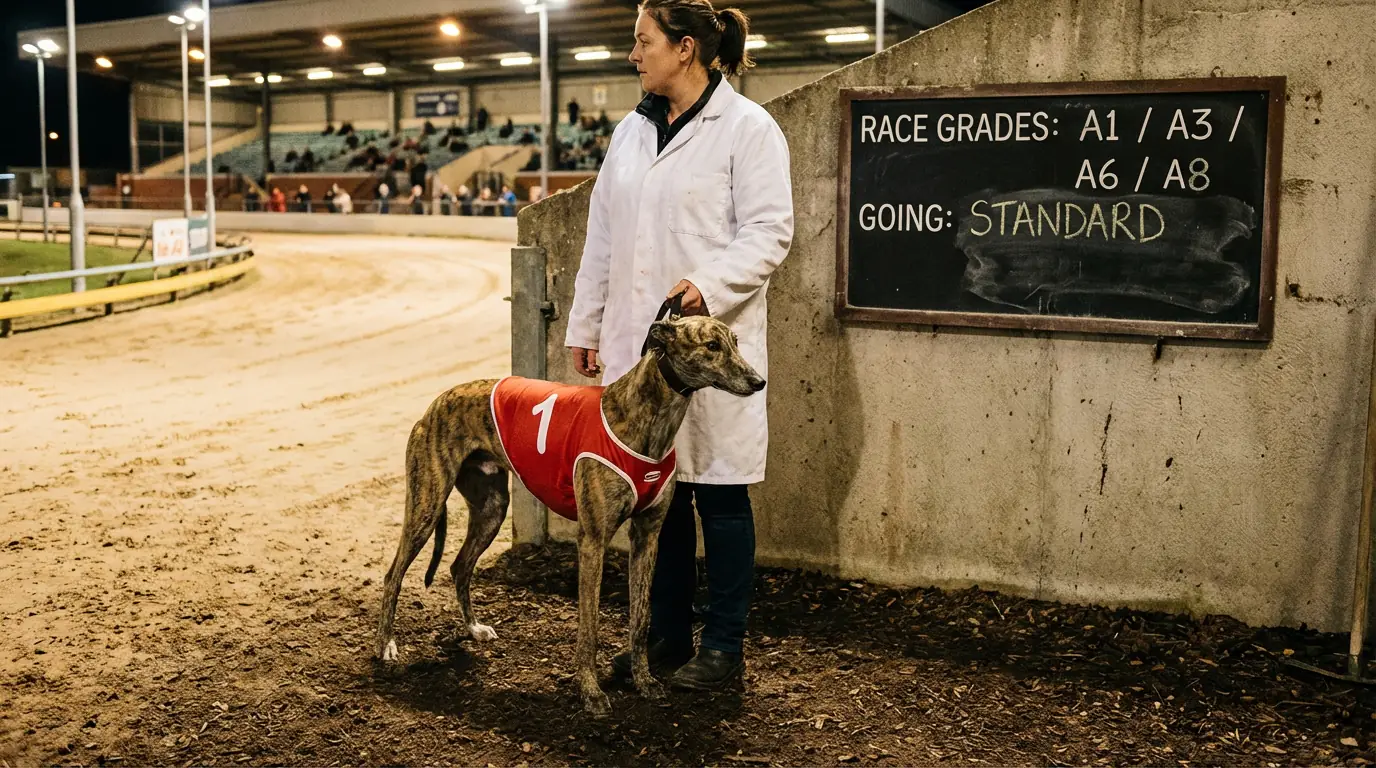
Without grading, the fastest dogs would win every race. The sport would devolve into a handful of dominant greyhounds sweeping up prize money while the rest of the field served as extras. Betting markets would collapse into short-priced favourites and disinterested punters. The grading system exists to prevent exactly this outcome. It separates dogs into tiers based on demonstrated ability, ensuring that each race pits roughly equivalent competitors against each other.
The concept is analogous to divisions in football or weight classes in boxing. A dog that runs consistently fast over 480 metres does not face a dog that is several lengths slower over the same distance. Instead, each is placed in a grade that reflects its level of performance, and races are assembled from dogs within the same grade at the same track. The result is tighter, more competitive racing — which is better for spectators, better for the integrity of the sport, and significantly better for betting.
In the UK, grading is managed at individual track level by racing managers, operating within guidelines set by the Greyhound Board of Great Britain. Each licensed track maintains its own grading structure, tailored to the pool of dogs racing there. The grades are not nationally uniform in the sense that an A3 at one track represents exactly the same standard as an A3 at another — times and competitive depth vary between venues. But the principle is consistent everywhere: grade reflects current form and time, and dogs move up or down as their performances dictate.
Understanding how grading works is essential for any bettor trying to assess a greyhound’s chance in a given race. A dog’s grade tells you what level it has been competing at, how recently it was assessed, and whether it is likely to be facing stronger or weaker opposition than usual.
A1 Through A12: How UK Grades Work
A1 is the top. A12 is the lowest. Movement between grades is based on time — specifically, the times a dog records over the standard distance at its home track. The grading system at most UK tracks uses an alphanumeric scale where A indicates the standard graded races, and the number indicates the tier within that scale. Lower numbers represent higher ability. An A1 dog is the fastest class of graded runner at the venue; an A12 dog is the slowest.
Not every track uses all twelve grades. The number of active grades depends on the volume of dogs racing at the stadium and the range of ability within that pool. A major track with a large kennel base might operate ten or more grades, providing fine-grained separation between ability levels. A smaller track with fewer runners might compress the scale into six or seven active grades. The structure adapts to the reality of each venue’s racing population.
The grading process works on a rolling basis. After each race, a dog’s time is recorded and compared against the benchmark times for its current grade. If a dog consistently runs faster than the upper boundary of its grade, it gets promoted — moved up to a higher grade, where it will face quicker opposition. If a dog’s times deteriorate, or if it consistently finishes behind the pace of its current grade, it drops down. This is not an annual reassessment; it happens continuously, with racing managers reviewing performances and adjusting grades on a meeting-by-meeting basis.
Some tracks also use additional classifications. You may see S grades for sprint distances, M grades for middle distance, or OR designations for dogs in open-race classes. Puppy races and veteran races carry their own designations, separating dogs by age rather than pure time. But the core A1-to-A12 framework covers the vast majority of standard flat races at any UK track.
The times used for grading are track-specific. A 29.50 second run over 480 metres at one venue does not automatically equate to the same grade at another, because track dimensions, surface conditions, bend profiles, and hare systems all influence times. This means that when a dog transfers from one track to another — a common occurrence — its grade at the new venue is reassessed based on its initial performances there, not simply carried over from its previous home.
Open Races, Handicaps, and Special Events
Open races throw the grading system out the window. In an open race, dogs from any grade can be entered, and the competition is not restricted by time classification. These events are typically the headline races at a meeting — the feature events that attract the best dogs, the biggest prize money, and the most attention from bettors and broadcasters.
The major competitions in the UK greyhound calendar — the Greyhound Derby, the St Leger, the Cesarewitch, and other prestige events — are run as open races or invitation events. Dogs qualify through earlier rounds or are selected based on form, reputation, and connections. There is no grade restriction, which means the field can include the very best dogs in the country competing directly against each other. For bettors, open races present a different challenge: form lines are harder to assess when the field is assembled from multiple tracks and grades, and the odds often reflect genuine uncertainty about the outcome.
Handicap races take a different approach to levelling the field. Instead of separating dogs by grade, handicap races allow dogs of mixed ability to compete, with lower-graded dogs receiving a head start based on the difference in their standard times. The fastest dog in the field starts from behind; the slowest starts with an advantage. The handicapper’s job is to set the starts so that, in theory, all dogs should reach the finish line at roughly the same time if they run to their expected standard.
In practice, handicap races are notoriously tricky for punters. The artificial levelling means that form figures from graded races do not translate directly. A dog that wins comfortably in A3 graded company might struggle in a handicap where it is conceding several metres to A8 and A9 dogs that have their own strengths at the lower level. The key to handicap betting is understanding the relationship between the starts and the dogs’ current form — not just their grade or nominal time.
Special events — charity races, match races, invitation sprint challenges — operate under their own conditions. These are less common in the regular calendar but add variety to the racing programme and occasionally produce memorable contests. For betting purposes, they are best treated as one-off occasions where standard form analysis applies but the context may be unfamiliar.
How Grading Changes Affect Betting
A drop in grade often signals value — but not always. When a dog moves down from, say, A4 to A5, the implication is that it has been running slower times or finishing behind the pace at the higher level. On paper, it should find the opposition in A5 less demanding. Bettors spot these drops and back the dog at what they perceive to be a reduced level of competition.
The catch is that grade drops happen for reasons, and not all of them are temporary. A dog might have dropped because it is carrying a minor injury that slows it by a few tenths of a second. It might have lost early pace due to age, making it less competitive regardless of the grade. Or it might simply be at a natural ceiling and struggling to adjust to a track or distance. Backing every dog that drops a grade is a losing strategy in the long run, because the market adjusts quickly: bookmakers and experienced punters see the same grade change you do, and the odds typically reflect the perceived advantage.
The more interesting betting angles come from grade rises. A dog promoted to a higher grade is assumed to face stiffer competition, and the odds lengthen accordingly. But if the promotion was triggered by a single fast run that may have been aided by a clear run, a favourable draw, or unusually quick track conditions, the dog might be over-promoted relative to its true ability. In these cases, the price can over-react, creating value on other runners in the race who benefit from the market’s attention being drawn to the newly graded dog.
The most reliable approach is to combine grade information with recent form, sectional times, and draw analysis rather than treating the grade change as a standalone signal. Used in isolation, a grade shift is noise. Used alongside other data, it becomes one more input in a decision that should always involve several.
Grade Is a Snapshot, Not a Verdict
Today’s A6 dog was last month’s A4 — and might be next month’s A3. Greyhound grades are fluid by design. They reflect recent performance, not permanent ability. A young dog improving rapidly can move through several grades in a matter of weeks. An older dog losing a step can slide just as quickly. Injuries, layoffs, track changes, and even the weather affect the times that drive grading decisions.
This fluidity is what makes greyhound form analysis both challenging and rewarding. Unlike sports where rankings are updated periodically and remain stable between assessments, greyhound grades shift in real time, tracking each individual dog’s trajectory. A bettor who pays attention to the direction of movement — not just the current grade — has a significant informational advantage over one who treats the grade as a fixed label.
The grading system is not perfect. It compresses complex variables into a single number, and it cannot fully account for factors like running style, temperament, or track preference. But it does something essential: it creates competitive fields, which in turn create genuine betting opportunities. Without grading, greyhound racing would be a procession. With it, every race carries at least the structural possibility that any dog in the field can win. That possibility is the foundation of the entire betting market — and the reason punters keep studying the form.