Greyhound Trap Colours: What Each Number and Jacket Means
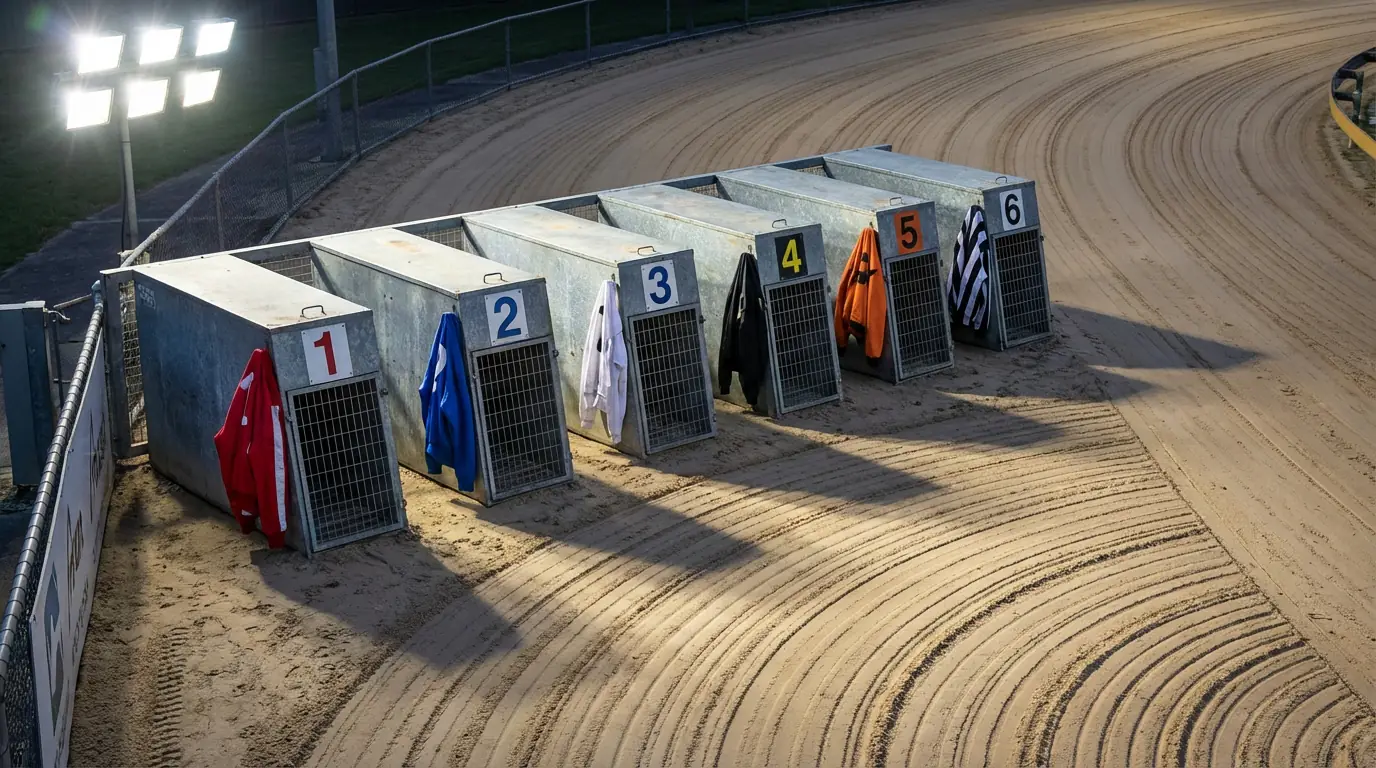
One Colour Per Trap, No Exceptions
Red, blue, white, black, orange, stripes — every trap has its colour, every colour its number. This is not a design choice left to individual tracks or a quirk of tradition that varies by region. The trap colour system in UK greyhound racing is standardised across every licensed stadium governed by the Greyhound Board of Great Britain. Whether you are watching at Romford on a Friday night or streaming a Tuesday matinee from Monmore Green, the colours mean the same thing.
For spectators, the system exists so you can follow your dog. Greyhound racing happens fast — a standard 480-metre race is over in roughly thirty seconds — and six dogs moving at up to 45 miles per hour around a compact oval track are not easy to distinguish by shape alone. The coloured jackets solve this instantly. You back trap 4, you look for the black jacket, and you know exactly where your selection is from the moment the traps open to the moment it crosses the line.
For bettors, the system carries additional weight. Trap number determines starting position, and starting position influences racing line, early pace, and the likelihood of trouble at the first bend. The colour you see on the jacket is a direct proxy for a dog’s draw — and the draw, as any serious greyhound punter knows, is one of the most significant variables in the result. Understanding what each trap colour represents is not just useful for following the action. It is the first step in reading the race before it happens.
The system has been consistent for decades. Unlike horse racing, where jockey silks represent owners and require a programme to decode, greyhound trap colours are universal knowledge within the sport. Learn them once and they apply everywhere, every time.
The Six UK Trap Colours
Trap 1 is red. Trap 6 is black and white stripes. Between those two endpoints, the sequence runs through blue, white, black, and orange. Here is the full breakdown as it applies at every GBGB-licensed track in the United Kingdom:
| Trap Number | Jacket Colour | Position |
|---|---|---|
| 1 | Red | Innermost (rail) |
| 2 | Blue | Second from rail |
| 3 | White | Third from rail |
| 4 | Black | Fourth from rail |
| 5 | Orange | Fifth from rail |
| 6 | Black and white stripes | Outermost (wide) |
The numbering runs from inside to outside. Trap 1 sits closest to the inside rail — the shortest route around the track. Trap 6 is widest, furthest from the rail, and faces the longest path unless the dog can cut across early. The positions between them graduate outward in order.
Most UK races feature six runners. The six-trap format has been the standard for decades, and while some tracks historically used eight-dog races on occasion, safety considerations led to those being phased out entirely. The six-colour system is therefore complete: no seventh jacket is needed, and the colour coding covers every possible runner in a standard field.
Visually, the jackets are designed for maximum contrast against each other and against the sand track surface. Red and orange stand out vividly. White is visible against the dark rail and the sand. Black and the black-and-white stripes are distinguishable from each other at speed. The system works not because the colours are arbitrary, but because each was chosen to be identifiable in a fast-moving group under floodlights. Commentators, camera operators, and spectators all rely on the same visual shorthand.
In Ireland, the system is identical. Australian greyhound racing uses a slightly different colour scheme and runs eight-dog fields, so the trap-colour assignments differ. American tracks have their own variations. But within the UK and Ireland, the colours are locked in. Trap 3 is always white. Trap 5 is always orange. There is no ambiguity, and no local exceptions.
How Trap Position Affects Racing Lines
Inside traps get the rail. Outside traps need early speed or trouble follows. This is the fundamental dynamic that makes trap position so important in greyhound racing, and it applies at every oval track regardless of dimensions.
The physics are simple. A greyhound track is an oval with four bends. The inside rail represents the shortest distance around the circuit. A dog running against the rail from trap 1 covers less ground than a dog running wide from trap 6, assuming both maintain their relative positions. At sprint distances — 200 to 300 metres, where races are decided in seconds — that difference in ground covered can be decisive. Even at standard distances of 480 metres, the advantage of the rail position is measurable.
But the advantage is not automatic. The crucial moment is the run to the first bend. At most UK tracks, the traps are positioned on a straight section, and the first bend arrives within 50 to 100 metres. What happens in that initial stretch determines which dog secures the rail and which dogs get shuffled wide, bumped, or checked. A fast-breaking dog from trap 1 can hug the rail from the start and maintain the shortest path. A slower breaker from the same trap risks being swallowed by dogs from wider traps cutting across.
Conversely, a dog drawn in trap 5 or 6 needs to either possess enough early pace to lead into the first bend, allowing it to cross toward the rail, or the racing style to sit wide and use stamina to overhaul the field on the run-in. Wide runners who lack early speed and lack closing power tend to face the worst of both worlds — they lose ground at the bends and have no mechanism to recover it.
Track configuration matters here. Tracks with a long run to the first bend give wider-drawn dogs more time to find a position before the field compresses. Tracks with a short run to the first bend amplify the inside draw advantage because the field is still tightly bunched when the bending starts. This is why trap bias statistics vary significantly from track to track. At some venues, trap 1 wins disproportionately often. At others, the middle traps — 3 and 4 — produce the best strike rates because they combine reasonable proximity to the rail with slightly more room to manoeuvre.
For bettors, the practical implication is straightforward: never ignore the draw. A dog’s form figures might look impressive, but those figures were achieved from specific trap positions at specific tracks. Move the same dog to a different draw, and the picture can change substantially. Checking whether a dog has performed well from its allocated trap — and whether the track layout favours that position — is one of the most reliable edges available in greyhound race analysis.
Reserve Runners and the ‘R’ Jacket
When a dog withdraws from a race due to injury, illness, or any other reason, a reserve runner may be substituted into the field. This does not happen automatically — a suitable reserve must be available, and the substitution must be approved under the rules governing the meeting. When it does occur, the replacement dog wears a distinctive jacket marked with the letter ‘R’ alongside the trap number and colour of the withdrawn runner.
The reserve system exists to maintain field sizes. A race with five dogs instead of six is less competitive, less appealing for spectators, and less interesting for bettors. Full fields generate better racing, higher turnover, and more engaging content for broadcasting. The reserve dog runs from the same trap as the withdrawn runner, wearing the same numbered jacket — but with the ‘R’ designation making it clear to punters, commentators, and officials that a late change has occurred.
From a betting perspective, reserve runners matter. A reserve dog may have different form, a different running style, and a different level of ability from the original selection. If you placed an ante-post or early-price bet on a race, the introduction of a reserve can alter the competitive dynamics of the field. Bookmakers apply Rule 4 deductions when a withdrawal occurs, adjusting payouts to reflect the changed field. Checking for non-runners and reserves before a race — particularly if you are betting in advance rather than at post time — is essential housekeeping for any serious greyhound punter.
The ‘R’ marking on the jacket is the visual confirmation that a substitution has taken place. If you are watching from the stands or on a stream, it is the simplest way to identify that the runner in a particular trap is not the dog originally listed on the racecard.
Colours Aren’t Luck — They’re Geometry
Trap colour tells you position. Position tells you racing line. And racing line, combined with early pace, track layout, and field composition, tells you a great deal about what is likely to happen in the first five seconds of a race — which, more often than not, determines the last twenty-five.
There is a persistent tendency among casual punters to treat trap colour as a lucky charm. Backing red because red feels right, or avoiding the stripes because the last striped dog lost. This is noise. The colours carry no inherent fortune. What they carry is information: a precise indication of where each dog starts and, by extension, what kind of race it will need to run.
The serious approach is to treat the trap draw as one variable in a multi-factor analysis. Check the dog’s record from that specific trap number. Check the track’s historical bias data for the distance being raced. Check whether the dog’s running style — front-runner, railer, wide-runner, closer — fits the position it has been assigned. These steps take minutes and are freely available through racecard data on platforms like Timeform, Racing Post, and Sporting Life.
Understanding the colour system is baseline knowledge. It costs nothing to learn and applies to every single race you will ever watch or bet on in the UK. It is the first thing a new greyhound punter should internalise, and it remains relevant no matter how experienced you become. Six colours, six positions, one mechanical hare, and whatever happens between the first bend and the finish line.