Greyhound Racecard Explained: Every Column Decoded
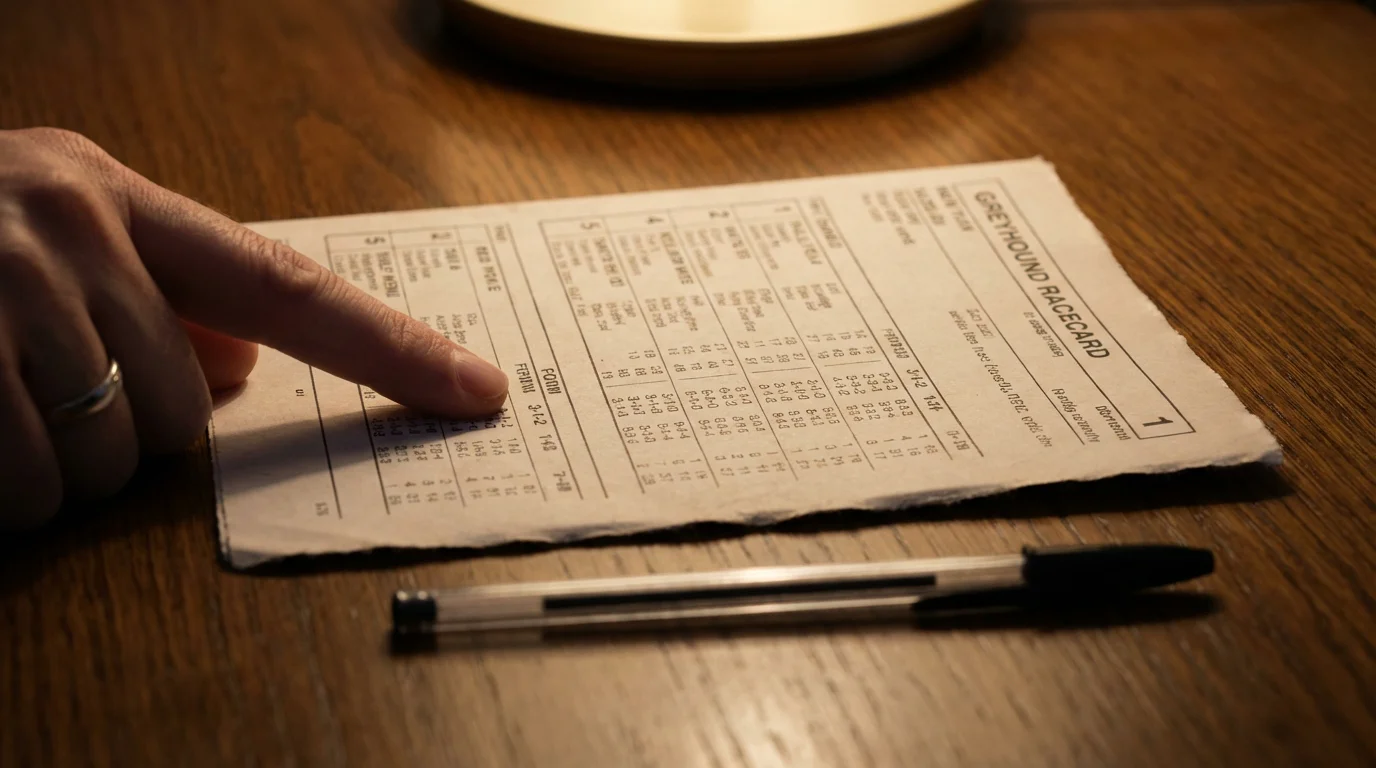
Everything You Need Is on One Page
The greyhound racecard is, in essence, a compressed biography of every dog in a race. It contains everything you need to form an opinion about each runner — their recent form, their best performances, their physical characteristics, their trainer, and the conditions under which they have succeeded or failed. All of it fits into a few lines of data per dog, presented in a format that is standardised across every UK track.
Learning to read a racecard is the single most important skill for any greyhound bettor. Without it, you are guessing. With it, you are making informed decisions based on publicly available evidence. The racecard does not guarantee winners — no analytical tool does — but it eliminates the need to rely on luck, tips, or the colour of a jacket. Every serious punter starts here.
The format can look intimidating at first glance, particularly if you are accustomed to the simpler presentation of other sports betting markets. But the columns follow a logical structure, and once you understand what each one represents, reading a racecard becomes second nature. This guide walks through every standard column, explains what the data means, and suggests how to use each element in your analysis.
Column-by-Column Breakdown
The first column on any UK greyhound racecard is the trap number, displayed alongside the jacket colour. Trap 1 (red), Trap 2 (blue), Trap 3 (white), Trap 4 (black), Trap 5 (orange), Trap 6 (black and white stripes). The trap number is the starting position — it determines where the dog breaks from and, at tracks with short run-ins, can significantly influence the outcome of the race.
Next comes the dog’s name, usually followed by its sex and colour. A typical entry might read “Ballymac Star (b d)” — where “b” stands for the colour (brindle, in this case) and “d” for dog (male). Bitches are denoted “b” for bitch. The breeding — sire and dam — is sometimes included below the name. Breeding information is more relevant for puppy races and for assessing distance aptitude in dogs with limited race history; for experienced runners with extensive form, the race data matters more than the pedigree.
The form figures follow the name. These are the dog’s finishing positions in its most recent races, read from left to right with the most recent run on the right. A form string of “3-1-2-4-1” tells you the dog finished third, then first, then second, then fourth, then first in its last five runs. This is the quickest way to assess recent performance at a glance, though the numbers alone do not tell you about the quality of opposition, the track, the distance, or the circumstances of each run.
Best time and last time are two of the most analytically useful columns. Best time is the dog’s fastest recorded time at tonight’s distance (and sometimes at tonight’s track specifically). Last time is the time recorded in its most recent race. Comparing the two tells you whether the dog is running near its best or below it. A significant gap between best time and last time — say, more than half a second — suggests the dog is either not in peak form, has been racing on a different surface, or encountered trouble in its recent run.
Weight is recorded in kilograms and can fluctuate between runs. A weight increase of more than half a kilogram might indicate a dog that has been rested and put on condition, while a significant drop could suggest illness or overracing. Weight changes are a secondary indicator — they rarely override form — but they contribute to the overall picture of a dog’s current condition.
The trainer column identifies who prepares the dog. In greyhound racing, the trainer is the single most important human variable. They decide when a dog races, at what distance, and in what grade. A top trainer entering a dog at a specific track and distance is making a deliberate choice that reflects their assessment of the dog’s readiness and the competitive conditions. Trainer form — their recent strike rate at the specific track — is one of the most underused analytical tools available to greyhound punters.
The grade column shows the race classification. Graded races match dogs of similar ability based on recent times. Open races have no grade restriction and attract the best dogs. Handicap races assign varying starts to equalise the field. The grade tells you the level of competition, which is essential for contextualising the form figures — a string of first-place finishes in A8 racing is not the same achievement as one win in A3.
Comment and run description codes appear alongside or below the form figures. These abbreviations describe how the dog ran in each race: “EP” (early pace), “Led” (led the race), “Crd” (crowded), “Bmp” (bumped), “RnOn” (ran on — finished strongly), “Fdd” (faded). These codes are crucial context. A dog that finished fifth but was bumped at the first bend and crowded on the second has a legitimate excuse; a dog that finished fifth in a clear run has none. The codes tell you whether the form figures are a true reflection of ability or a misleading summary of interrupted races.
Interpreting Trainer and Kennel Data
The trainer’s name on the racecard is more than administrative detail. In greyhound racing, the trainer is simultaneously the coach, the strategist, and the scout. They control the dog’s preparation, select its races, manage its fitness, and decide whether to step it up or drop it down in grade. A dog is only as good as its management, and the trainer’s decisions shape every aspect of its racing career.
Trainer strike rates — the percentage of runners that win — vary significantly and are track-specific. A trainer might operate at 18% at their home track but only 10% when sending dogs to an away venue. That differential reflects the advantage of local knowledge: understanding the surface, the trap biases, the grading system, and the competitive landscape at a specific track. Backing a top local trainer’s runners at their home venue is one of the most consistently effective angles in greyhound betting.
Kennel form — the collective performance of all dogs from a single trainer over a recent period — is another useful metric. A trainer whose dogs have won six of their last thirty runners is in strong form. A trainer on a twenty-runner losing streak might be dealing with a kennel issue — illness, poor surface conditions at their training gallop, or simply a batch of dogs between peak form. Checking the trainer’s recent results at the specific track, rather than their overall career record, gives the most actionable insight.
Some racecards also display the dog’s owner, which is generally less relevant for betting purposes. Kennel companion information — whether two dogs from the same trainer are in the same race — can occasionally matter, as trainers may have a preferred runner and a pacemaker, though this is more common in horse racing than in greyhound racing. The trainer column, treated with the attention it deserves, is one of the highest-value pieces of information on the card.
Racecard Sources: Where to Find Them
UK greyhound racecards are widely available online, typically published the evening before or the morning of each meeting. The Racing Post publishes comprehensive racecards with form data, times, and tipping content. Timeform offers racecards with their proprietary ratings and analysis. Sporting Life provides free racecards with basic form information. The RPGTV website and the major bookmaker sites — Ladbrokes, Coral, William Hill, Betfair, and others — all display racecards for upcoming meetings with varying levels of detail.
At the track, printed racecards are available at the entrance, usually included in the admission price or sold separately for a small fee. The printed card contains the same information as the online version, though it lacks the ability to hyperlink to individual dog profiles or historical data. Many trackside punters use both: the printed card as a working document on which to make notes, and a phone or tablet for deeper research when needed.
For punters who want the richest possible data, combining multiple sources is worthwhile. A Racing Post racecard gives you the form and comment lines. A Timeform card adds ratings. A bookmaker site shows the early prices. Checking all three takes five minutes per race and gives you a more complete picture than any single source provides.
The timing of racecard publication matters for punters who take early prices. Most racecards are finalised and published by early evening the day before an afternoon meeting, or by late morning for an evening fixture. The early prices from bookmakers typically appear shortly after the racecard is published. Punters who study the card as soon as it is available and place their bets early — before the market has fully reacted to the form — can sometimes secure prices that shorten by the time the race goes off. This is particularly relevant at tracks where the regular betting community is small and the early prices are less efficient than at busier venues.
The Racecard Rewards Attention
Every piece of information on the racecard is there for a reason. The trap number tells you about the draw. The form figures tell you about recent performance. The times tell you about ability. The weight tells you about condition. The trainer tells you about management. The run descriptions tell you about circumstances. None of these elements, in isolation, is sufficient to make a selection. Together, they form a coherent picture of each dog’s current standing and its likely performance in tonight’s race.
The punters who profit consistently from greyhound racing are the ones who read the racecard completely, not selectively. They do not glance at the form figures and ignore the run descriptions. They do not back the fastest dog on best time without checking whether that time was set on a different surface six months ago. They treat the racecard as a complete document, where every column earns its space and every data point contributes to the assessment.
That level of attention takes time — perhaps ten minutes per race if you are thorough. Over a twelve-race card, that is two hours of preparation before the first trap opens. Most punters will not invest that time, which is precisely why the punters who do have an edge. The racecard makes its information freely available to everyone. The advantage goes to those who actually use it.