Crayford Stadium: History, Closure and Legacy of the Dogs
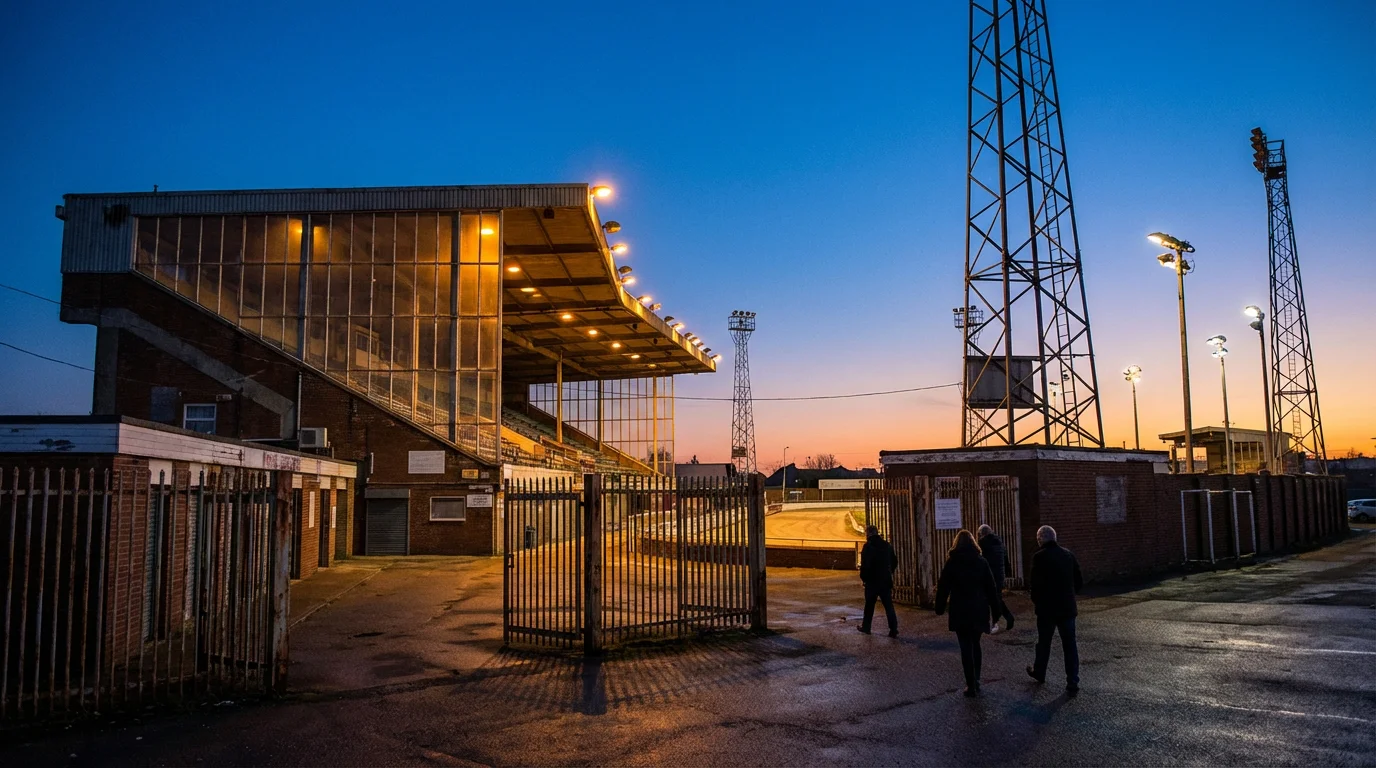
The Track That Nearly Wasn’t
Crayford Stadium was born out of a supermarket deal. In 1984, Ladbrokes sold fifteen of twenty acres at the original Crayford and Bexleyheath Stadium to Sainsbury’s, pocketing the land value and committing to rebuild a brand-new greyhound track on the remaining five. It was a transaction that could easily have ended the sport in south-east London altogether. Instead, it produced a modern, purpose-built venue that would host nearly four decades of racing before the lights went out for good in January 2025.
The replacement stadium opened on 1 September 1986, dropping the Bexleyheath half of the name. The mayor of Bexley and Ladbrokes chairman Cyril Stein did the honours. At the time, the press called it the first new greyhound track built in thirty years — a claim that was not quite accurate, given that Nottingham and Reading had both opened within the previous decade, but the enthusiasm was real. Crayford arrived with an all-sand circuit measuring 334 metres in circumference, race distances of 380, 540, 714 and 874 metres, a Sumner outside hare, a twin-tier glass-fronted grandstand, a restaurant seating 138, two bars, and a sports complex that included a swimming pool and fitness centre. For a sport that had been losing venues since the 1960s, this was a statement of intent.
What made Crayford unusual was its dual identity. It was a working greyhound track — evening meetings on Tuesdays and Sundays, matinees through the week — but it also served as a community facility in a corner of London that sat awkwardly between Bexley and Dartford. The sports hall brought in locals who would never have considered attending a race meeting. The restaurant attracted groups who wanted a night out that did not involve central London prices. For decades, the track was not just a venue for betting. It was a social fixture.
That social role matters when assessing Crayford’s legacy, because it helps explain why the closure hit harder than the cold economics might suggest. Tracks close regularly in British greyhound racing. It has been happening since the post-war peak, when London alone boasted more than thirty stadiums. But Crayford was not just another closure. It was the end of a venue that served a specific community, occupied a specific place in the sport’s geography, and hosted competitions — the Golden Jacket, the Grand National over hurdles — that had real significance in the greyhound calendar. The stadium’s story is a compressed version of the sport’s entire modern history: ambition, reinvention, slow decline, and a final acknowledgment that the numbers no longer worked.
From Bexleyheath to Crayford: 1937–1985
The original stadium opened eight decades before the replacement closed. Greyhound racing began at the Crayford and Bexleyheath Stadium in 1937, part of the wave of track construction that followed the sport’s explosive arrival in Britain during the late 1920s. The first official meeting in the UK had taken place at Belle Vue in Manchester in 1926, and within a decade tracks had sprung up across the country — particularly in working-class areas of London, where dog racing offered cheap entertainment, easy-to-understand betting, and an atmosphere that horse racing could not match for accessibility.
Crayford and Bexleyheath occupied a twenty-acre site in what was then the Borough of Bexley, on the southern fringe of Greater London. Like most tracks of the era, it was built for purpose but without extravagance. The stadium served the local community through the war years and into the golden age of British greyhound racing in the 1940s and 1950s, when national attendance figures regularly exceeded thirty million per year. It was never one of the elite venues — White City, Wembley, and Wimbledon held that status — but it was a reliable fixture in the London circuit, drawing steady crowds from Bexley, Dartford, and the surrounding areas of north Kent.
By the 1970s, the landscape had changed. Television had altered leisure habits. Betting shops, legalised in 1961, meant punters no longer needed to attend a track to place a wager. Attendances declined across the sport, and stadium owners began to look at their land with different eyes. The sites were often in residential areas, close to transport links, and worth far more as development plots than as racing venues. One by one, London’s greyhound stadiums fell. Catford, Park Royal, Harringay, Clapton — the list grew longer each decade.
Crayford’s moment came in 1984 when Ladbrokes, who had acquired the stadium, struck the Sainsbury’s deal. Racing ended on 18 May 1985. For sixteen months, the site was a construction zone. The old stadium vanished; the new one rose on a fraction of the original footprint. It was a transition that saved the racing — technically — but fundamentally changed what Crayford was. The expansive pre-war venue, with its decades of accumulated character, was gone. In its place stood something sleeker, smaller, and entirely dependent on the continued financial commitment of its corporate owner.
The Ladbrokes Era: 1986–2024
The new Crayford opened on five acres, with a restaurant for 138 and more races than ever. Ladbrokes ran it as a professional operation from day one. The compact all-sand track with its outside Sumner hare suited fast, competitive racing, and the stadium quickly found its rhythm: evening meetings on Tuesdays and Sundays, matinees through the working week, a steady supply of runners from trainers based in Kent and the south-east.
The late 1980s and 1990s were productive years. In 1987, the Golden Jacket — a prestigious competition that had been homeless since Harringay’s closure — found a permanent base at Crayford, where it would remain until the stadium’s own demise. The Grand National, run over hurdles, also became a Crayford staple. Dinky Luckhurst trained Breeks Rocket to Grand National glory in 1988. Dynamic Display repeated the feat in 1996 for Barry O’Sullivan. Trainer Ricky Holloway would go on to prepare six Grand National winners at various venues, but Crayford was central to the competition’s identity during this period.
The 2000s brought personnel changes and commercial shifts. Racing manager Paul Lawrence departed in 2000, replaced by Harry Bull, with Danny Rayment eventually taking over the role in 2006. That same year, trainer Lorraine Sams introduced Spiridon Louis to the track — a black-and-white greyhound who would become the 2007 Greyhound of the Year after winning the St Leger, the TV Trophy, and the Regency. It was a reminder that Crayford could still produce moments of genuine quality despite operating at the smaller end of the scale.
Corporate restructuring continued in the background. In 2017, Ladbrokes merged with Gala Coral to form Ladbrokes Coral, later absorbed into Entain. The stadium signed a deal with SIS in 2018 to expand its broadcasting output, adding Tuesday morning and evening meetings, Thursday afternoons, and Friday and Saturday mornings. More racing meant more content for betting shops and online platforms — but it also meant the track needed more dogs, more trainers, and more commitment from an industry that was steadily contracting.
In 2022, Entain signed a long-term media rights deal with the Arena Racing Company, starting in January 2024. By then, cracks were visible. Meetings were being cancelled due to insufficient runners. The ratio of six-dog races — the standard competitive field — had dropped well below the 90 per cent target that made a card commercially viable. The Ladbrokes era had delivered consistent racing for nearly four decades, but the final chapter was already being written.
Key Races and Record-Holders
The Golden Jacket found its permanent home at Crayford in 1987. Originally inaugurated at Harringay in 1975, the competition had drifted between Hall Green and Monmore Green before settling at the south-east London track, where it became one of the most anticipated events on the matinee calendar. Television coverage gave the Golden Jacket a profile that extended beyond the stadium’s regular audience, and for nearly four decades it drew high-quality fields that justified the prestige. With Crayford’s closure in 2025, the competition moved to Monmore Green, where it was staged over 684 metres and won by Mongys Wild in record-breaking fashion — proof that some events can outlive the venues that defined them.
The Grand National over hurdles was Crayford’s other signature race. Hurdle racing occupies a specialist niche within the sport, and Crayford’s track dimensions suited it well. Sherrys Prince holds the record with three Grand National victories between 1970 and 1972, though those wins came at the competition’s earlier homes. At Crayford specifically, Plane Daddy’s 2010 triumph for trainer Gemma Davidson was a standout, extending the track’s association with the event across multiple decades. The race moved to Crayford from Central Park in Sittingbourne in 2022, with Ladbrokes stepping in as sponsor, but the final running took place in 2023 before the stadium’s impending closure made future editions untenable.
In 2015, the track resurrected the Gold Collar — one of greyhound racing’s original classic competitions — along with the Guys and Dolls, which had first arrived at Crayford in 1997. These revivals were part of a broader effort to maintain the stadium’s relevance within the sport’s shrinking calendar of prestige events. Whether that effort succeeded depends on your metric. The competitions drew decent fields and genuine interest. But they could not, on their own, reverse the structural decline that was pulling the venue toward closure.
Lights Out: What Closed the Stadium
Entain cited the numbers, but the decline started years before the announcement. When the company’s UK communications director Simon Clare confirmed the intended closure in November 2024, the language was precise: dwindling support, insufficient trainer interest, fewer competitive race days, lower attendance. Only 18 per cent of races at Crayford that season had been six-dog affairs — a figure so far below the 90 per cent benchmark that the card was effectively uncompetitive on most nights.
The reasons behind those numbers were structural, not sudden. Greyhound racing in Britain has been losing stadiums for decades, and the pattern is consistent: land values rise, attendances fall, corporate owners calculate that the site is worth more redeveloped than racing. Crayford sat in a borough where housing demand was high and regeneration plans were already circulating. The five acres the stadium occupied represented significant development potential — 559 homes were mentioned in early planning discussions — and the commercial logic of continuing to race on that land grew harder to justify with each passing year.
But the immediate cause was simpler. There were not enough dogs. Trainer numbers had dropped, and the remaining kennels could not supply sufficient runners to fill six-dog fields across a full race card multiple nights per week. Without full fields, the racing product deteriorated. Without a competitive product, the broadcasting and betting revenue that sustained the operation diminished. It was a feedback loop with no external force strong enough to break it.
Several parties expressed interest in alternative plans after the closure announcement. Entain reviewed their proposals. None were deemed viable. The final meeting took place on the evening of 19 January 2025, and the stadium fell silent. Romford, Hove, and Monmore — Entain’s remaining tracks — were declared safe. The trainers were offered transition support. The dogs were allocated to rehoming programmes or transferred to other tracks.
Crayford’s closure was not a surprise. It was the logical conclusion of forces that have been reshaping British greyhound racing for half a century. The stadium was built because a supermarket needed land. It closed because the sport could no longer fill it. Between those two transactions lies the story of a place that gave south-east London nearly forty years of racing, a handful of genuine sporting moments, and a community venue that outlived the community’s willingness to sustain it.