Greyhound Tricast Bets: How to Predict the First Three Home
 Available in US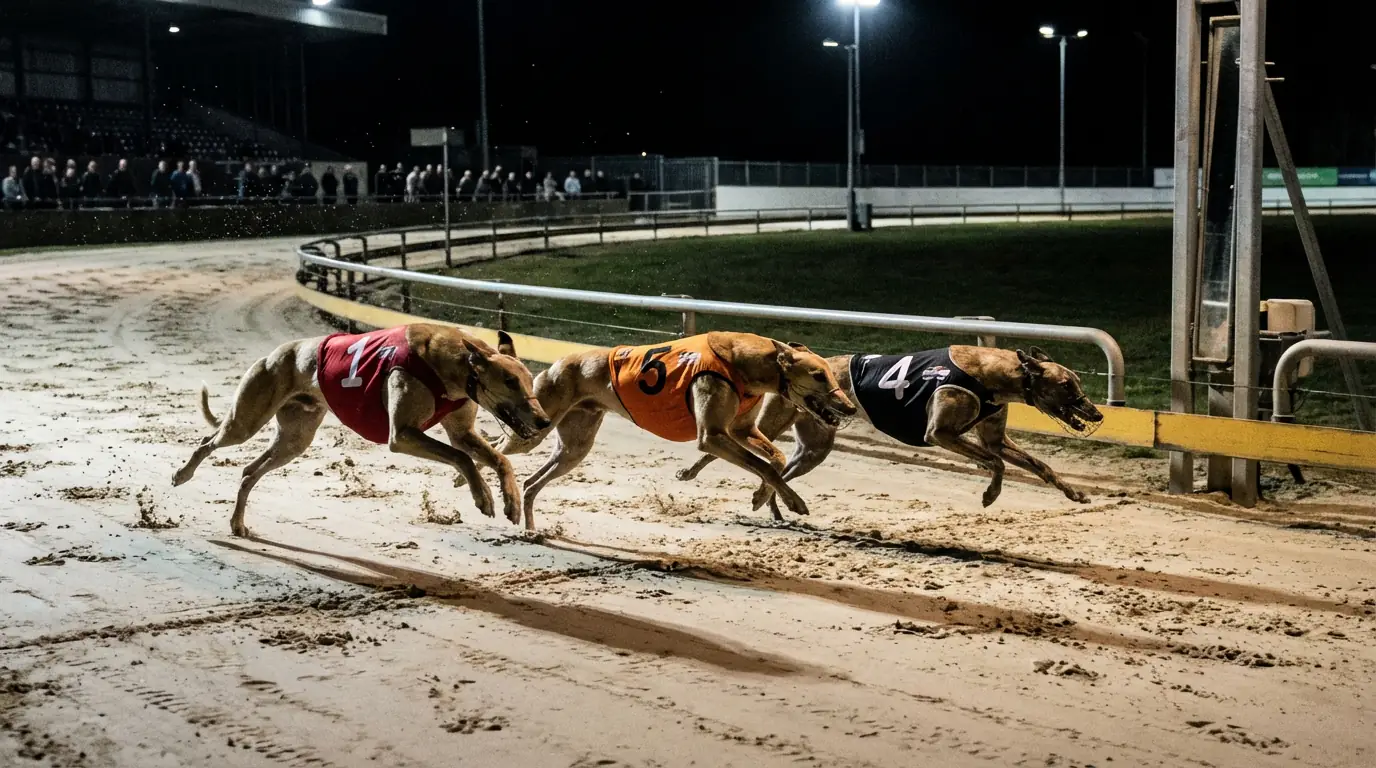
Three Dogs, in Order — the Biggest Regular Payout
Most greyhound bet types ask you to identify one thing: a winner, or maybe a pair of finishers. The tricast asks for something considerably more ambitious. You need to name the first three dogs home — and in a straight tricast, you need to name them in the correct order. Get it right, and the dividends dwarf anything a win or forecast bet will produce on the same race. Get it wrong, and your stake is gone in roughly thirty seconds.
That risk-reward profile is what makes tricast betting attractive to a certain kind of punter. Not the casual once-a-week visitor who backs trap four because the name sounds lucky, but the form student who watches replays, tracks sectional times, and builds a mental model of how a race will unfold from the first bend to the finish. Tricasts reward that level of engagement. They punish guesswork.
In UK greyhound racing, the tricast is available on virtually every six-dog race run under GBGB rules. It operates as a pool bet through the Tote, or as a fixed-odds wager with bookmakers — and those two mechanisms produce very different returns, which we will get into shortly. What matters first is the structure: three selections, three finishing positions, and a payout that reflects the difficulty of calling all three correctly.
The appeal is not complicated. A standard win bet on a 4/1 shot returns five times your stake. A tricast on the same race might return fifty, eighty, or even several hundred times your unit, depending on the prices of the dogs involved. The catch is obvious — your strike rate drops significantly when you need three things to happen instead of one. But for punters who approach it with discipline rather than optimism, the tricast is one of the most rewarding structures in the greyhound betting toolkit.
This guide covers both forms of the tricast — straight and combination — along with the maths behind each, and the situations where tricast betting is a rational choice rather than an expensive lottery ticket.
Find more bet type guides at crayforddogsresults.
Straight Tricast Explained
A straight tricast is the purest form of the bet: you select which dog finishes first, which finishes second, and which finishes third. All three must land in exactly the positions you nominated. There is no margin for error — if your first and second picks swap places but the third is correct, you lose.
The mechanics are straightforward. On a Tote pool tricast, your stake goes into a shared pool with every other tricast bet placed on that race. The pool is divided among winning tickets after the operator’s deduction, which typically sits around 22-26% on greyhound tricasts. That deduction is higher than the Tote takes on simpler bets, which reflects the larger individual payouts.
With a bookmaker, the tricast dividend is usually declared after the race based on a computer straight tricast calculation. This is essentially a formula applied to the starting prices of the three placed dogs. The payout is fixed once declared and does not depend on how many other punters backed the same combination. In practice, the computer tricast and the Tote pool dividend can differ substantially on the same race — sometimes by a factor of two or more — so checking both is worth the few seconds it takes.
Consider a six-dog field where you fancy Trap 2 to win, Trap 5 to run second, and Trap 1 to finish third. With a straight tricast, your single unit stake covers precisely that sequence: 2-5-1. If the finishing order is 2-1-5 instead, you collect nothing, despite correctly identifying all three dogs. That rigidity is what generates the big payouts. In a six-dog race, there are 120 possible permutations of the first three finishing positions — so a straight tricast effectively asks you to identify one outcome out of 120.
Typical straight tricast dividends on UK greyhound racing range from around 20/1 when three shorter-priced dogs fill the places, to several hundred to one when the result involves a longer-priced runner. Dividends exceeding 500/1 are uncommon but not unheard of, particularly at meetings with less-formed dogs or after disrupted races where early pace predictions failed.
The key discipline with straight tricasts is selectivity. Because the strike rate is inherently low, the bet only makes sense when your race-reading gives you genuine conviction about the running order — not just the likely winner. That means paying attention to early pace, trap draw, and how each dog tends to run its race through the bends. A strong closer from an outside trap, for instance, might be a viable third selection behind two dogs that are known front-runners from inside draws.
Combination Tricast: Costs and Coverage
If the straight tricast demands precision, the combination tricast offers a structured concession to uncertainty. You still select three dogs, but instead of nominating exact finishing positions, you cover every possible ordering of those three. If all three finish in the top three — in any sequence — you collect.
The cost is predictable. Three dogs can be arranged in 3 x 2 x 1 = 6 different orders. A combination tricast is therefore six straight tricasts bundled together. A 1 pound combination tricast costs 6 pounds. A 50p unit costs 3 pounds. The maths is rigid and the bookmaker handles the permutations automatically — you are not manually writing out six separate bets.
Where this gets more interesting is when you expand beyond three selections. Most bookmakers and the Tote allow you to select four, five, or even all six dogs in a combination tricast. The number of permutations scales rapidly. With four selections, you are covering 4 x 3 x 2 = 24 combinations. With five, it is 60. With all six dogs, 120. Your unit stake multiplies accordingly.
Here is a practical example. You have studied the racecard for a midweek meeting at Romford. Three dogs stand out: Trap 1 has been posting strong sectional times over the distance, Trap 3 has dropped a grade and looks well drawn, and Trap 6 is an experienced stayer with a habit of closing late. You think all three will fill the frame, but the running order is impossible to call with confidence. A 1 pound combination tricast on 1-3-6 costs 6 pounds and covers every possible arrangement: 1-3-6, 1-6-3, 3-1-6, 3-6-1, 6-1-3, and 6-3-1.
The dividend you receive will correspond to whichever permutation actually occurred. If the finishing order is 6-1-3 and the declared tricast for that sequence pays 85 pounds, your return is 85 pounds from a 6 pound outlay. The other five losing permutations within your combination are simply absorbed into the total cost.
The obvious trade-off is dilution. Your returns per pound staked are always lower on a combination tricast than on the equivalent straight tricast — by definition, since you are placing six bets instead of one. A punter who correctly identified 6-1-3 as the exact order and placed a straight tricast at 1 pound would have collected the same 85 pounds for a sixth of the cost. But the combination tricast’s value lies in acknowledging what you do not know. If your form analysis tells you which three dogs will be competitive but not how they will sort themselves out, the combination is the honest bet. It is also, crucially, the bet that still pays you.
The trap that catches some punters is escalating their selections without adjusting the stake. A four-dog combination tricast at 1 pound per unit costs 24 pounds. At five dogs, 60 pounds. These are serious outlays for a single race, and the dividends need to be substantial to justify the investment. As a rule of thumb, sticking to three or four selections keeps the combination tricast in rational territory. Beyond that, the maths starts working against you — you are covering so many permutations that the cost approaches the expected payout, especially in races with shorter-priced dogs.
When Tricast Betting Makes Sense
The tricast is not a default bet. It is a situational weapon, and applying it to the wrong race is a reliable way to drain a bankroll. Knowing when the tricast offers genuine value — rather than just the illusion of a big number on a betting slip — requires an honest assessment of how much you actually know about the race in front of you.
The strongest tricast opportunities share a few characteristics. First, a competitive but not chaotic field. Races where one dog is a prohibitive favourite and the rest are essentially fighting for minor places tend to produce low tricast dividends — you are taking on considerable difficulty for an unexciting reward. Equally, completely open races where any of the six dogs could fill any position are poor tricast territory because your three selections have no meaningful edge over the dogs you left out. The sweet spot is a race where you can confidently separate three or four contenders from the rest of the field based on form, draw, and distance suitability.
Second, look for races where the likely pace scenario narrows the possibilities. If you can identify a probable leader from an inside draw, a challenger with strong mid-race sectionals, and a closer who tends to pick off tiring dogs on the run-in, you have a structural thesis for the first three — not just three names picked off a racecard. This kind of race-reading is what separates tricast punting from random selection.
Third, the dividends need to justify the outlay. On a race where the three shortest-priced dogs dominate the market, the tricast payout — particularly via the computer tricast — can be disappointingly modest. A 30/1 return on a 6 pound combination is a net profit of 24 pounds. Acceptable, but not transformative. Tricasts become genuinely worthwhile when at least one of your three selections is a bigger price, pushing the dividend into triple figures per unit.
There is also a tactical consideration around pool size. Tote tricast pools at smaller midweek meetings can be thin, which creates volatility — both upside and downside. A poorly-attended meeting might have a tiny tricast pool, meaning a winning ticket collects a disproportionately large share. Conversely, a heavily-bet Saturday night fixture will have deeper pools and more predictable dividends.
The punters who make tricasts work over time tend to share one trait: they are selective. They might place two or three combination tricasts across an entire meeting of twelve races, rather than backing a tricast in every event. That selectivity is the difference between a tricast strategy and a tricast habit. The first is a betting tool deployed with purpose. The second is a subscription to losing slowly.
Tricast Is Precision at a Premium
Every bet type in greyhound racing sits somewhere on a spectrum between simplicity and ambition. The win bet is at one end — one dog, one question, one answer. The tricast occupies the far end, asking you to construct a three-part prediction about how a thirty-second race will unfold. That level of specificity is precisely what generates the payouts that make tricast betting worthwhile, and precisely what makes it unsuitable as a casual wager.
The straight tricast is the sharpest tool in the box. It rewards conviction and punishes anything less. If you have watched replays, studied the draw, and built a clear picture of who leads, who challenges, and who runs on for third, the straight tricast puts your analysis to the most demanding test available. The payoffs reflect that difficulty. But so does the strike rate — and any punter who expects to land straight tricasts regularly is either exceptionally skilled or not tracking their results honestly.
The combination tricast is the pragmatist’s version. It accepts that correctly identifying three dogs is hard enough without also calling the exact order. The cost is higher per race, but the probability of collection rises six-fold compared to the straight version. For most punters — including experienced ones — the combination tricast represents a better balance between ambition and reality.
What ties both formats together is the underlying requirement: you need to know a race well enough to narrow the first three positions to a small group of dogs. That means doing the work before the race, not during it. Studying sectional times, understanding each dog’s running style, assessing how the draw interacts with the track geometry, and factoring in grade changes or recent absences. None of that guarantees a winning tricast. But it does guarantee that when you place one, you are betting on analysis rather than hope.
Also read our greyhound forecast bets.
The tricast will never be a volume bet. Its natural frequency is a handful of races per meeting at most — the ones where your preparation produces genuine clarity about the likely first three home. Treated as a precision instrument rather than a scattergun, it remains one of greyhound racing’s most satisfying wagers. The dividends, when they arrive, tend to remind you why you spent the time studying the card in the first place.
