
How to Read Greyhound Racecards: A Form Guide for Bettors
 Available in US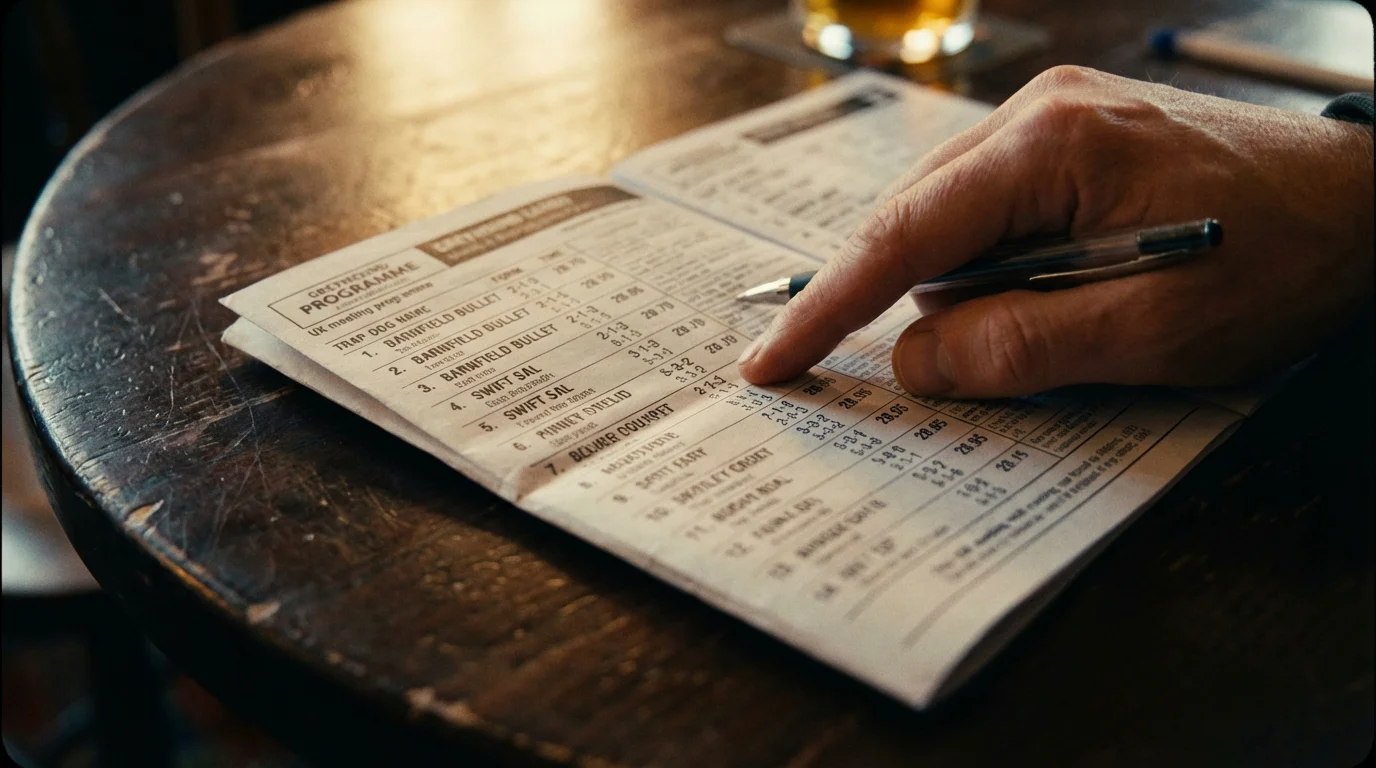
The Racecard Is Your Edge — If You Know How to Read It
Most casual punters pick a name or a number — you can do better. Walk into any greyhound stadium in Britain, or pull up a racecard on your phone before the first bend, and you are looking at one of the most information-dense documents in sports betting. Six dogs, roughly a dozen columns of data per runner, and every piece of it placed there because somebody, at some point, decided it mattered enough to record. The racecard is the closest thing greyhound racing has to a scouting report, and the punters who learn to read it properly have a structural advantage over those who treat it as wallpaper behind a list of names.
This guide is built for UK greyhound racing specifically. The format of British racecards — governed by the Greyhound Board of Great Britain and published across platforms like the Racing Post, Sporting Life, and Timeform — follows a standardised structure, though different sources may present the data with slight cosmetic variations. The underlying information is the same: trap, form, identity, breeding, times, weight, trainer, and a set of abbreviated comment codes that tell you what actually happened during each previous run. If you have ever looked at a form string like “342651” and wondered what to make of it, or seen “Crd” next to a result and had no idea what the dog experienced, this is where those gaps get filled.
We will work through the racecard column by column, explain what each data point reveals and — just as importantly — what it conceals. Form figures are the headline, but they only tell you where a dog finished, not why. Run descriptions add context. Sectional times add depth. And when you layer all three together, you start to see patterns that the casual bettor misses entirely: the dog that finished fourth but was bumped at the second bend; the one that won by six lengths but only because the leader fell; the steady performer whose closing sectional time has improved by half a length over three starts.
None of this guarantees winners. Greyhound racing involves six live animals running at forty miles per hour around tight bends, and the margin between a clean run and a collision is measured in inches. But the racecard gives you the best available framework for making informed decisions, and informed decisions compound over time.
By the end of this guide, you should be able to pick up any standard UK greyhound racecard and extract actionable insight from every column. Whether you are betting on Saturday night at Romford or studying a midweek card from Monmore Green, the principles are identical. The data speaks the same language at every track.
Get more form guides at crayforddogsresults.
Anatomy of a UK Greyhound Racecard
Every column earns its space on the card. A standard UK greyhound racecard packs a remarkable amount of information into a compact layout, and once you understand the structure, you can scan it in seconds rather than minutes. The core elements are consistent across all GBGB-licensed tracks: trap, form, identity, breeding, times, weight, trainer, and a set of comment codes. Different platforms may add editorial extras — star ratings, tipster picks — but the base data is factual, and that is where your analysis starts.
Trap Number and Jacket Colour
The first column is always the trap number: 1 through 6 in a standard race, sometimes extending to 8 in open or special events. Each trap number corresponds to a fixed jacket colour — trap 1 is red, trap 2 is blue, trap 3 is white, trap 4 is black, trap 5 is orange, and trap 6 is black and white stripes, as specified in GBGB Rule 118. This is not decorative. The trap number determines where the dog starts, which in turn determines its racing line through the first bend.
Inside traps (1 and 2) hug the rail. Outside traps (5 and 6) have more ground to cover but fewer dogs cutting across their path. Middle traps (3 and 4) are often the most vulnerable to crowding, because dogs from both sides converge on the same racing line. The significance of the trap draw varies by track — some circuits favour inside runners because the first bend is tight, while others give outside dogs a cleaner run because the bends are wider. But the trap number is always your first piece of positional intelligence.
If a dog has been reassigned from its usual trap — perhaps drawn wide when it normally runs from the inside — that information alone can shift your assessment. A dog with strong rail form drawn in trap 6 faces a fundamentally different race than one drawn in trap 1.
Name, Sex, Colour, Breeding
The identity block on the racecard gives you more than a name. You will typically see the dog’s name, followed by its sex (d for dog, b for bitch), colour (bk for black, wbd for white and brindle, and so on), and its sire and dam. On some cards, you also get the age and the date of birth.
The sex distinction is not trivial. Dogs and bitches race separately in most graded races at GBGB tracks, but when they meet in open races or mixed-sex events, the physical differences matter. Dogs tend to be heavier and marginally quicker over sprint distances. Bitches can be more agile through bends. Neither generalisation is absolute, but knowing the sex helps you calibrate expectations against the rest of the field.
Breeding information is less immediately useful for casual analysis but becomes relevant if you follow the sport closely. Certain sires produce consistent speed types — offspring that favour short, sharp sprints — while others breed stamina dogs that run stronger over 550 metres and beyond. If you are betting on a maiden with limited form, the sire line can offer a rough indication of running style before the race record fills in.
Colour is recorded for identification purposes and has no bearing on performance, despite persistent folk wisdom to the contrary.
Form Figures Decoded
The form column is the heartbeat of the racecard. It displays the dog’s finishing positions in its most recent races, read from left to right in chronological order (oldest first, most recent last). A form string of “132641” tells you the dog finished first, then third, then second, then sixth, then fourth, then first again over its last six runs.
At first glance, this looks straightforward. Lower numbers are better. But form figures without context are dangerously misleading. A “1” could mean the dog won a weak A8 race by a short head after every other runner encountered trouble. A “6” could mean the dog was bumped at the first bend in a competitive A2 event and never recovered. The number tells you position; the run description and the grade tell you quality.
Look for patterns rather than isolated results. A form string of “111111” is obviously impressive, but a string of “233221” might belong to a dog that is consistently competitive at a higher grade — and potentially better value when it drops down a class. Conversely, a string that starts with low numbers and ends with high ones (“112345”) suggests declining form, which could reflect injury, age, or a step up in grade that the dog cannot handle.
The letter “T” in a form string indicates a trial run, not a competitive race. You will also see “M” for a moved race, and occasionally a dash or an asterisk to indicate a break in racing. These are not finishes — they are gaps in the sequence, and understanding why the gap exists (rest, injury, change of trainer) can be as informative as the finishes themselves.
One critical point: form figures on UK racecards typically cover the dog’s last six runs, though some platforms show more. If a dog has only run twice, you will see just two figures. A short form string is not necessarily a red flag — the dog might be a maiden with limited experience, or it might have recently moved from another track where its previous form is not displayed inline. In those cases, dig into the full race history if the platform allows it.
Best Time, Last Time, and Why Both Matter
Best time tells you ceiling. Last time tells you current form. Both appear on the racecard, and the relationship between them is one of the most useful — and most overlooked — analytical tools available to greyhound bettors.
The best time column shows the fastest time a dog has recorded over the race distance at the specific track. This is distance-specific and track-specific, which means a dog’s best time at Romford over 400 metres tells you nothing about its ability over 480 metres at Monmore Green. The surfaces differ, the bend radii differ, the running lines differ. Best time is a benchmark within a controlled context, not a universal speed rating.
What best time does reveal is potential. If a dog’s best time over 480 metres at a particular track is 29.14 seconds, you know that under the right conditions — clean run, firm going, no crowding — it is capable of that level of performance. Whether it will reproduce that time on any given night is a different question. But the ceiling establishes a frame of reference. If the dog has been running 29.50 to 29.70 in its last few outings, you know there is a performance gap, and the next question becomes why: is it a loss of form, a tougher grade, interference, or simply a slower pace on the night?
Last time is the clock from the dog’s most recent run, and it carries different weight depending on context. A last time of 29.60 at the same track and distance tells you how the dog is running right now. If that represents a steady improvement from 29.80 two runs ago and 29.72 the run before, the trajectory is positive regardless of whether it matches the best time. Conversely, if the last time is significantly slower than recent efforts, something has changed — and the racecard alone may not tell you what.
The interaction between best time and last time becomes particularly useful when comparing dogs within the same race. Suppose two runners in a six-dog field have identical last times of 29.45. One of them has a best time of 29.10; the other, 29.42. The first dog is running well below its peak. The second is running close to its ceiling. Which one has more room for improvement? Which one is more likely to find another gear if the pace is fast? These are the questions that separate mechanical form reading from genuine analysis.
There is a trap here, though. Best time can be a historical artefact. A dog might have posted its best time eighteen months ago, before an injury, a change of kennel, or simply the natural ageing process. The older the best time, the less reliably it predicts future performance. Some racecards show when the best time was recorded; if yours does not, checking the full race history is worthwhile, especially for dogs over three years old.
Run Descriptions and Comment Codes
Those two-letter codes after each result tell the story of the race. A finishing position of “4” tells you where the dog ended up; the run description tells you what happened between the traps opening and the line. Without this layer of context, form figures are just a sequence of numbers. With it, they become a narrative.
UK greyhound racecards use a standardised set of abbreviation codes to describe how each run unfolded. These vary slightly in presentation between providers, but the core vocabulary is universal. Here are the codes you will encounter most frequently and what they actually mean in practice.
“EP” stands for early pace. A dog marked EP showed speed from the traps and was prominent in the early stages of the race. This is significant for trap draw analysis — a dog with consistent EP from an inside trap is likely to secure the rail, while an EP dog drawn wide might cut across the field and cause crowding. If you see a dog that routinely shows EP but has not shown it in recent runs, something may have changed: a slower break, an injury, or fatigue.
“SnLd” means soon led — the dog took the lead shortly after the traps opened. Related to EP but more specific, it tells you the dog was not just quick away but actually in front. “Led” or “ALd” (always led) is the strongest version: the dog led from start to finish. Front-runners are important in greyhound racing because the inside rail is the shortest route, and the dog that reaches the first bend in front usually gets to choose its racing line.
“Crd” is crowded. This is one of the most important codes for form assessment. A dog that finished fourth but was crowded at the second bend had its race compromised by other runners. Its finishing position does not reflect its true ability on that occasion. Punters who ignore “Crd” routinely underestimate dogs whose form figures look worse than their actual performances. The same logic applies to “Bmp” (bumped) — a physical contact during the race that disrupted the dog’s stride or line.
“RnOn” (ran on) indicates a dog that finished strongly, closing the gap on the leaders in the final stages. This is a hallmark of a dog with a good closing sectional time — one that runs faster over the second half of the race than the first. A dog that consistently runs on but finishes third or fourth might be suffering from poor early pace or a bad draw, and could be a value play when conditions change in its favour.
“SAw” means slow away — the dog was sluggish out of the traps. In a sport where the first two seconds can determine the first bend position, a slow start is a major handicap. Occasional slow starts happen to every dog. Persistent slow starts suggest either a temperamental issue or a physical problem. “MsdBrk” (missed break) is more severe — the dog lost significant ground at the start and spent the race chasing. If a dog missed the break and still finished in the top three, its raw ability may be higher than the form suggests.
“Wide” or “Wd” indicates the dog raced wide on the bends, covering more ground than those on the rail. This adds distance and costs time. A dog that raced wide and still finished within a length of the winner has run a stronger race than the bare result implies.
Less common but still significant: “Fell” (the dog fell during the race), “Ret” (retired — pulled up or did not finish), “Dis” (disqualified), and “Vd” (veered, changed direction sharply). Each of these represents a race that should be treated cautiously when assessing form. A fall does not mean the dog is slow; it means the run is void as a performance indicator.
The key discipline when reading run descriptions is to look for excuses and explanations, not just results. A dog with a form string of “465” looks ordinary until you discover it was crowded in the “4” run, bumped and wide in the “6” run, and ran on strongly to finish fifth in a race where the leaders set a blistering early pace. That is not a dog in poor form. That is a dog whose numbers have been suppressed by circumstance.
Sectional Times: The Serious Punter’s Tool
Two dogs can post the same overall time and run completely different races. One breaks fast, leads into the first bend, and fades in the home straight. The other starts slowly, gets crowded at the second bend, and closes with ferocious late pace to finish alongside the leader on the line. Their finishing times are identical. Their racing profiles could not be more different. Sectional times are the tool that exposes this distinction, and they are the single most underused data point available to greyhound bettors.
A sectional time splits the race into segments — typically a time to the first bend (or first split) and a time from there to the finish (the run-in or closing split). Some tracks and data providers break the race into three or even four sections, but the most common format in UK greyhound racing is two: early pace and closing pace. Together, they tell you not just how fast a dog ran, but how it distributed its effort across the race.
The first split — the time from the traps to the first timing point, usually around the first bend — measures raw early speed. Dogs that post fast first splits are the ones showing EP or SnLd on the racecard. They break sharply, reach the bend in front, and control the race from the front. In sprints over 260 or 270 metres, a fast first split is almost everything, because the race is effectively over by the second bend. Over longer distances, a fast first split matters less if the dog cannot sustain its pace through the closing stages.
The closing split measures what happens after the field has settled. This is where you find dogs that the bare form figures undervalue. A dog with a mediocre overall time but a fast closing sectional is one that encountered trouble early — crowding, a slow break, a wide run — and then made up ground through superior stamina or acceleration in the final stretch. These are the dogs that produce value bets, because the market typically prices them on overall time or finishing position rather than the quality of their finish.
Consider a practical example. Two dogs in the same 480-metre race post overall times of 29.50 seconds. Dog A ran a first split of 4.10 and a closing split of 25.40. Dog B ran 4.45 and 25.05. Dog A was fast away and faded. Dog B was slow away and finished like a train. If both dogs are drawn in the same race next time out, and Dog B gets a clean break, its closing speed suggests it has more in reserve. The overall time was identical, but the race shape was not.
Not all racecard providers display sectional times prominently. Timeform is one of the more reliable sources for sectional data in UK greyhound racing, and the Racing Post includes split times in its detailed form view. If your preferred platform does not show sectionals, it is worth cross-referencing with one that does, particularly for races where you are considering a significant stake. The data exists; the question is whether you take the time to find it.
Sectional analysis also interacts with trap draw. A dog with a fast closing split drawn in trap 1 might struggle to use its finishing speed if it gets boxed in on the rail. The same dog drawn in trap 5 or 6 might have a wider run but more room to accelerate in the home straight. The sectional profile does not exist in isolation — it has to be read alongside the trap draw, the likely pace of the race, and the running styles of the other dogs in the field.
One more dimension worth noting: track-specific sectional benchmarks. A first split of 4.20 at one track might be fast; at another, it might be average, because the distance from the traps to the first bend varies. Do not compare sectional times across different tracks without adjusting for track geometry. The value of sectionals is in comparing dogs at the same track, over the same distance, under similar conditions. And since the majority of the market still prices dogs on finishing position and overall time rather than closing splits, the punter who uses sectional data is working with a richer model. The market is not always wrong — but it is often incomplete, and sectionals are one of the clearest ways to exploit that incompleteness.
Putting It Together: A Sample Racecard Walkthrough
Let’s read a real racecard from top to bottom. Theory is useful, but the skill only develops when you apply it to an actual card and force yourself to interpret every column before settling on a view. What follows is a walkthrough of a hypothetical but realistic six-dog race at a standard UK track, using the kind of data you would find on any published racecard.
The race is a graded A4 contest over 480 metres. Six dogs, six traps, and roughly ninety seconds of action once the hare passes the boxes. Your job is to assess each runner and arrive at a shortlist — not a certainty, but a ranking of probability that you can then compare against the odds to determine whether any selection offers value.
Start with the trap draw. Look at each dog’s form and note whether it typically shows early pace. Trap 1 has a dog with recent form of “211312” and run descriptions showing EP or SnLd in four of its last six runs. This is a confirmed front-runner drawn on the rail — the best possible combination. It will likely lead into the first bend and set the pace. In a race where no other dog shows similar early speed, this runner has a significant positional advantage.
Trap 3 has a dog with form reading “443325” — nothing spectacular on the surface. But the run descriptions reveal “Crd” in the “4” run, “Bmp” followed by “RnOn” in the second “4” run, and “SAw” in the “3” that follows. Three of its six runs were compromised by external factors. Its two best finishes (“2” and “5”) came when it had a clean run. The closing sectional in those races was among the fastest in the field. This dog is better than its form string suggests, and the market might not have noticed.
Trap 5 shows “111211” — outstanding form. Best time is two lengths quicker than anything else in the race. This is clearly the class act of the field, and the odds will reflect it: probably favourite at 6/4 or shorter. The question is not whether this dog is the best — it almost certainly is — but whether the price compensates for the risk. Drawn in trap 5, it will need a clean run through the first bend, and if the trap 1 dog leads, it might have to race wide. A “1” at short odds from a wide draw is not guaranteed money. It is a likely outcome at a thin price.
Weight changes and trainer form add the final layers. If a dog has gained a full kilogram since its last run, it may have had a rest period — not necessarily negative, but it introduces uncertainty. And if the trap 3 dog with those strong closing sectionals is trained by a handler who has had four winners from the last twelve runners at this track, that pattern supports the idea that the dog is fit and well-prepared despite its modest form figures. Conversely, if the trap 5 favourite comes from a kennel on a cold streak, class alone might not be enough.
After this walkthrough, your shortlist might include the trap 1 front-runner as the most likely leader, the trap 3 closer as the value play, and the trap 5 favourite as the class act that the market has already priced in. You have not picked a winner — you have built a hierarchy of probability, and you can now compare that hierarchy against the available odds. If the trap 3 dog is 8/1 and you believe its true chance is closer to 4/1, that is a value bet regardless of whether it wins tonight.
The Card Tells You What Happened — Your Job Is to Decide What Happens Next
Every racecard is a test of interpretation, not memory. The data it contains is historical — it records what has already occurred. Your task as a bettor is to take that backward-looking information and project it forward into a race that has not yet been run, under conditions that may differ from anything in the form book. That is a fundamentally uncertain exercise, and anyone who claims otherwise is selling something.
But uncertainty is not randomness. Greyhound racing is more predictable than a coin flip and less predictable than a chess endgame. The racecard sits in that middle ground as the best available tool for assessing relative probability. A dog that has run fast times, shown early pace from favourable draws, and finished strongly when given a clean run is more likely to perform well than one whose form shows declining times, persistent crowding from poor draws, and a trainer on a losing streak. Neither outcome is guaranteed, but the probabilities are not equal, and the racecard is what allows you to quantify the difference.
The most common mistake among intermediate punters — those who have moved past picking names but have not yet developed a systematic approach — is to anchor on a single data point. They fixate on best time, or they fall in love with a dog that ran on strongly once. Effective racecard reading is holistic. It asks you to weigh the trap draw against the running style, the running style against the likely pace of the race, the pace against the sectional profiles of every runner, and all of that against the trainer form and the weight record. No single column gives you the answer. The answer emerges from the interaction between columns.
It is also worth acknowledging what the racecard cannot tell you. It cannot tell you that a dog is feeling stiff today, or that rain in the last hour has changed the going. These are variables that exist outside the data, and they introduce irreducible uncertainty into every race. But if greyhound racing were perfectly predictable from the racecard, the favourites would always win and there would be no profit for anyone. The fact that the racecard provides strong but imperfect information is precisely what creates opportunities for punters who read it more carefully than the market does.
Also read our greyhound racecard explained.
The racecard does not owe you winners. But it offers clarity, and in a sport where most money is wagered on instinct and impulse, clarity is a genuine edge. The card tells you what happened. What happens next is your call.
