
History of Greyhound Racing in Britain: 1926 to Present
 Available in US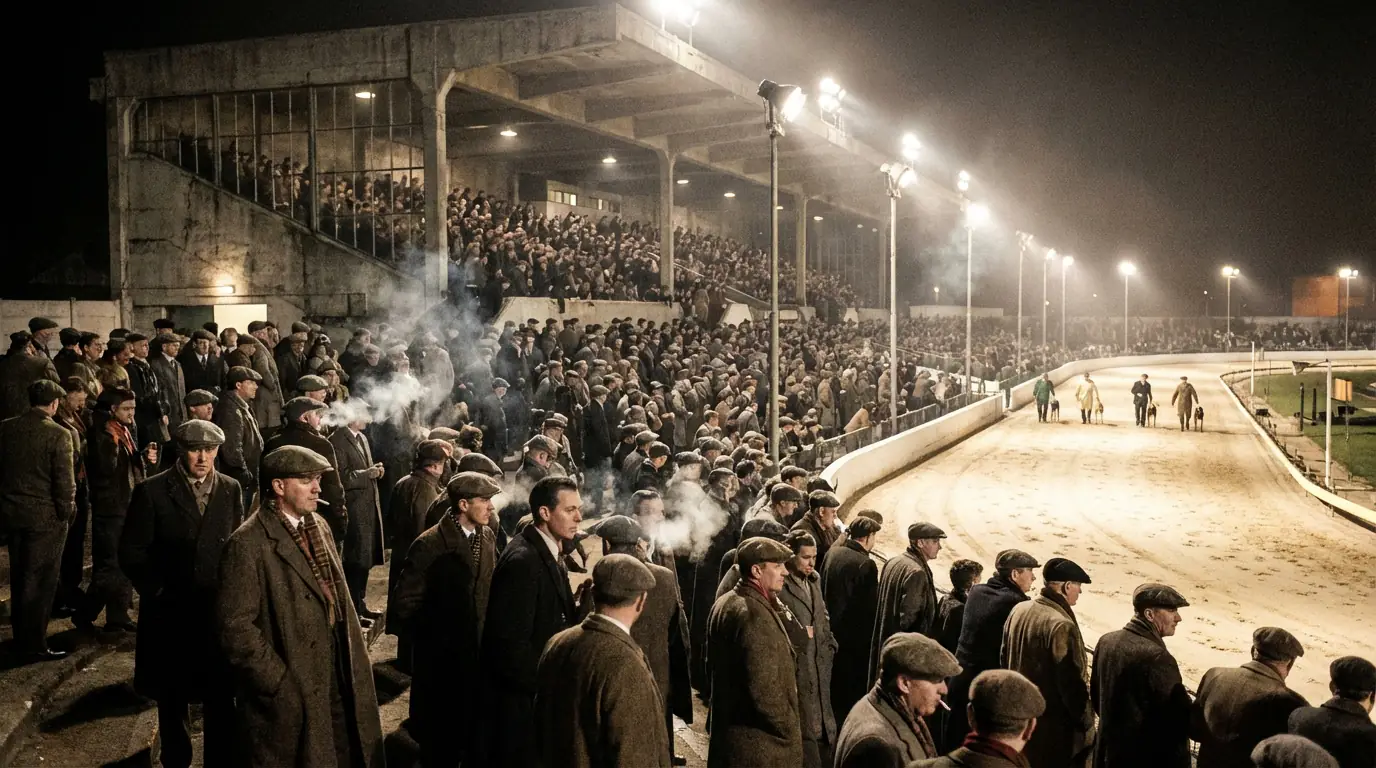
A Sport Born in the Betting Shops
Greyhound racing arrived in Britain not as a sporting innovation but as a commercial proposition. The first official meeting took place at Belle Vue Stadium in Manchester on 24 July 1926, organised by American businessman Charles Munn and Brigadier-General Alfred Critchley, who had formed the Greyhound Racing Association using the mechanical hare system developed in the United States by Owen Patrick Smith. The concept was straightforward: dogs chase an artificial lure around an oval track, spectators watch and wager. Within months, it was clear that the British public had an appetite for it. The sport combined the excitement of animal racing with the accessibility of a local evening out — no countryside estate required, no afternoon off work, just a stadium in the suburbs and a few shillings to bet.
The speed of its growth was remarkable. Within two years of that first Manchester meeting, tracks had opened across London and the major cities. By the end of the 1920s, dozens of venues were operating, and the sport was drawing crowds that rivalled football in some industrial towns. The appeal was partly the racing itself and partly the betting — greyhound tracks offered a regulated, legal environment for gambling at a time when off-course betting on horses was still technically illegal. The dog track became the working man’s casino, and the turnstiles clicked accordingly.
That commercial DNA has defined greyhound racing ever since. It has always been a sport sustained by betting revenue, and its fortunes have risen and fallen with the gambling market. Understanding that history is not antiquarian nostalgia — it is context for the sport as it exists today, a much-diminished but still functioning part of British sporting culture.
Learn more about the sport at crayforddogsresults.
The Golden Era: 1920s to 1960s
The interwar period was the first golden age. By the mid-1930s, Britain had more than seventy licensed greyhound tracks, with attendance figures that now seem almost unbelievable. In 1946, the year after the war ended, total attendance at British greyhound meetings was estimated at around 70 million — more than football, more than horse racing, more than any other spectator sport in the country. The dog track was where Britain went on a Wednesday evening, and the betting windows handled a volume of money that funded stadiums, trainers, breeders, and an entire parallel economy.
The stadiums became social institutions. White City in London, which had been built for the 1908 Summer Olympics and was repurposed for greyhound racing in 1927, could hold 93,000 spectators and hosted the Greyhound Derby from 1927 onwards. Wembley Stadium staged greyhound racing alongside its other events. Wimbledon, Belle Vue, Hall Green, Catford, Harringay — each city had its track, and each track had its community of regulars, its local heroes, and its rituals. The dogs were celebrities. Mick the Miller, who won the Greyhound Derby in 1929 and 1930, became a national figure, appearing in a feature film and attracting crowds that would be extraordinary for any sport today.
The post-war boom continued into the 1950s, though the peak had already passed. Television was arriving in British homes, offering entertainment that did not require leaving the house. The 1960 Betting and Gaming Act legalised off-course betting shops, which meant punters could bet on horse racing without going to the course. Greyhound tracks, which had thrived partly because they were the most accessible legal betting venue, suddenly faced competition from every high-street bookmaker. The structural advantage evaporated, and attendance began a decline that has never reversed.
The quality of racing during this period was exceptional. The Greyhound Derby, the St Leger, the Cesarewitch, the Scurry Gold Cup — these events drew the best dogs from across Britain and Ireland, and the competition was fierce. Trainers like Paddy Keane, Leslie Reynolds, and Phil Rees became legends of the sport, their names attached to generations of champions. The infrastructure — purpose-built stadiums, professional training operations, regulated breeding programmes — reflected a sport at the height of its cultural and commercial power.
Decline and Closures: 1970s to 2010s
The story of British greyhound racing from the 1970s onwards is a story of contraction. Tracks closed, attendance fell, and the sport retreated from the mainstream of British cultural life. The reasons were multiple and cumulative: the rise of television, the competition from betting shops, changing social habits, the increasing value of urban land, and a slow erosion of the working-class leisure culture that had sustained the sport for decades.
The closures accelerated in the 1980s and 1990s. White City, the most famous greyhound stadium in the world, closed in 1984 and was demolished to make way for the BBC White City development. Hackney Wick, Catford, Harringay, Park Royal — London lost track after track, each closure driven by the same equation: the land beneath the stadium was worth more as housing or commercial space than the racing revenue could justify. Developers made offers that stadium owners could not refuse, and the bulldozers followed.
The pattern repeated across the country. Bristol, Coventry, Reading, Oxford — cities that had supported greyhound racing for fifty years or more lost their tracks. By the turn of the millennium, the number of licensed tracks had fallen below forty, and the trend showed no sign of reversing. Each closure displaced a community of punters, trainers, and track staff, and each displaced community was expected to find its way to the nearest surviving venue — which, in many cases, was no longer especially near.
Walthamstow Stadium, beloved by its East London community, closed in 2008 despite a fierce campaign to save it. The site became a housing development. Wimbledon followed in 2017, ending decades of racing at one of the sport’s most prestigious venues. The proposed redevelopment of the Wimbledon site into a new stadium for AFC Wimbledon football club symbolised the shift in sporting priorities — a greyhound track replaced by a football ground, reflecting which sport the public was willing to pay for.
The most recent major closure was Crayford Stadium in January 2025. Owned by Entain, the parent company of Ladbrokes, Crayford had been in operation since 1986 and was one of two remaining tracks in Greater London. Its closure left Romford as the sole London venue and provoked the familiar mix of nostalgia, anger, and resignation that accompanies every track shutdown.
The Digital Age and Greyhound Racing Today
The sport that survives in 2026 is structurally different from the one that packed White City in the 1940s. Fewer than twenty licensed tracks remain, and the audience has migrated from the grandstands to the screens. The Bookmakers’ Afternoon Greyhound Service, launched in the 1980s, transformed greyhound racing from a spectator sport into a betting content provider. BAGS meetings — run during the day, without paying crowds, filmed by SIS cameras and streamed to betting shops — generate the majority of the sport’s commercial revenue. The dogs still run, but they run for cameras, not for crowds.
Online betting has extended that model further. Every BAGS meeting is available through bookmaker streaming platforms, accessible to anyone with a funded account. Punters in Aberdeen can bet on a Monday afternoon race at Perry Barr without knowing where Perry Barr is. The geographical connection between punter and track has been severed, replaced by a digital relationship mediated by odds, streams, and results feeds. For the sport’s finances, this is functional — the betting revenue sustains the tracks. For its culture, the loss is harder to quantify.
The evening meetings — Thursday and Saturday nights at Romford, Hove, Monmore, and the other active venues — preserve something of the traditional experience. People attend, eat in the restaurants, bet at the Tote windows, and watch the races from the rail. The crowds are smaller than they once were, but the atmosphere on a good night retains a warmth and an informality that no digital platform can replicate. These meetings are the social heart of a sport that has lost most of its body.
The regulatory framework has also modernised. The GBGB governs welfare standards, drug testing, and retirement programmes with a thoroughness that would have been unrecognisable to the pre-war operators. Welfare is no longer an afterthought — it is a condition of the sport’s licence to operate, and the scrutiny from animal welfare organisations ensures that standards are maintained publicly. The sport’s relationship with its animals has improved substantially, even as its relationship with its human audience has diminished.
History Repeats in Every Empty Grandstand
Every closed greyhound stadium tells the same story: a community that gathered to watch dogs run, a business model that could not compete with rising land values, and an audience that drifted away one retirement at a time. The details vary — White City is not Crayford, and 1984 is not 2025 — but the arc is consistent. A sport that once drew 70 million spectators a year now measures its audience in thousands, and the stadiums that remain operate in the knowledge that the economics could turn against them at any time.
What persists is the racing itself. The dogs are faster and better cared for than they were in 1926. The data available to punters is richer than at any point in the sport’s history. The betting market, enhanced by online platforms and streaming, is more accessible than the trackside Tote windows ever were. The sport is smaller, but for those who participate — as punters, trainers, or spectators — the core experience is intact. Six dogs, one hare, thirty seconds, and a result that validates or refutes your judgement.
Also read our how greyhound racing works.
History does not predict the future of British greyhound racing. It might continue its slow contraction until only a handful of tracks remain. It might stabilise at its current level as a niche betting product sustained by BAGS revenue and online engagement. It might even experience a modest revival if the cultural pendulum swings back toward live, local entertainment. What history does tell you is that the sport has survived worse than this before — wartime closures, legislative threats, cultural irrelevance — and the dogs have kept running. They are still running now.
