
Greyhound Hurdle Racing: How It Works and Betting Considerations
 Available in US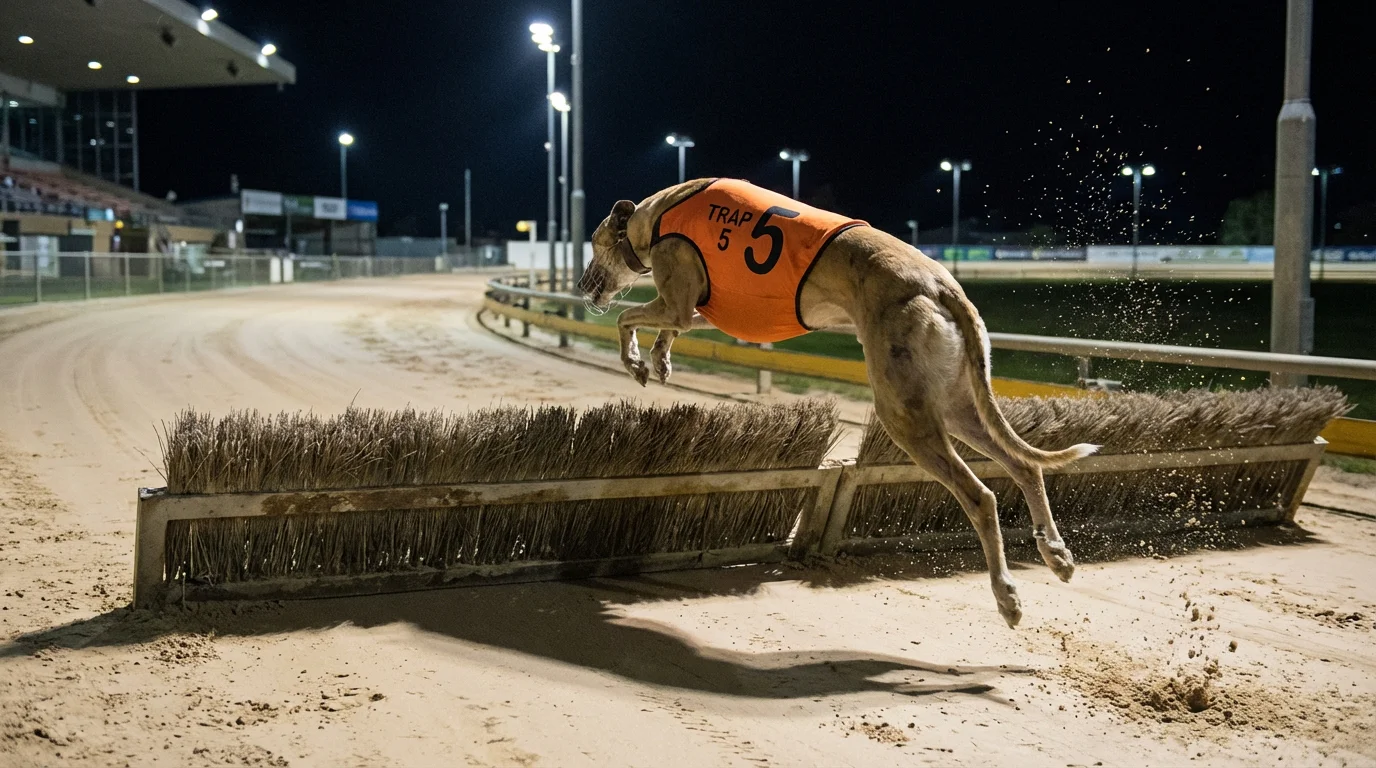
Dogs over Jumps — a Different Contest
Most greyhound punters spend their careers analysing flat races. Six dogs, an oval track, a mechanical hare, and the first past the post wins. Hurdle racing takes that formula and introduces obstacles — low barriers placed on the straights that every dog must clear during the race. It sounds like a minor addition. In practice, it changes almost everything: the running style that succeeds, the form that matters, and the type of dog that wins.
Hurdle races occupy a small but persistent corner of the UK greyhound calendar. They are not staged at every track or at every meeting, but the venues that do run them — Romford among the most notable, with its 400-metre hurdle trip — produce a distinctive type of racing that attracts its own following. For punters willing to learn the nuances, hurdles offer something the flat programme does not: a less efficient betting market, shaped by the fact that fewer people study hurdle form seriously.
The barriers themselves are not imposing. They are typically around 25 centimetres high — low enough that a greyhound in full stride clears them without breaking rhythm. But that apparent simplicity disguises the real challenge, which is not the height of the hurdle but the frequency with which a dog must adjust its stride pattern while racing at top speed. A dog that misjudges its take-off or lands awkwardly loses momentum, and in a sport measured in hundredths of a second, even a slight disruption can be the difference between winning and finishing mid-pack.
This guide covers the rules, the distances, the form factors, and the major hurdle competitions in UK greyhound racing — everything you need to approach hurdle betting with the same analytical rigour you would apply to the flat programme.
Find more race type guides at crayforddogsresults.
Hurdle Race Rules and Distances
Hurdle races in UK greyhound racing are governed by the same GBGB regulations as flat events, with the addition of rules specific to the obstacles. The hurdles are positioned on the straights — typically three or four per race, depending on the distance — and every dog in the field must clear each one. Unlike horse racing hurdles, there is no penalty for knocking a barrier down, and dogs are not pulled up for poor jumping technique. The race continues regardless of how cleanly or messily the field negotiates the obstacles.
The standard hurdle distance at most UK tracks is the same as the standard flat distance — 400 metres at Romford, 480 metres at Monmore, and so on — meaning the hurdle race covers the same ground as a flat race with the addition of the barriers. This is important for form comparison: a dog’s flat time over the same distance provides a baseline, and the difference between its flat and hurdle times tells you something about its hurdling efficiency.
The hurdles are constructed from lightweight materials and are designed to fall over if struck with force. This means that a dog which clips a hurdle loses rhythm but is not physically stopped. The risk is not injury from the hurdle itself — though that can happen in rare cases — but from the disruption to stride and the consequent loss of position. A dog that stumbles over the third hurdle may lose two or three lengths, which at greyhound racing speeds is almost unrecoverable in the remaining distance.
Fields for hurdle races are the standard six dogs, drawn from traps one through six in the usual coloured jackets. The grading for hurdle races is separate from the flat grading at most tracks, reflecting the different skill set required. A dog graded A3 on the flat might be graded differently over hurdles, because hurdling ability and flat speed are related but not identical attributes. Some dogs are natural hurdlers — they clear the barriers in their stride without losing pace — while others are poor jumpers who lose ground at every obstacle regardless of their flat ability.
Trainers who specialise in hurdle racing develop dogs specifically for the discipline, working on stride pattern and timing during training gallops. The preparation is not dramatically different from flat training, but it includes regular work over practice hurdles to build muscle memory and confidence. A dog with extensive hurdle experience will almost always outperform a flat specialist making its hurdle debut, because the technique is learned rather than innate.
How Hurdles Change Form Analysis
The fundamental shift in hurdle form analysis is that flat form becomes a secondary rather than primary indicator. A dog that dominates A2 flat racing might struggle over hurdles if its stride pattern does not suit the barriers, while a dog that is middling on the flat might excel over hurdles because it clears them efficiently and loses less momentum than its rivals.
The first thing to check when assessing a hurdle runner is its hurdle form — not its flat form. How has it performed in its last three or four hurdle races? What were its finishing positions, and what were the run descriptions? A dog that finished fourth in a hurdle race but was noted as “cleared well” or “fluent at hurdles” is a different proposition from one that finished fourth with comments like “slow over hurdles” or “hampered at third flight.” The run descriptions carry more weight in hurdle racing than on the flat, because they capture the variable that flat racing does not have: the quality of jumping.
Sectional times tell a specific story in hurdle races. A dog with a fast first sectional but a slow closing time might be one that breaks well but loses momentum through the hurdles on the back straight. A dog with a moderate first sectional but a strong finish might be one that clears the obstacles cleanly and gains ground on tiring, less fluent jumpers. This pattern — where the better hurdler gains an advantage in the final third of the race — is one of the most reliable indicators of hurdle ability and one of the most profitable angles for punters who track the data.
Trap draw is slightly less decisive in hurdle races than on the flat, because the hurdles disrupt the running order in ways that the first bend alone does not. A dog that leads to the first bend might be overtaken by a better jumper after the first hurdle. The redistribution of positions through the barriers creates more fluidity in the race, which marginally reduces the inside-trap advantage that dominates flat racing at many tracks.
Experience matters disproportionately. A dog with twenty hurdle runs under its belt has developed a stride pattern and a confidence level that a hurdle debutant simply does not have. When you see a dog making its first hurdle start, treat it with caution regardless of its flat credentials. The transition from flat to hurdles involves a learning curve, and the first two or three runs are typically where that learning happens — often at the expense of the finishing position.
Major UK Hurdle Competitions
Hurdle racing does not enjoy the same profile as the flat programme — there is no hurdle equivalent of the Greyhound Derby or the St Leger. But several tracks host established hurdle events that attract quality entries and generate genuine interest from the specialist hurdle-racing community.
Romford stages hurdle races over 400 metres as a regular part of its programme, and the track has a tradition of producing good hurdlers. The compact circuit rewards dogs that can clear the barriers at pace without losing position through the tight bends — a specific combination of jumping ability and flat speed that not every dog possesses. Romford’s hurdle events are among the best-attended hurdle fixtures in the south-east and produce competitive fields with informative form.
Perry Barr, Monmore Green, and several other Midlands and northern tracks include hurdle races in their calendars, though the frequency varies by venue and by season. Some tracks stage dedicated hurdle events with open-race status and enhanced prize money, while others incorporate hurdle races into their standard graded programme. The variation means that punters need to check the racecard carefully — a hurdle race can appear on a card alongside flat races, and it is possible to miss the distinction if you are scanning quickly.
The prestige hurdle events, where they exist, tend to attract a small but dedicated following. The betting markets on hurdle races are typically thinner than on equivalent flat events, which creates price inefficiency. The bookmakers price hurdle races with less confidence than flat races — fewer punters study hurdle form seriously, and the market has less collective wisdom to draw on. For the punter who has done the work, this inefficiency is an opportunity. The prices available on hurdle races often reflect the market’s uncertainty rather than the true probability of each outcome.
If you are interested in hurdle betting, the practical starting point is the same as for flat racing: specialise at one track, learn which dogs are fluent hurdlers, track their form over multiple runs, and build a dataset that gives you an informational edge over a market that is not paying close attention.
Hurdles Add a Dimension Most Punters Ignore
The greyhound hurdle programme is a niche within a niche. Most casual punters do not bet on hurdles, and many serious flat-racing analysts overlook them entirely. That neglect is precisely what makes hurdle racing interesting from a betting perspective. The less attention a market receives, the less efficient it is — and the greater the opportunity for a punter who bothers to study the form.
The analytical framework is not radically different from flat racing. You still assess recent form, trap draw, distance suitability, and trainer patterns. But you add a variable — jumping ability — that the flat programme does not have, and that variable can override everything else. The best flat dog in a hurdle race will lose to a moderate flat dog that clears the barriers like they are not there. That inversion of the form hierarchy is what makes hurdle racing unpredictable for the casual observer and profitable for the specialist.
Also read our greyhound racing distances.
If you have already established a routine for studying flat racing at your chosen track and you want to expand your repertoire, hurdles are a natural extension. The data is available, the races appear on the same cards, and the betting market is waiting to be exploited by anyone who treats hurdle form with the same seriousness they apply to the flat. Most punters will not bother. That is your advantage.
