
Greyhound vs Horse Racing Betting: Key Differences Explained
 Available in US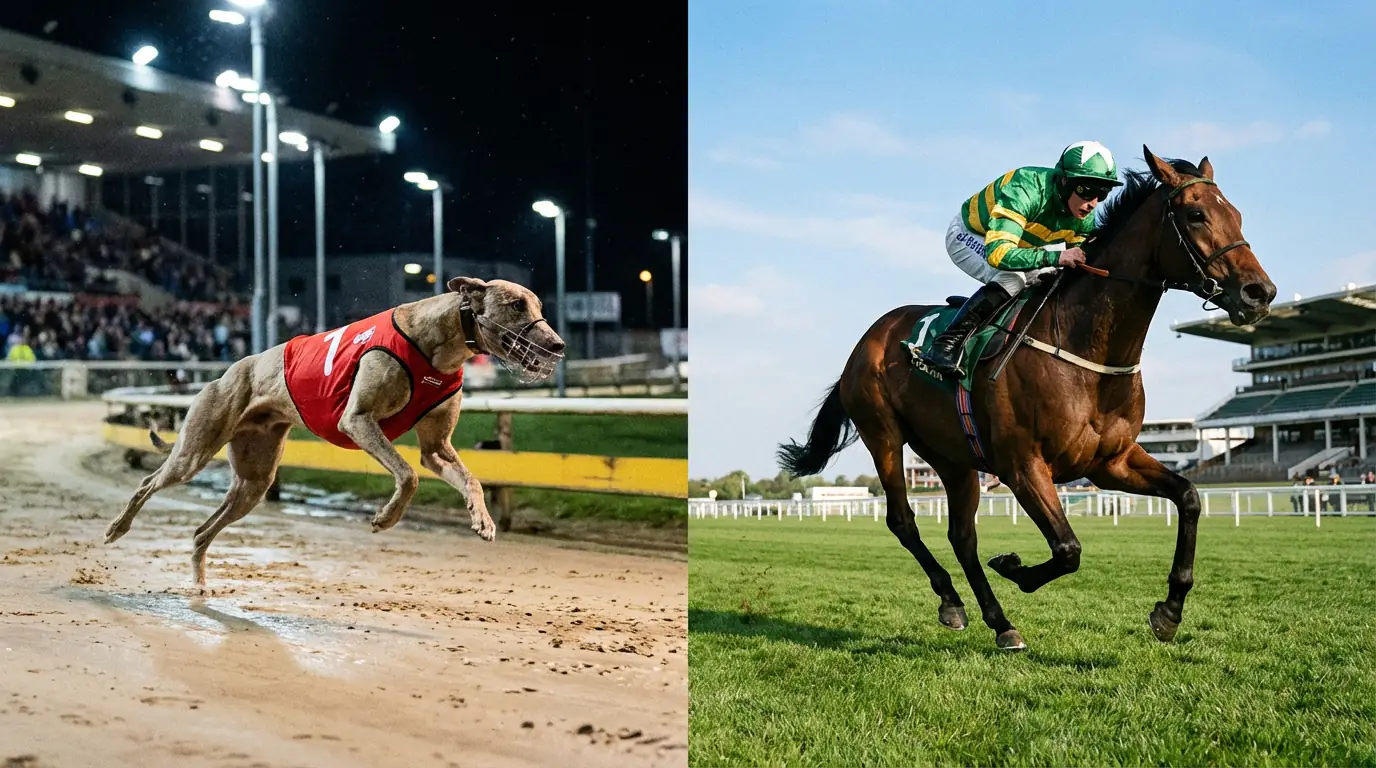
Two Sports, Different Rhythms
Greyhound racing and horse racing are both oval-track sports where animals chase a finish line while punters chase a return. On the surface, they look like variations of the same activity. In practice, they demand different analytical skills, different staking approaches, and different temperaments. A profitable horse racing bettor will not automatically succeed at the dogs, and vice versa. The rules overlap; the rhythms do not.
Understanding the structural differences between the two sports is useful for anyone who bets on one and is considering the other, or who bets on both and wants to adjust their approach to suit each format. The differences are not obscure — they are visible in every aspect of the betting experience, from field size to market depth to the pace of the action. What matters is recognising which of your existing skills transfer and which need to be rebuilt from scratch.
This is not a case for one sport being better than the other. Both are legitimate betting mediums with their own complexities. It is a case for understanding what you are dealing with, so that your approach matches the sport in front of you.
Find more betting guides at crayforddogsresults.
Field Size and Market Depth
The most immediately obvious difference is the field. Greyhound racing in the UK uses six-dog fields. Horse racing fields range from five or six runners in a small-field conditions race to twenty or more in a big handicap. That numerical gap has cascading effects on every aspect of betting.
In a six-dog race, the random chance of picking the winner is roughly 16.7%. In a twenty-runner horse race, it is 5%. The smaller field in greyhound racing means that favourites win more often — approximately 30-35% of the time in graded greyhound races, compared to around 30% in horse racing — and the market is less volatile. There are fewer runners to assess, fewer unknown variables, and a narrower range of possible outcomes. This makes greyhound racing more predictable on an individual-race basis, but it also means the odds are shorter and the potential returns per winning bet are lower.
Market depth is another significant difference. Horse racing attracts vastly more betting volume than greyhound racing, particularly on major meetings. A Cheltenham handicap might see millions of pounds traded in the betting exchanges alone, creating a deep, liquid market where prices are efficient and move only on significant new information. A Tuesday afternoon greyhound race at a BAGS meeting might attract a tiny fraction of that volume. The thinner market means prices are less efficient — they respond more sharply to small amounts of money, and there is more room for individual punters to find mispriced dogs.
That inefficiency is one of the reasons some serious bettors prefer greyhounds over horses. In horse racing, the market is so deep and so well-informed that finding an edge against the collective wisdom is extremely difficult. In greyhound racing, the shallower market and the less-scrutinised form data create genuine value opportunities for punters who do the work. The trade-off is that the lower stakes and smaller pools limit how much money you can realistically put through the market without affecting the prices.
Pace of Betting: 15-Minute Gaps vs Full Cards
Greyhound meetings run on a relentless schedule: twelve races in an evening, roughly fifteen minutes apart, over and done in three hours. Horse racing operates on a more spacious timetable, with larger gaps between races and fewer events per meeting. A typical horse racing card might offer six or seven races across an afternoon, with twenty to thirty minutes between each.
The pace of greyhound racing has direct implications for betting behaviour. Fifteen minutes between races is enough time to check the card for the next event and place a bet, but it is not enough time for deep analysis. If you are going to approach a greyhound meeting with analytical rigour, the work needs to be done before you arrive — or before the first race goes off, if you are betting remotely. Trying to study form between races at a live meeting is a recipe for rushed decisions and impulsive bets.
Horse racing’s slower pace allows more time for deliberation. You can study the form during the meeting, watch the market move, assess conditions, and wait for the best moment to commit. The betting experience is more reflective and less pressured. For punters who prefer to think carefully about each selection, horse racing’s rhythm is more forgiving. For punters who enjoy the intensity of rapid-fire decisions and the discipline of pre-prepared analysis, greyhound racing’s pace is energising rather than stressful.
The rapid schedule also affects staking discipline. In horse racing, you might place three or four bets across an afternoon and have plenty of time to reconsider between them. In greyhound racing, you could easily place ten bets in a single evening without ever feeling like you are overreaching. That ease of action is dangerous for punters without a clear staking plan. Setting a budget and a maximum number of bets before the meeting starts is more important in greyhound racing precisely because the opportunities to bet come so frequently.
There is also the multi-track factor. Greyhound racing often has multiple meetings running simultaneously across the country, with BAGS cards overlapping throughout the afternoon. A punter with streaming access and online accounts could theoretically bet on races at four or five different tracks in a single session. The temptation to spread too thin — to bet on tracks you do not know well just because the action is available — is a distinctly greyhound-racing problem. Horse racing has it too, but the slower pace and fewer meetings per day create natural limits.
Form Analysis: Simpler or Just Different?
A common claim is that greyhound form is simpler to analyse than horse form. There is some truth to this, but it deserves nuance. Greyhound racecards are shorter and contain fewer variables: no jockeys, no going preferences in the horse-racing sense, no wide variation in trip from one run to the next. A dog’s form can be assessed more quickly than a horse’s because there are fewer factors to weigh.
But simplicity of data is not the same as simplicity of analysis. A greyhound race is compressed into thirty seconds, and the outcome often hinges on what happens in the first three — the trap break and the first bend. There is less time for ability to override circumstances. A talented dog that gets bumped at the first bend in a horse race has two minutes and a mile of running to recover. A talented greyhound that gets bumped at the first bend has perhaps twenty seconds and three hundred metres. The margins are tighter, and the impact of random incidents is proportionally larger.
The form variables that do exist in greyhound racing are highly specific. Trap draw, track-specific times, sectional data, trainer patterns at individual venues — these are the tools of greyhound form analysis, and they require track-level expertise that does not translate between venues. A horse racing punter who studies the going, the draw, and the jockey booking is operating at a similar level of specificity, but the dataset is richer and the analytical community is vastly larger. In greyhound racing, the smaller community means less competition for information — but also less publicly available insight to build on.
One genuine simplification in greyhound racing is the grading system. Dogs are grouped by ability based on recent times, so every race on a standard card features runners of broadly similar quality. Horse racing handicaps aim for a similar effect through weight assignments, but the system is more complex and more subjective. In greyhound racing, you are usually comparing dogs on a fairly level playing field. In horse racing, you are trying to assess whether the handicapper has got the weights right — which adds an entire layer of analysis that greyhound bettors do not need to worry about.
There is one area where horse racing form analysis has a clear advantage: historical depth. A horse might have a racing career spanning five or six years, with dozens of runs across multiple tracks and conditions, generating a rich form profile. A greyhound’s career is shorter and more concentrated — most dogs race for two to three years, and the relevant form window is typically the last six to ten runs. That shorter history means greyhound form can change rapidly. A dog that was winning in A3 six months ago might be losing in A6 today, and the reasons are not always obvious from the form figures. Horse racing form, by contrast, tends to be more stable and more predictable over longer timeframes, which gives the horse racing analyst a deeper dataset to work with.
Choose the Sport That Matches Your Temperament
The best sport to bet on is the one you understand best and enjoy studying. If you are drawn to the depth and variety of horse racing — the big festivals, the narrative arcs of champion horses, the tactical complexity of a three-mile chase — then horse racing will hold your attention long enough for you to develop expertise. If you prefer the speed, the pattern recognition, and the rapid feedback loop of greyhound racing — twelve results in an evening, each one a fresh data point — then dogs are your medium.
Some punters bet on both, switching between sports as the calendar dictates. That can work, provided you maintain separate analytical frameworks for each. The skills overlap — both require form analysis, staking discipline, and value assessment — but the specific knowledge is different. Applying horse-racing instincts to greyhound races, or vice versa, will produce results that reflect neither sport accurately.
The structural differences between the two sports also mean that the bankroll profile differs. Greyhound betting tends to involve more frequent, smaller bets at shorter odds. Horse racing tends to involve fewer, larger bets with a wider range of potential returns. Your bankroll management should reflect whichever rhythm you are operating in — and if you do both, maintaining separate bankrolls for each prevents the results of one sport from distorting your staking in the other.
Also explore our UK greyhound betting guide.
Neither sport is easier to beat. Both are challenging, both reward patience and skill, and both will take money from punters who approach them without preparation. The question is not which sport is more profitable — it is which sport matches the way you think, the way you analyse, and the way you want to spend your time. The punter who treats that question seriously, and commits to learning one sport properly rather than dabbling in both, will almost certainly outperform the generalist who never develops real expertise in either.
