
Starting Price vs Early Price in Greyhound Racing Explained
 Available in US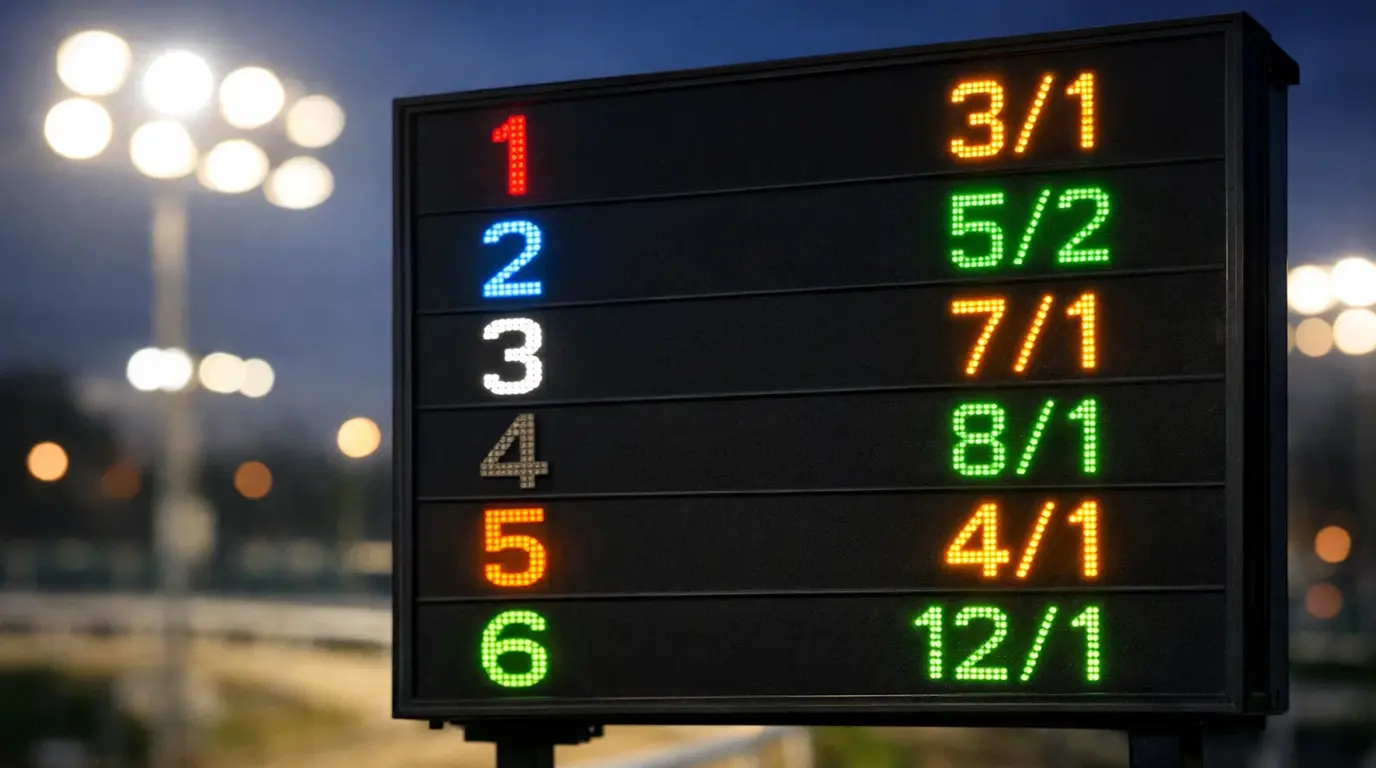
Two Prices, One Race — Your Decision
Every greyhound race presents the punter with a choice that has nothing to do with which dog to back. Before the traps open, you face a decision about when to commit to a price. You can take the odds offered right now — the early price, available from the moment the market opens — or you can wait and accept the starting price, the final odds returned at the off. Both approaches have consequences. Neither is automatically better than the other. The right answer depends on the race, the market, and what you think is about to happen to the odds.
This distinction matters more in greyhound racing than in many other sports. Greyhound markets are thinner than horse racing markets, meaning the prices can shift substantially in the minutes before a race. A dog might open at 5/1 in the morning and drift to 8/1 by race time — or shorten to 3/1. If you took the early price, you are locked into whichever number you accepted. If you waited for SP, you get whatever the market settles on. Those swings are larger and more frequent in greyhound racing because the betting pools are smaller and a single significant wager can move the odds visibly.
Understanding the mechanics behind both pricing systems — and knowing when each one serves your interests — is a fundamental skill for any greyhound punter. It is not glamorous analysis. Nobody brags about timing a price. But over hundreds of bets, the cumulative difference between consistently taking the right price and consistently accepting the wrong one can be the gap between a punter who grinds out a marginal profit and one who leaks money steadily through poor price discipline.
This guide breaks down how the starting price is set, when the early price offers genuine value, and how the Best Odds Guaranteed promotion — available from certain bookmakers — can remove the risk from that timing decision entirely. The mechanics are straightforward. Applying them consistently takes a little more practice.
Find more odds guides at crayforddogsresults.
How Starting Price Is Determined
The starting price is the official odds returned on a dog at the moment the race begins. In horse racing, the SP is derived from on-course bookmakers’ boards — an official returner surveys the available prices at the off and records the industry starting price. Greyhound racing works differently in practice, though the principle is similar.
For greyhound races, the SP is typically determined by the odds available on licensed bookmaker platforms at the time the traps open. The process has shifted over the years from on-course boards to a more digital mechanism, reflecting the reality that the vast majority of greyhound betting now happens online or in betting shops rather than trackside. The result is a price that represents the market’s collective assessment of each dog’s chance at the moment of the off — not ten minutes before, not an hour before, but right then.
The SP fluctuates in the run-up to the race as money flows into the market. When significant money is placed on a particular dog, its odds shorten (decrease) because the bookmaker adjusts to limit their liability. When a dog attracts little interest, its odds drift (increase). In a typical six-dog greyhound race, the market is thin enough that these movements can be pronounced. A few hundred pounds placed on a 4/1 shot in a Monday afternoon BAGS race at Monmore might be enough to push it down to 3/1. That same amount would barely register in a horse racing market for a major handicap.
For the punter, the SP carries one specific advantage: you do not have to commit to a number in advance. If you select SP on your bet slip, you are deferring the price decision to the market. That can be beneficial when you have no strong view on whether the current odds are likely to shorten or drift — you simply want to back a dog and accept whatever the collective market determines. The disadvantage is that you surrender control. If the dog is heavily backed before the off and shortens from 5/1 to 7/2, your SP bet collects at the lower price.
One important nuance: the SP is not always the best price available at the off. Different bookmakers may show slightly different odds at the same moment, and the official SP represents a consensus rather than the absolute best available number. Punters who shop between multiple bookmaker accounts can sometimes find odds marginally better than the returned SP, though the differences in greyhound racing are typically smaller than in horse racing.
When to Take the Early Price
The early price is the odds available in advance of the race, sometimes hours before the off and occasionally the evening before for major meetings. Taking the early price means locking in that number — your bet is settled at the odds you accepted, regardless of what happens to the market between then and the start of the race.
The clearest case for taking an early price is when you believe the odds will shorten. This happens most often with strongly fancied dogs that the market has not yet fully adjusted to. If a dog has dropped a grade, drawn a favourable trap, and has strong recent form, experienced punters will identify it early and back it, causing the price to contract. By the time the race goes off, a dog that opened at 3/1 might be 2/1 or shorter. If you took the 3/1 in the morning, you are collecting at a price that no longer exists.
Conversely, taking an early price is less attractive when you suspect the odds will drift. This can happen when early money pushes a dog to an artificially short price that the broader market does not support. As more opinions enter the market closer to race time, the price corrects outward. A dog offered at 2/1 in the morning that drifts to 3/1 by the off represents poor value for anyone who locked in the shorter number.
So how do you judge the direction of the market? There are a few reliable indicators. First, class changes: a dog dropping from A3 to A5 at a track where it has recent winning form is likely to attract money. The market usually adjusts, and early prices on such dogs tend to shorten. Second, trap advantage: a known front-runner drawn in trap one at a track with a short run-in is an obvious candidate for support. Third, trainer intent: if a leading trainer enters a dog at a distance or grade that suggests it has been specifically prepared for this race, early money tends to follow.
The situations where waiting for SP makes more sense are the uncertain ones — races where the form is mixed, the draw produces no obvious advantage, and you have no strong thesis about which way the market will move. In those cases, SP is a reasonable default. You are not leaving value on the table because you have no basis for believing the current price is better than the eventual one.
One practical point: taking an early price requires a settled opinion. You need to have done your analysis, decided which dog to back, and committed before the market moves. Punters who study the card the evening before and place their bets early tend to be more disciplined than those who make last-minute decisions at the track or in a betting shop, where the pressure of the moment can override analysis.
Best Odds Guaranteed as a Risk Eliminator
Best Odds Guaranteed, commonly abbreviated to BOG, is a promotion offered by several UK bookmakers that fundamentally changes the early-price calculation. The principle is simple: if you take an early price on a greyhound and the starting price turns out to be higher, the bookmaker pays you at the SP instead. You get the better of the two numbers, whichever it is.
Consider a practical example. You back Trap 3 at an early price of 4/1 on a Thursday evening race at Monmore. By the time the traps open, the dog has drifted to 6/1 — perhaps other fancied runners attracted support and this one was overlooked by the late market. With BOG in place, your bet is settled at 6/1 rather than the 4/1 you accepted. If the dog had instead shortened to 3/1, you would still collect at your original 4/1. Either way, you receive the higher price.
This removes the primary risk of taking an early price: the possibility of locking into a number that the market subsequently moves past. With BOG, there is no penalty for being early. You can take the morning price with confidence, knowing that if the market disagrees and pushes the dog out to a bigger number, you benefit from the correction.
The catch — and there is always a catch — is that not every bookmaker offers BOG on greyhound racing, and among those that do, the terms vary. Some restrict BOG to specific tracks or race types. Some only apply it to win bets, excluding each-way or forecast wagers. Some cap the maximum enhanced payout. Reading the terms before assuming BOG is in play is essential, because placing a bet under the assumption of BOG protection and discovering after the race that it did not apply is an expensive lesson.
For punters who regularly take early prices on greyhounds, BOG-eligible bookmakers should be the default choice. The mathematics are straightforward: over a large number of bets, BOG will produce a higher average return than the same selections placed without the promotion, because every instance where the SP exceeds your early price generates a free uplift. It costs you nothing. It pays you occasionally. Over time, that one-way benefit compounds into a meaningful improvement in your overall return.
The promotional landscape changes — bookmakers add and remove BOG at their discretion — so checking which operators currently offer it on greyhounds, and which tracks and races qualify, should be a regular habit rather than a one-time check.
Timing Is a Form of Analysis
Most of the conversation around greyhound betting focuses on which dog to back. Form analysis, trap draws, sectional times, trainer records — all of it is directed at the selection itself. Far less attention is paid to when to place the bet, and at what price. Yet the timing decision can be worth as much as the selection decision over a sustained period of betting.
A punter who consistently backs the right dog at the wrong price will underperform a punter who backs the same dog at the right price. That sounds obvious when written down, but in practice it requires a discipline that many casual bettors lack: the willingness to study the market as carefully as the racecard, to form a view on likely price movement, and to act on that view before the market moves.
Starting price is a fine default when you have no edge on the direction of the odds. It is also the appropriate choice for punters who prefer to bet close to the off and react to late market information. But when your analysis identifies a dog whose current price underestimates its chance — and particularly when BOG is available to protect against drifting — the early price is where the value sits. You are being paid a premium for committing before the market reaches its conclusion.
Also explore our odds value guide.
None of this guarantees profit. A well-timed price on a losing dog is still a losing bet. But over hundreds of races, the habit of taking the best available price at the right moment — rather than accepting whatever number is in front of you at a random time — adds a layer of discipline that separates the recreational bettor from the serious one. Greyhound racing compresses the entire betting cycle into minutes. The decision of when to step in, and at what number, is part of the skill. Treat it accordingly.
