Monmore Green Dogs: Track Guide, Schedule and Betting Tips
 Available in US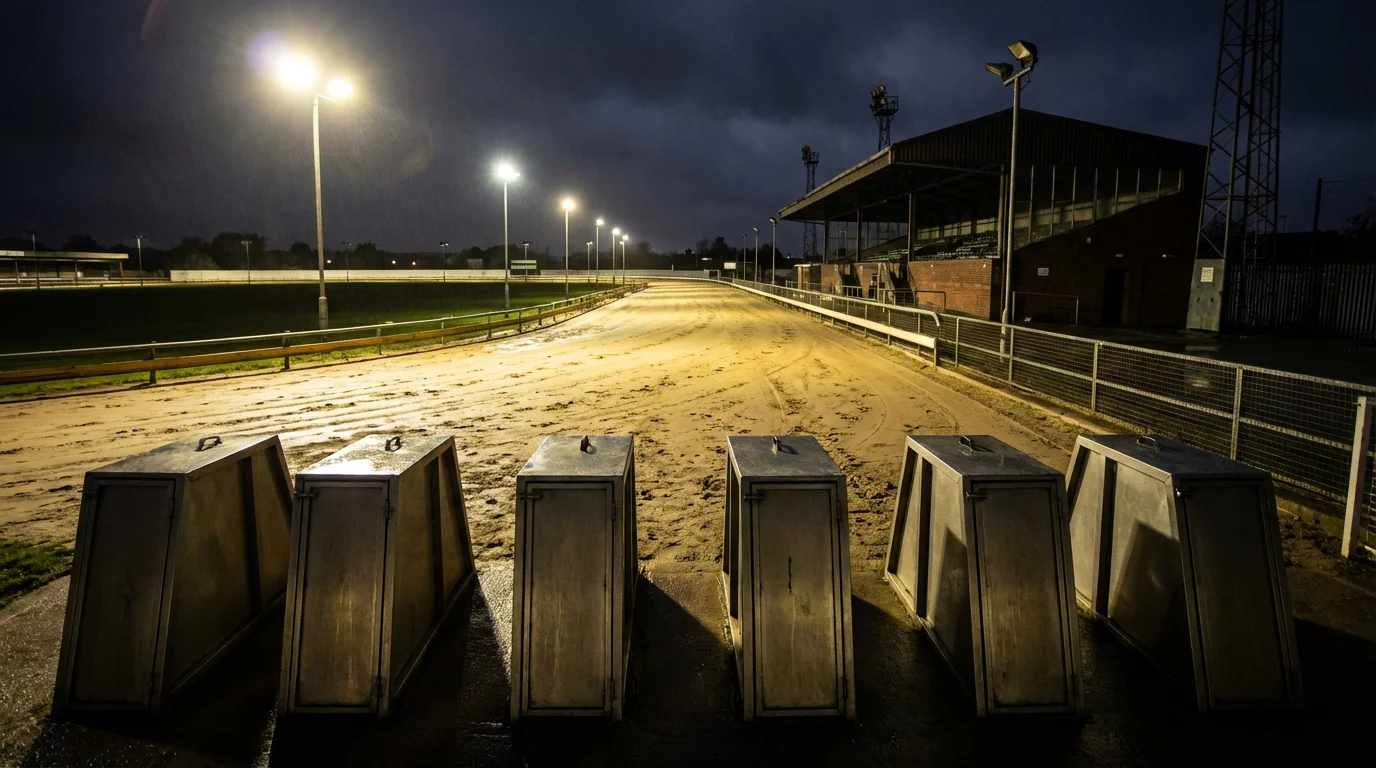
The Midlands Heartbeat
Monmore Green sits on Sutherland Avenue in Wolverhampton, roughly a mile from the city centre, wedged between the Great Western Railway line and the green expanse of East Park. It has been racing greyhounds since January 1928, when 10,000 people turned up for the opening night — a number that most modern UK tracks would struggle to attract across an entire month. The Midland Greyhound Racing Association organised that first meeting, and nearly a century later the stadium is still in operation, now owned by Entain and carrying the Ladbrokes sponsorship branding.
Monmore is not glamorous. Wolverhampton is not Brighton, and the stadium does not sell itself on scenic charm. What it sells is volume and quality. The track hosts racing four or five days a week, carries some of the most prestigious puppy and staying events in UK greyhound racing, and has a tradition of producing top-class dogs and attracting trainers who operate at the highest level of the sport. Kevin Hutton’s arrival at Monmore in 2018 brought a level of training expertise that elevated the track’s competitive standing further.
The venue has a capacity of 1,150 spectators, a restaurant, bars on three levels, and a car park that can accommodate coaches — a nod to the era when greyhound racing was a group outing, not just a solo hobby. Thursday and Saturday evenings are the main events, drawing the better-graded dogs and the paying crowds. Monday and Friday afternoons serve the BAGS circuit, and these fixtures are free to attend, which makes Monmore one of the more accessible tracks for anyone wanting to watch live racing without spending money at the door.
For punters, Monmore occupies a significant position in the UK greyhound betting landscape. Its BAGS content streams into every major bookmaker, its results are part of the daily fabric of the greyhound betting market, and its track characteristics — distinct dimensions, a specific set of race distances, and a surface that rewards certain running styles — create a venue that rewards specialisation. Understanding Monmore means understanding a track that behaves differently from Romford, Hove, or any other circuit on the calendar.
Find more track guides at crayforddogsresults.
Track Dimensions and Characteristics
Monmore’s circuit measures 419 metres in circumference, placing it between the compact Romford (350 metres) and the more spacious Hove (455 metres). The run to the first bend is 103 metres, which is generous by UK standards and gives dogs drawn in the outside traps a legitimate chance to find position before the first turn. That longer run-in is one of the defining features of Monmore’s racing — it reduces the raw inside-trap advantage and opens the field up to dogs with strong early pace regardless of draw.
The standard race distances are 264, 480, 630, 684, and 835 metres. The 264-metre sprint is among the shortest offered at any UK track, a two-bend blast that rewards trap speed and little else. The 480-metre trip is the workhorse distance, used for the majority of graded races. The 630-metre and 684-metre events test middle-distance ability, while the 835-metre staying races are a genuine test of stamina and tactical intelligence over multiple bends.
One of Monmore’s distinguishing traits is the breadth of its staying programme. Several of the track’s most prestigious open events are run over the longer distances, and the staying races at Monmore have a reputation for producing high-quality, competitive fields. For punters who enjoy analysing pace scenarios and running styles — the kinds of races where the outcome depends on how the first three bends unfold — the 630-metre and 835-metre events are among the most tactically interesting fixtures in UK greyhound racing.
The surface is sand, maintained to GBGB standards. Monmore’s sand has a reputation for riding slightly differently depending on the time of year — firmer in summer, heavier after prolonged wet spells. Like all sand tracks, it favours dogs with a clean running action and punishes those that chop and change through the bends. The hare type is a Swaffham, running outside the track perimeter.
Monmore also has a speedway track on the inner portion of the venue, used by the Wolverhampton Wolves during the speedway season from March to October. The shared-use nature of the site is unusual in modern UK greyhound racing and adds a layer of complexity to surface management, though the two disciplines operate independently.
Race Calendar and Fixtures
Monmore’s weekly schedule follows a pattern common to commercially active UK tracks: evening meetings on Thursday and Saturday for the regular paying public, and BAGS-contracted daytime meetings on Monday, Tuesday, Wednesday, and Friday to serve the bookmaker market. The evening sessions feature the higher-graded dogs and the stronger fields. The daytime fixtures are free to attend, lower in grade, and aimed primarily at generating betting content for shops and online platforms.
The track’s major events calendar punches above its weight. The Ladbrokes Puppy Derby is Monmore’s most prestigious competition, a race for dogs aged between 15 and 24 months that carries substantial prize money and attracts entries from the best puppy trainers in the country. It is one of the highest-profile puppy events in UK greyhound racing, second in reputation only to the more established Puppy Derby formerly associated with Wimbledon. The competition runs over 480 metres and typically takes place across several rounds, building a narrative that dedicated followers track across weeks.
The Ladbrokes Gold Cup is another headline event, a Category 1 race that draws quality staying entries for the 630-metre trip. The Summer Cup, the Festival 630s, and the Peter John Chinn Memorial round out the annual programme, along with the Trafalgar Cup — a prestigious puppy event added in 2015 that has quickly established itself on the calendar.
For historical context, Monmore also hosted the Golden Jacket in 1986 — one of the classic races in greyhound racing — before it moved to Crayford. The Midland Gold Cup, a pre-war event, was revived in 1994 and continues to draw strong entries.
A typical race meeting at Monmore runs to twelve races with roughly fifteen-minute intervals. Evening meetings start around 7pm, while afternoon BAGS fixtures begin earlier and run on a slightly compressed schedule. The racecard is available in advance through the usual channels — Racing Post, RPGTV, Sporting Life, and the major bookmaker sites — giving punters time to study form, check trap draws, and compare early prices before the first race goes off.
The volume of racing at Monmore is one of its most useful characteristics for punters who want to specialise. With fixtures four or five days a week, you can build a substantial dataset of track-specific observations over the course of a few months — enough to develop a genuine feel for how the track rides, which trainers are in form, and how different distances favour different running styles.
Form Trends and Trap Data
Monmore’s 103-metre run to the first bend produces trap statistics that are more balanced than most UK tracks. Over the standard 480-metre distance, no single trap dominates the win data to a degree that would make blind trap-based betting profitable. The inside traps still hold a marginal edge — physics dictates that the shortest distance to the rail is an advantage — but the effect is muted compared to venues with a shorter run-in. Punters who rely heavily on trap bias at Romford or other compact circuits need to recalibrate when switching to Monmore.
The more productive angle at Monmore is pace analysis. Over 480 metres, the races typically split into front-runners who establish position through the first two bends and closers who make ground from the third bend onwards. The balance between these two styles depends on the specific field composition in each race. When a card features multiple front-runners drawn in adjacent traps, the early scramble can set up opportunities for a patient closer sitting in behind the traffic. Conversely, a lone front-runner in a field of midpack dogs can steal a race unchallenged from the front.
Over the longer distances — 630 metres and 835 metres — the dynamics shift considerably. Early pace still matters for establishing position, but stamina and running efficiency become dominant factors. Dogs that run wide through the bends at 480 metres can absorb the extra distance without fatal consequences; over 835 metres, those wasted lengths through six or more bends accumulate into lost ground that cannot be recovered. The best stayers at Monmore are dogs that run economically — tight to the rail through the turns, with enough late pace to hold position on the final straight.
Trainer form is another significant variable at Monmore. The track has a core group of trainers who know the surface, the distances, and the grading system intimately. When these local trainers run a dog at a particular distance for the first time, or drop a dog into a lower grade, it is worth paying attention — they understand their dogs’ capabilities at this specific venue in a way that external trainers may not. Checking the trainer strike rate at Monmore over the past three months, rather than their overall career record, gives a more relevant picture of current form.
The BAGS meetings on Monday and Friday deserve separate attention. The standard of racing is lower, and the fields are less predictable. This creates an environment where upsets are more frequent and tricast dividends can spike to attractive levels. But it also makes form analysis harder — dogs in the lower grades change form rapidly, and a three-run form string can include two completely different versions of the same animal. The punters who profit from BAGS meetings at Monmore tend to be the ones who watch replays consistently rather than relying solely on the printed form.
Monmore’s Quiet Strength
Monmore Green does not generate headlines the way London tracks once did. It does not have the seaside charm of Hove or the last-track-standing narrative that follows Romford. What it has is consistency. It races multiple times a week, year-round, in conditions ranging from midsummer warmth to midwinter frost. Its events calendar includes some of the most respected races in UK greyhound racing. Its trainers are among the best in the sport. And its BAGS output makes it one of the most-bet-upon tracks in the country.
That quiet reliability is Monmore’s defining quality. In a sport that has lost more venues than it has kept, the tracks that survive tend to be the ones that function well without needing constant attention. They maintain their surfaces, they attract entries, they run their meetings on time, and they generate enough commercial activity — through betting turnover, media rights, and on-course revenue — to justify continued operation. Monmore does all of this without fanfare.
For the punter, the practical value of Monmore lies in its regularity. If you want to specialise at a single track, Monmore gives you enough racing to develop track-specific knowledge within weeks rather than months. You can learn how the 480-metre races unfold, identify which trainers are in peak form, track how the surface changes through the seasons, and build a reliable mental model of what winning at Monmore looks like. That kind of specialisation is how consistent bettors are made — not through systems or tipsters, but through accumulated understanding of a single venue’s rhythms.
Also read our Romford dogs guide.
The stadium opened in 1928 to a crowd of 10,000. The crowds are smaller now, and the Midland Greyhound Racing Association that organised that first meeting is long gone. But the track is still there, between the railway line and the park, doing what it has done for almost a century. The dogs still run on Thursday nights, the traps still open, and the sand still records the story of every race. For a venue that never sought the spotlight, Monmore has built a legacy that many more famous tracks would envy — simply by turning up, week after week, and getting the job done.
