
Hove Dogs: Track Guide, Distances and Racing Information
 Available in US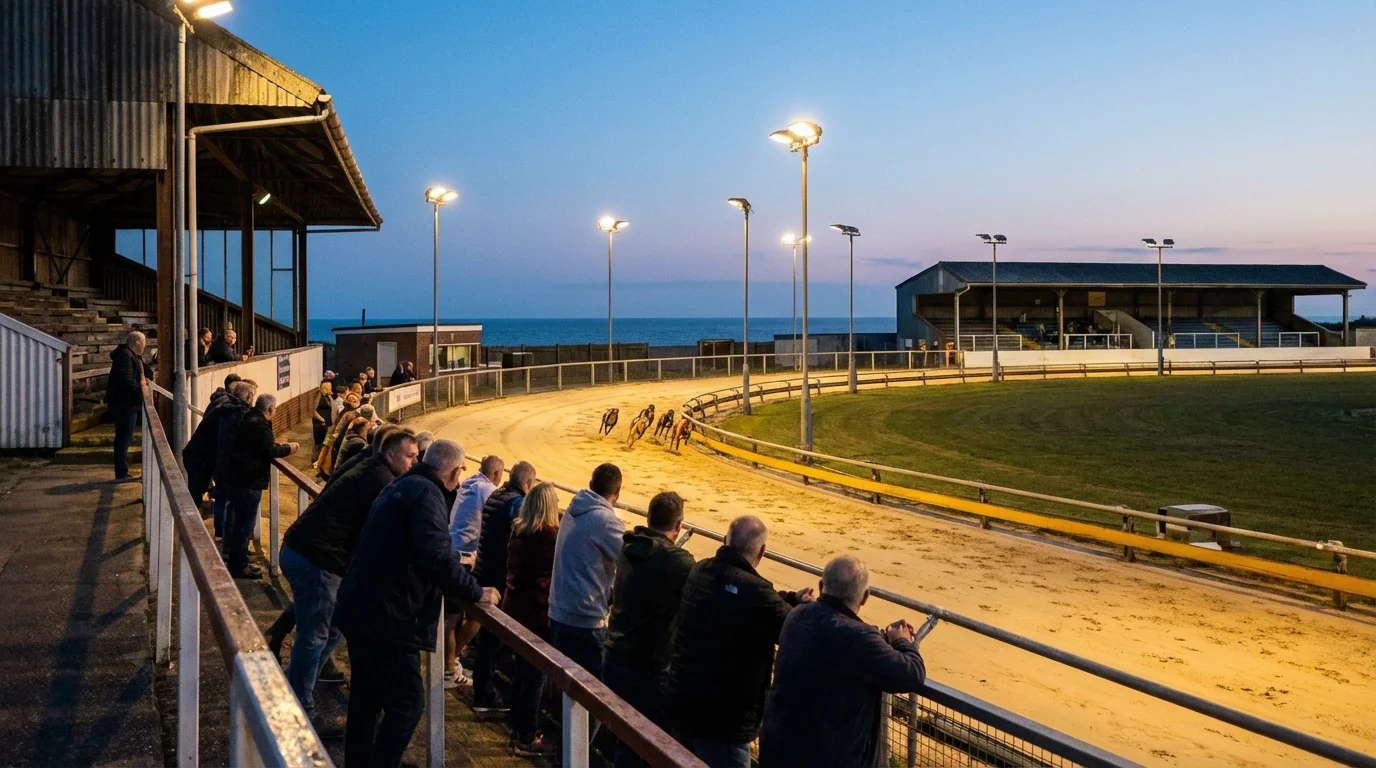
South Coast Greyhound Racing
Brighton and Hove Greyhound Stadium sits in the Hove Park area of East Sussex, close enough to the seafront that you could walk to the beach in twenty minutes. It has been racing dogs since 1928, which makes it one of the oldest continuously operating greyhound venues in Britain — and, in a sport that has lost dozens of tracks over the past half-century, one of the most resilient.
The stadium is owned by Entain and officially branded as Coral Brighton and Hove Greyhound Stadium. It has a capacity of around 2,200 spectators, a Skyline Restaurant with views over the track, five licensed bars, and facilities that have been incrementally upgraded over the decades. This is not a spartan venue. The combination of its seaside setting and its long racing heritage gives Hove a character that most other UK tracks cannot match — there is a social atmosphere here, particularly on Saturday evening meetings, that feels closer to an event than a routine race night.
Racing takes place five days a week. Thursday and Saturday evenings are the main events, drawing the strongest fields and the largest crowds. Wednesday and Sunday afternoons cater to the daytime racing market, and Friday mornings supply the early BAGS content. The schedule is dense enough to give regular punters ample opportunities, and varied enough in terms of race quality to suit different levels of engagement.
Hove’s racing reputation was cemented in 1986 when Ballyregan Bob, trained at the track by George Curtis, broke the world record for consecutive wins — 32 in a row. That feat made national headlines and remains one of the defining moments in British greyhound racing history. The stadium has never quite reached those heights again, but it has not needed to. Its continued existence, its quality calendar of open events, and its ability to attract strong entries from leading trainers keep it firmly among the top tier of UK tracks. For punters in the south of England, and particularly those affected by Crayford’s closure, Hove offers a credible alternative with genuine depth of racing.
Find more track guides at crayforddogsresults.
Track Profile and Distances
Hove’s circuit measures 455 metres in circumference, making it noticeably larger than Romford’s 350-metre loop and more in line with the bigger UK tracks. The wider bends and longer straights produce a different style of racing. Dogs have more room to manoeuvre, overtaking opportunities are more frequent, and the first-bend scramble that defines racing at tighter circuits is less decisive here. That is good news for closers and dogs drawn in the outside traps — the track geometry does not punish a wide draw as severely as a compact venue would.
The run to the first bend is 105 metres on four-bend races and 50 metres on six-bend events. That 105-metre run-in on the standard distances gives every dog time to establish position before the first turn, which reduces the trap bias relative to tracks with shorter approaches.
Hove races seven different distances: 285, 475, 500, 515, 695, 740, and 970 metres. The 285-metre sprint is over almost before it begins — two bends, maximum pace, minimal tactics. The 515-metre distance has historically been the track’s signature, used for all four of its major open events. In 2019 the track reintroduced the 500-metre distance, which had not been used since the 1970s, while retaining 515 metres for its prestigious open races. The 695-metre middle-distance events and the 970-metre marathons test stamina and race intelligence in ways the shorter distances do not.
The surface is all-sand, though Hove was actually the last track under GBGB rules to remove its turf surface, converting fully to sand in 1987. The track uses an outside Swaffham hare, which runs along the outer rail. Hove’s surface has a reputation for being well-maintained and relatively consistent, though like all sand tracks it responds to weather. The proximity to the coast means wind can be a factor — a strong headwind on the back straight slows finishing times, and dogs that rely on sustained late pace can be affected more than front-runners who build their advantage before the wind becomes a factor.
The 515-metre track record stands at 29.30 seconds, set by Barnfield on Air in 2007. When assessing form at Hove, comparing a dog’s recent times against the track benchmarks for each distance is a straightforward way to gauge whether it is running at or near its peak.
Notable Events and Competitions
Hove’s annual racing calendar features four flagship competitions, each with its own history. The Regency is the most prestigious, a Category 1 event first run in 1948 when it was known as the Regency Produce Stakes and restricted to British-bred greyhounds. That restriction was dropped in 1966, opening the race to all entries, and it has since become one of the most respected open events on the UK calendar. The Regency currently runs over 695 metres and offers substantial prize money — enough to attract top entries from the best kennels in the country.
The Olympic has a longer history than its Hove residency might suggest. It originated at Wandsworth Stadium in 1947, moved to Charlton when Wandsworth closed in 1966, and appeared to be finished when Charlton itself shut in 1971. Eight years later, Hove revived it. The race has been a permanent fixture here since 1979, and its survival through three different venues is a useful metaphor for the sport’s habit of finding new homes when old ones disappear.
The Brighton Belle, inaugurated in 1975, is Hove’s own creation. It has never been held anywhere else. Coral currently sponsor the event, and while it carries less historical weight than the Regency or the Olympic, it is a well-supported 515-metre event that consistently attracts competitive fields. The Sussex Cup, running since 1972, completes the quartet. All four events are typically run in the Thursday or Saturday evening slots, generating the kind of atmosphere that regular race nights cannot quite replicate.
Beyond the headline events, Hove also hosts the Ballyregan Bob Memorial, a fitting tribute to the dog that put the track on the national map. The Sussex Puppy Trophy gives young dogs a showcase, and the regular graded programme throughout the year maintains a consistent standard of racing. The concentration of Category 1 and Category 2 events at Hove is one of the reasons serious trainers maintain entries here despite the relative remoteness of the south coast location compared to Midlands venues.
For punters, the open events offer a different betting challenge than regular graded racing. Fields include dogs from multiple trainers and tracks, making direct form comparisons harder. The established Hove specialists — dogs and trainers with a strong record at the venue — tend to have an edge in these situations, and backing local knowledge has historically been a sound approach at open-event finals.
Betting Considerations at Hove
Hove’s generous track dimensions produce trap statistics that differ meaningfully from tighter circuits. The data shows a relatively even distribution of winners across all six traps over the 515-metre distance. Trap four has historically held a marginal edge, winning roughly 19% of races against a random expectation of about 16.7%, but the gap is not dramatic enough to build a system around. For place bets, trap one is more interesting — it finishes first or second at a higher rate than any other trap, reflecting the advantage of the inside rail through the first two bends even on a wide track.
The more useful betting angle at Hove comes from understanding running styles in the context of the track’s shape. Because the bends are wide and the straights are long, dogs that run prominently through the early stages have slightly less of a structural advantage than they would at Romford or other tight tracks. Closers — dogs that settle in the pack early and produce a late surge — find Hove’s layout more forgiving. If a dog’s form shows consistently strong closing sectional times but mediocre finishing positions at a tighter track, it may be worth considering at Hove where the geometry gives it more room to run on.
Distance suitability is another factor worth emphasising. Hove’s range from 285 metres to 970 metres is broader than most UK tracks, and dogs frequently race over multiple distances here. A dog that posts quick times over 285-metre sprints is not necessarily well suited to the 515-metre trip, and vice versa. Checking a dog’s recent form at the specific distance of tonight’s race — rather than just its overall Hove record — is a basic discipline that separates informed punters from casual ones.
The coastal weather adds a genuine variable. Wind patterns can shift between races, and a blustery evening affects race dynamics differently depending on running style. Dogs that lead from the front tend to handle windy conditions better because they set the pace without battling turbulence from other runners. Closers can find that the wind robs them of the final burst they need. This is not a decisive factor in every race, but on evenings when the flags are stiff, it is worth incorporating into your reading of the card.
Finally, Hove’s BAGS meetings — the Wednesday and Sunday afternoon and Friday morning fixtures — tend to feature lower-graded dogs with less predictable form. Upsets are more frequent, tricast dividends can be generous, and the challenge of finding value shifts from identifying the best dog to identifying the most likely pace scenario. These are sessions where a punter who watches replays and tracks sectional times can find edges that the casual market misses.
Hove’s Endurance in a Shrinking Sport
There is something quietly impressive about a greyhound stadium that has been racing since 1928 and shows no sign of stopping. While tracks across Britain have closed to make way for housing developments, retail parks, and memories, Hove has kept going — adapting its schedule, upgrading its facilities, and maintaining a calendar of events that attracts entries from the top of the sport.
Part of that survival is geography. A seaside location in a prosperous part of southern England gives Hove a catchment area that combines local regulars with visitors who treat a race night as an evening out rather than a purely betting-focused exercise. The restaurant, the bars, the proximity to Brighton’s nightlife — all of it helps the venue function as an entertainment destination rather than relying solely on serious punters to keep the lights on.
But sustainability in greyhound racing ultimately comes down to commercial viability, and Hove’s arrangement with Entain and the Arena Racing Company for media rights ensures that its BAGS fixtures generate revenue beyond the turnstiles. Every race streamed to bookmakers’ platforms and every bet placed on a Hove result by a punter in a Coral shop in Newcastle or a William Hill branch in Glasgow contributes to the track’s financial model. In that sense, Hove’s audience extends far beyond the 2,200 seats in its grandstand.
Also read our Romford dogs guide.
For the form student who wants to specialise, Hove offers enough variety to stay interesting. Seven distances, regular open events, a training pool that includes some of the best-known names in the sport, and enough racing days per week to build a dataset worth studying. It rewards patience and track knowledge — the punter who understands how Hove’s bends ride, which trainers excel at the specific distances, and how the coastal weather affects surface conditions will consistently find value that the generalist market does not price in.
Ballyregan Bob ran his record-breaking races here almost forty years ago. The track is still going. In a sport defined by closures and farewells, that persistence is itself worth noting. Hove does not need to be the biggest track or the most prestigious. It just needs to keep racing. So far, it has.
