Romford Dogs: Track Guide, Distances, Tips and Race Schedule
 Available in US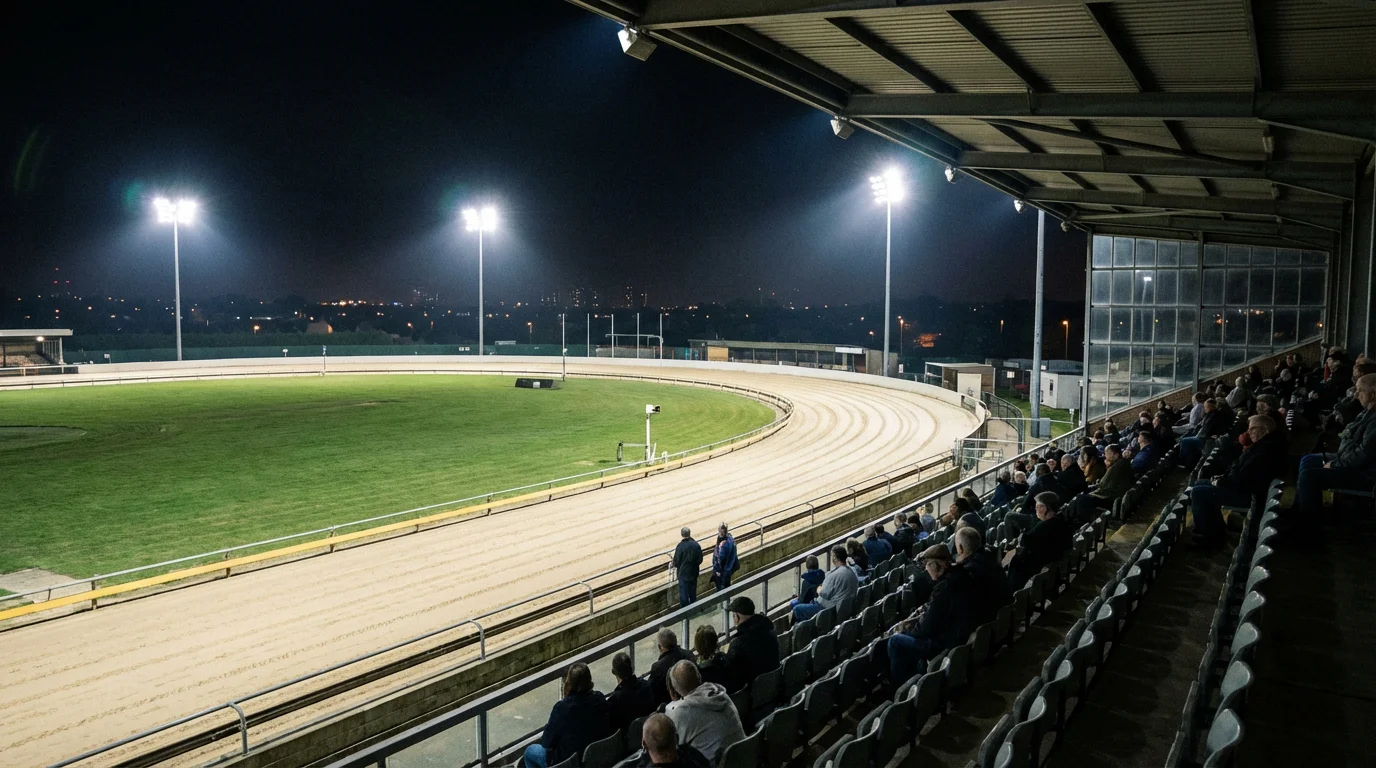
London’s Last Dog Track
When Crayford Stadium closed its doors in January 2025, Romford inherited a title nobody particularly wanted: the last greyhound track inside the M25. What had been one of two options for London-based racegoers became the only option overnight, and the weight of that distinction sits on a venue that has been running dogs since 1929.
Officially known as Coral Romford Greyhound Stadium, the track sits on London Road in the Borough of Havering, roughly where east London gives way to Essex. It is not a glamorous location. The surrounding streets are a mixture of light industrial units and residential terraces, and the stadium itself does not announce itself from a distance. But step inside and the place functions with a slickness that justifies the 10 million pound refurbishment completed in 2019 — a new grandstand, a Paddock Restaurant seating around 200, and a track resurfaced with over 11,000 tonnes of sand.
Romford races six times a week. Evening meetings on Friday and Saturday draw the biggest crowds, but there are daytime fixtures on Monday, Thursday, and other days throughout the week that keep the BAGS (Bookmakers’ Afternoon Greyhound Service) content flowing to betting shops and online streams nationwide. For punters who never set foot in Havering, Romford is still a constant presence — its results scroll across screens in every Ladbrokes, Coral, and William Hill branch in the country.
The track has history worth knowing. Lauries Panther, trained at Romford, won the 1982 English Greyhound Derby. Ballyregan Bob took the Essex Vase here in 1985 during his record-breaking unbeaten run. The venue has Category 1 status on the GBGB calendar and hosts competitions — the Essex Vase, the Champion Stakes, the Golden Sprint — that attract serious entries from top trainers. For anyone transitioning from Crayford or simply looking for the nearest London track to study live form, Romford is not a consolation prize. It is a serious racing venue that happens to be the last one standing in the capital.
Find more track guides at crayforddogsresults.
Track Layout, Distances, and Surface
Romford’s circuit measures 350 metres in circumference, making it one of the tighter tracks on the UK calendar. The run to the first bend is 67 metres on the standard 400-metre and 575-metre races, which is relatively short. That matters for betting. A short run-in gives inside traps a natural advantage — dogs breaking from traps one and two reach the first bend with less ground to cover and a cleaner racing line. Outside runners need exceptional early pace to avoid getting squeezed wide on the initial turn.
The track races over five standard distances: 225 metres (a sharp sprint that barely involves the bends), 400 metres (the bread-and-butter distance for most graded races), 575 metres (middle distance, requiring a blend of pace and stamina), 750 metres, and 925 metres for the staying events. Hurdle races are also staged over 400 metres. Each distance produces a different type of race, and the compact nature of the circuit amplifies those differences. A 225-metre sprint at Romford is essentially a test of trap speed and first-bend positioning. A 925-metre staying event demands genuine stamina because the dog will negotiate multiple tight bends where energy gets burned on every turn.
The surface is sand, as is standard across all UK GBGB-licensed tracks. Following the 2019 resurfacing, the running strip at Romford is generally regarded as well-maintained, though like any sand track, conditions can vary with weather. Heavy rain produces a slower surface; dry spells firm it up. Experienced Romford punters keep an eye on weather forecasts because a dog that posted a fast 400-metre time on a dry surface might struggle to reproduce it after a wet afternoon.
The hare is an outside Swaffham type, which runs on a rail around the outer perimeter of the track. This is relevant to running style — dogs that prefer to chase the hare close tend to race wider, while those that cut in from the outside traps may lose ground if they lose sight of the lure early. The combination of tight bends, a short run-in, and the outside hare makes Romford a track where layout directly influences outcomes — something we will return to in the betting section below.
Track records at Romford reflect its compact dimensions. The 400-metre record stands at 23.58 seconds, set by Sandwichsunshine in 1996. The 575-metre record is 34.81 seconds, courtesy of Palace Issue in 1999. These are useful benchmarks when assessing form — a dog posting within half a second of the track record at any distance is running at a very high level.
Race Schedule and Key Events
Romford operates one of the busiest racing schedules in UK greyhound racing. Evening meetings on Friday and Saturday are the flagship sessions — these are the nights when the better-graded dogs race, the restaurant fills up, and the on-course atmosphere comes closest to what greyhound racing looked like in its heyday. Daytime meetings on Monday, Thursday, and other weekdays serve the BAGS circuit, providing content for bookmakers and online streaming platforms. These afternoon cards tend to feature lower-graded races, but they are still competitive and well-attended by the betting market.
The track’s annual calendar is anchored by several Category 1 and Category 2 competitions that have been part of UK greyhound racing for decades. The Essex Vase, first run in 1939, is a 575-metre event that has attracted some of the finest middle-distance dogs in the sport’s history. Five-time winning trainer Mark Wallis has made it something of a personal fiefdom in recent years. The Champion Stakes, originally held at Wimbledon before being revived at Romford in 1988, is another 575-metre event with genuine prestige.
For sprint enthusiasts, the Golden Sprint has been a Romford fixture since 1987, run over 400 metres. And the Romford Puppy Cup, limited to dogs aged between 15 and 24 months, carries prize money that makes it one of the leading puppy events in the country — second only to the Ladbrokes Puppy Derby at Monmore Green in terms of financial reward. The Coronation Cup, which migrated to Romford after Southend Stadium closed in 1986, rounds out the major events over 575 metres.
For the regular punter, the key information is simpler: Romford races almost every day, the racecard is published the evening before each meeting, and the standard card runs to twelve races. Evening meetings typically start between 7pm and 8pm, with roughly fifteen minutes between races — enough time to study the next racecard, check early prices, and place your bet without feeling rushed. Daytime BAGS meetings follow a tighter schedule, with shorter intervals, but the principle is the same.
One practical note: Romford’s proximity to central London makes it accessible by public transport. Romford station is on the Elizabeth Line, and the stadium is a short walk or taxi ride from there. For anyone who used to attend Crayford, the journey across south-east London to Havering is longer, but it is the closest live greyhound racing available within London’s boundaries.
Trap Stats and Betting Angles at Romford
Every greyhound track produces trap bias data, and Romford’s numbers tell a consistent story. The inside traps — particularly trap one and trap two — outperform their expected share of winners over the standard 400-metre distance. This is a direct consequence of the track geometry: a 350-metre circumference with a 67-metre run to the first bend means that inside-drawn dogs reach the turn first and establish racing position with minimal effort. Outside runners either need to show blistering early speed to cross over, or accept that they will race wider through the bends and cover more ground.
That does not mean traps five and six never win. They do, particularly when an outside-drawn dog has a front-running style and the early pace from the inside traps is weak. But over a large sample of races, the numbers favour the rail. Serious Romford punters build this into their analysis as a baseline factor, not a standalone system. A trap-one dog with poor recent form is still a poor bet; a trap-six dog with excellent sectional times and a strong early-pace profile can still win despite the draw disadvantage.
Over longer distances — 575 metres and above — the trap bias softens. More bends and more running time allow dogs to find their position, and closing speed becomes a more important factor than initial break. The trap effect never disappears entirely at Romford, but it diminishes as the race distance increases.
The other betting angle worth noting is the impact of the BAGS schedule on race quality. Daytime meetings tend to feature dogs from the lower grades, which means less predictable form, more upsets, and occasionally larger tricast dividends. The evening Friday and Saturday cards are more competitive and attract better-graded dogs with more reliable recent form. Some punters prefer the BAGS fixtures precisely because the prices are longer and the value opportunities more frequent. Others stick to the evening cards where form holds up more consistently.
Weather is the final variable. Romford’s sand surface is sensitive to moisture, and heavy rain can turn a quick track into something considerably slower. Dogs that are known to prefer firm ground can struggle after a wet spell, and vice versa. Checking the weather forecast for Romford before the first race is a small habit that pays for itself over time. It is not sophisticated analysis — it is common sense applied to a physical sport run on a natural surface. But it is remarkable how many punters skip it.
Romford Carries the London Legacy
Greyhound racing in London has a history that stretches back nearly a century. White City, Wimbledon, Hackney Wick, Catford, Walthamstow, Crayford — all gone. Romford is what remains, and whether that feels like the last chapter of a long story or the foundation of a new one depends largely on what happens in the next decade.
What is clear is that Romford is not simply surviving. The recent investment in its facilities was a significant commitment to a sport that many have written off, and the track continues to host Category 1 events that attract the best dogs and trainers in the country. The racing schedule is dense, the BAGS content keeps the venue commercially viable, and the evening meetings still draw crowds that, if not what they were in the 1970s, are still substantial enough to fill a restaurant and create an atmosphere around the track.
For punters, Romford offers something that no amount of online streaming can fully replicate: proximity to the action. Watching a dog break from trap three and take the first bend is a different experience when you are standing twenty metres from the rail, hearing the mechanical hare whir past and feeling the thump of six dogs hitting the sand at full speed. That sensory dimension informs race-reading in ways that a screen cannot. You notice how a dog handles the bends, whether it crowds the rail or drifts wide, how it reacts to traffic — details that a replayed video captures imperfectly at best.
Romford also serves as the most practical entry point for anyone new to live greyhound racing in London. It has modern facilities, the staff are accustomed to newcomers, and the racecard is available online before you arrive. You do not need to be an expert to attend. You need a basic understanding of the bet types, some interest in watching fast dogs run, and a willingness to learn the track over a few visits. The rest follows.
Also read our Hove dogs guide.
As the sole London survivor in a sport that once filled stadiums across the city, Romford’s role goes beyond its own results. It carries the memory of every closed track, every empty grandstand, every displaced punter looking for somewhere to go. That is a lot to put on one stadium in Havering. But Romford has been absorbing displaced racegoers since long before Crayford closed — since Walthamstow went in 2008, since Wimbledon shut in 2017. It knows the role. It plays it well.
